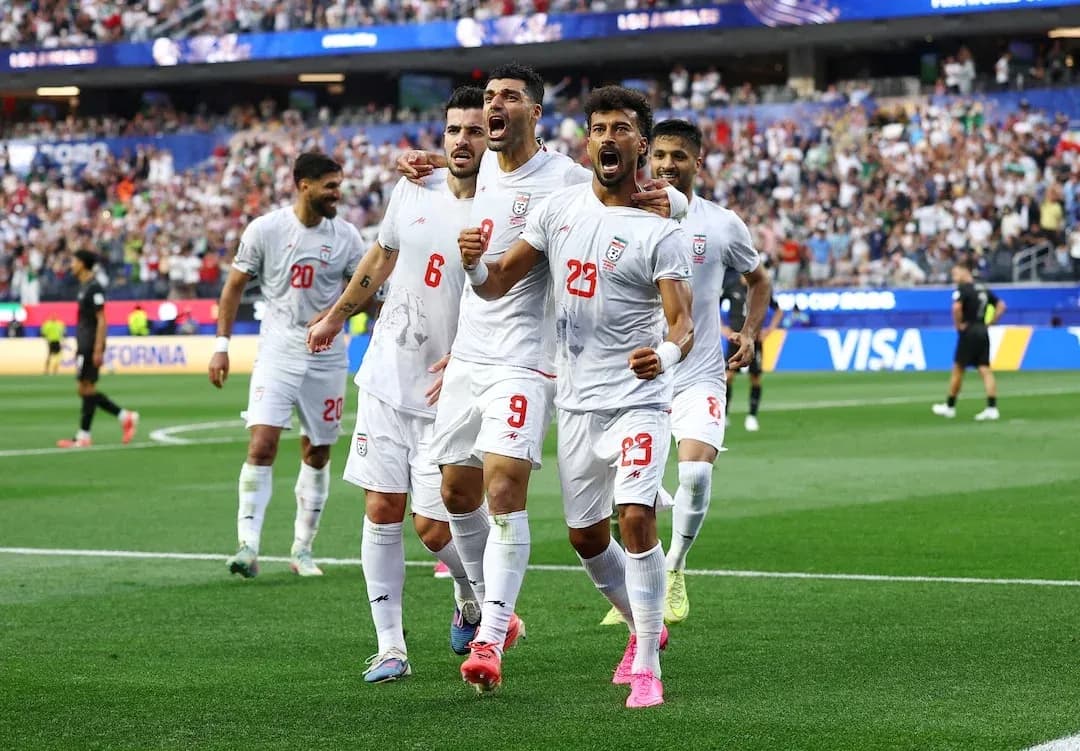
Iran and New Zealand Battle to 2-2 Draw at SoFi Stadium
Iran and New Zealand produced a tactically balanced 2-2 draw at SoFi Stadium in a match where structure and in-game adjustments were more telling than the raw scoreline. Iran, in a 4-4-2 under Amir Ghalenoei, leaned on wide pressure and direct combinations, while New Zealand’s 4-2-3-1 under D. Bazeley prioritized controlled possession and vertical service into Chris Wood. The statistical profile – 48% possession and 17 shots for Iran versus 52% and 14 shots for New Zealand – reflected two contrasting but equally effective approaches.
I. Executive Summary
New Zealand twice led through Elijah Just but were pegged back by Iran’s full-back and midfield line-breaking contributions, with Ramin Rezaeian and Mohammad Mohebi on the scoresheet. The half-time score of 1-1 and full-time 2-2 matched the even nature of the contest: New Zealand sharper in the box (8 shots on goal to 4), Iran more voluminous and aggressive in shot creation. Both sides’ xG – 1.5 for Iran, 1.24 for New Zealand – confirmed a match that could plausibly have tilted either way without feeling unjust.
II. Scoring Sequence & Disciplinary Log
New Zealand’s opening goal at 7' encapsulated their attacking blueprint: a direct connection from Chris Wood into the advanced line, with Elijah Just finishing. The combination of Wood’s presence between the Iranian centre-backs and Just’s timing from the left side of the attacking midfield band exploited the space outside Iran’s full-backs, catching the 4-4-2’s wide line slightly high.
Iran’s equaliser at 32' through Ramin Rezaeian came from the opposite dynamic: the right-back stepping high and attacking the half-space. With no assist recorded, the goal highlighted Iran’s willingness to let the full-backs break the first pressing line and arrive in finishing zones, compensating for a relatively static front two in early phases.
At 54', New Zealand re-established the lead via the same axis: Elijah Just again scoring, again assisted by Chris Wood. This repetition underlined a clear tactical mismatch – Iran’s back four struggled to manage Wood’s hold-up and lay-offs while simultaneously tracking Just’s diagonal runs inside from the left. The 4-2-3-1’s front four effectively overloaded the channels around Saeid Ezatolahi, forcing Iran’s centre-backs to step out and leaving gaps behind.
Iran’s 64' equaliser by Mohammad Mohebi, assisted by Rezaeian, was a direct response in structural terms. Rezaeian’s advanced position and delivery from the right targeted the seam between New Zealand’s left-back and left centre-back, an area that had begun to open as New Zealand’s full-backs alternated their involvement higher up. Mohebi’s run from the right side of midfield into the box turned Iran’s wide 4-4-2 into a temporary 4-2-4 in attack.
Disciplinary events were minimal but telling. At 89', Ehsan Hajsafi (Iran) received a yellow card — Tripping. This late booking reflected Iran’s increased risk in transition defense as they committed numbers forward in search of a late winner, with Hajsafi forced into a recovery intervention on the flank.
III. Tactical Breakdown & Personnel
Iran’s 4-4-2 was built around a clear spine: Alireza Beiranvand (Iran) behind a back four of Milad Mohammadi, Ali Nemati, Shoja Khalilzadeh and Rezaeian; Ezatolahi anchoring midfield with Saman Ghoddos and Mohebi providing progression, and Shahriar Moghanlou plus Mehdi Taremi as the front pair. In possession, Iran tilted the shape: Rezaeian pushed high, Mohebi drifted inside, and one striker often dropped to link play, effectively creating a 3-4-1-2 in some phases. This helped generate 17 total shots and 10 efforts inside the box, but the shot profile skewed towards volume rather than clear separation, as reflected in the 1.5 xG.
Out of possession, the 4-4-2 mid-block was designed to funnel New Zealand into wide areas, but Wood’s ability to pin and set, combined with Just’s and Sarpreet Singh’s positioning between the lines, repeatedly forced Iran’s centre-backs to defend facing their own goal. Beiranvand (Iran) was busy, making 6 saves; the negative goals prevented value (-0.2) suggests that, relative to shot quality, he marginally underperformed, particularly against New Zealand’s more accurate finishing.
New Zealand’s 4-2-3-1, with Max Crocombe (New Zealand) in goal, Tim Payne and Liberato Cacace as full-backs, and Finn Surman plus Michael Boxall centrally, prioritised stability in the double pivot of Joe Bell and Marko Stamenic. Bell’s distribution and Stamenic’s screening allowed the front four – Just, Singh, Callum McCowatt and Wood – to stay high and narrow, compressing the central channel and enabling quick combinations. Their 52% possession and superior pass accuracy (446 passes, 377 accurate, 85%) compared to Iran’s (405 passes, 312 accurate, 77%) showed a side comfortable circulating under pressure.
Crocombe (New Zealand) faced fewer on-target efforts and made 2 saves; the -0.2 goals prevented indicates he conceded slightly more than the model expected from Iran’s chances, but his defense limited clear one-on-ones by keeping the block compact and forcing Iran to shoot through traffic – New Zealand allowed 17 shots but only 4 on target, with just 2 blocked, indicating that many Iranian efforts missed the target under pressure.
Substitutions subtly shifted the tactical picture. For Iran, the 46' change – Mehdi Ghayedi (IN) came on for Aria Yousefi (OUT) – added a more vertical, dribbling threat from wide areas, turning some of Iran’s possession into more direct incursions between full-back and centre-back. At 53', Ali Alipour (IN) came on for Shahriar Moghanlou (OUT), adding depth runs behind New Zealand’s line rather than back-to-goal play, which stretched the 4-2-3-1 and opened pockets for Ghoddos and Mohebi. Later, at 65', Ehsan Hajsafi (IN) came on for Saman Ghoddos (OUT), giving Iran a more conservative left side but also a better left-footed outlet for switches of play, important in the final 25 minutes as Iran probed for width against a tiring New Zealand block. At 80', Amirhossein Hosseinzadeh (IN) came on for Mehdi Taremi (OUT), a move that traded hold-up and fouls won for mobility and pressing, signalling Iran’s shift towards a higher-tempo, transition-focused final phase.
New Zealand’s 68' double change – Benjamin Old (IN) came on for Liberato Cacace (OUT) and Ryan Thomas (IN) came on for Callum McCowatt (OUT) – rebalanced the side. With Old offering fresh legs wide and Thomas providing an extra layer of ball security in the middle, New Zealand tried to regain control of tempo after conceding the second equaliser. At 78', Callan Elliot (IN) came on for Tim Payne (OUT), maintaining the full-back profile while injecting energy for the closing stages. Deep in added time, at 90+2', Jesse Randall (IN) came on for Sarpreet Singh (OUT) and Tyler Bindon (IN) came on for Marko Stamenic (OUT), small but telling shifts that suggested Bazeley wanted more defensive security and fresh pressing legs to see out the draw rather than over-commit for a late winner.
IV. The Statistical Verdict
The statistical landscape reinforces the impression of a finely poised tactical contest. Iran’s 17 total shots to New Zealand’s 14, and 10 shots inside the box for both, show parity in territorial penetration. However, New Zealand’s superior accuracy – 8 shots on goal against Iran’s 4 – points to cleaner chance quality, aligning with the close xG comparison (1.24 vs 1.5). Iran’s 4 corner kicks to New Zealand’s 1 underline the home side’s sustained pressure phases, particularly after falling behind twice.
Discipline was lopsided but minimal: Iran committed 10 fouls to New Zealand’s 8 and received the only card of the match, Hajsafi’s yellow for Tripping at 89', reflecting Iran’s slightly more aggressive, risk-taking defensive posture in transition. In passing terms, New Zealand’s 446 passes, 377 accurate (85%) versus Iran’s 405, 312 accurate (77%) demonstrate that the 4-2-3-1 provided a more stable possession platform, particularly through Bell and Stamenic. Yet Iran’s willingness to play quicker and more vertically allowed them to generate a marginally higher xG and equalise twice. Both goalkeepers, Beiranvand (Iran) with 6 saves and Crocombe (New Zealand) with 2, were integral to maintaining the stalemate, even if the goals prevented figures indicate neither fully outperformed the underlying shot quality. In sum, the 2-2 draw was a fair tactical equilibrium between Iran’s direct, full-back-driven aggression and New Zealand’s structured, possession-based 4-2-3-1.