England's World Cup Challenge: Navigating Transfers and Distractions
Representing England at a World Cup should be the one thing on a player’s mind.
It isn’t.
Not this summer, not in this market, not with Thomas Tuchel’s 26-man squad scattered across every corner of the rumour mill while trying to chase the biggest prize in the sport.
For five weeks, the World Cup will run in parallel with the transfer window. Sporting directors won’t stop calling because England are in camp. Agents won’t switch their phones off because there’s a group game looming. Deals will be chased, clauses triggered, futures debated in hotel lobbies and over late-night calls from Europe to West Palm Beach.
Tuchel knows exactly what he is up against.
“If I said to the players not to deal with it now, their telephone will still blow up,” he said. “I can see the distraction if clubs want to sign you, and sporting directors, agents and coaches are trying to get you on the phone, of course it is a distraction.
“It’s a reality, though. We will always recommend a player to take a decision before a tournament starts and as early as possible and go with the decision, but it’s not always possible for the player. We’re not alone in this, it’s just how it plays out.”
A World Cup and a shop window
A World Cup has always been a double-edged stage. On one side, glory. On the other, opportunity.
James Rodriguez turned Brazil 2014 into a personal audition and left with a move to Real Madrid. Enzo Fernandez rode the wave of 2022 to Chelsea. Harry Maguire’s performances in 2018 pushed him into Manchester United’s sights.
Careers can change in a month.
But for every Rodriguez, Fernandez or Maguire, there are players who find the noise around their futures crowding out the clarity needed on the pitch. That’s the tightrope Tuchel must walk: pushing England to their ceiling while transfer talk swirls around some of his most important names.
The setting only heightens the contrast. England are grinding through their preparations in the humidity of West Palm Beach, Florida, working on tactical detail while also learning how to cope with the heat and the travel demands that will define this World Cup. The sessions are sharp, the margins fine.
And for a clutch of players, all of that runs alongside a more personal question: where will they be playing when this is over?
Anderson on the brink of a record
Elliot Anderson is right at the heart of it.
The midfielder arrives off a standout season with Nottingham Forest and has forced his way into Tuchel’s squad on merit. Now he finds himself with two Manchester clubs circling.
Both City and United are watching closely. City have already seen one opening bid knocked back by Forest this week. The 23-year-old is believed to favour a move to Etihad Stadium, a choice that would drop him into a side stacked with titles and expectations.
Any agreement will not be small. The potential fee has the power to reshape the domestic market, with figures that could eclipse the £105m Arsenal paid West Ham for Declan Rice in 2023. A British transfer record, hanging over a player trying to nail down a place in England’s midfield.
Every training drill, every friendly, every World Cup minute for Anderson will be viewed through that lens. Perform well and the price climbs. Struggle and the questions start.
Rogers in demand
He is not alone.
Morgan Rogers heads into the tournament after a relentless season with Aston Villa: 55 appearances, 14 goals, 12 assists. Those are not numbers you can hide from in the modern game. They land on recruitment dashboards across Europe, and they bring heavyweight clubs to your door.
Arsenal, the Premier League champions, are interested. Manchester United are in the conversation. Chelsea and Manchester City have also been linked. The chase is real, the list of admirers long.
But Villa are in a position of strength. According to BBC Sport’s senior football correspondent Sami Mokbel, any club wanting Rogers will need to break the £80m barrier. That figure alone tells you what Villa think they have – and what any buyer would expect in return.
So Rogers, like Anderson, walks into a World Cup knowing that one sparkling performance can tilt negotiations, that one quiet night might be replayed in a boardroom somewhere.
Gordon settled, Rashford waiting
Not every England player has arrived in the United States with question marks attached.
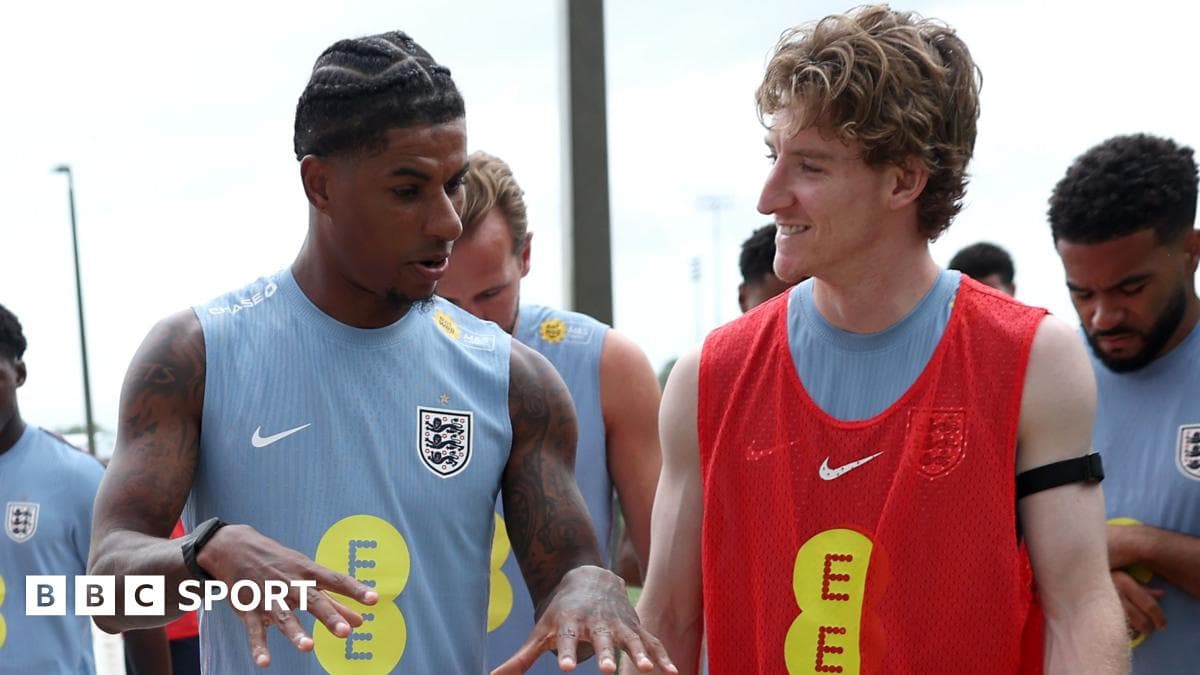
Anthony Gordon made sure of that. He completed his move from Newcastle United to Barcelona last month, closing the chapter on his Premier League future before boarding the flight across the Atlantic. For Tuchel, that kind of clarity is gold dust.
Marcus Rashford does not have it.
The forward is on loan at Barcelona from Manchester United, and the clock is ticking. The Catalan club have until 15 June – just two days before England open their World Cup campaign against Croatia – to activate a clause that would make his move permanent for £26m.
Barcelona have been trying to renegotiate those terms. The deadline looms. The possibility remains that it comes and goes without agreement, leaving Rashford in limbo as England kick off their tournament and discussions drag on in the background.
It is the kind of situation that can gnaw away at a player’s focus. Club, country, future, present – all colliding in the space of a few days.
Stones closes a chapter
At the other end of the career spectrum, John Stones is starting from scratch.
After a decade at Manchester City, he will leave in search of a new club. In that time, he has quietly become one of the most decorated English players of his generation: six Premier League titles, a Champions League, two FA Cups, five League Cups and more silverware besides.
Now he heads into a World Cup as a free man. No contract, no next step confirmed, just a CV that speaks loudly and a market that knows exactly what he can do.
For Tuchel, that mix of experience and uncertainty demands careful handling. Stones brings leadership and calm on the pitch; off it, he is weighing up the final major move of his career.
Tuchel’s tightrope
Tuchel is not trying to fight reality. He is trying to manage it.
“It’s about common sense. I would not like it [transfers] the day before a match, or on a matchday, that’s the policy,” he said.
“But everything else if it’s done privately, efficiently and quietly then we are always happy to help.
“It helps to have clarity around the player. The best thing we can have is clarity so if anyone has a chance to complete a change of club and a transfer we will not stand in their way.
“But it has to align, of course, with our schedule and our goals which is to be focused and prepared for matches.”
That is the balance: allowing players to sort their futures without letting negotiations bleed into matchdays, meetings or the fragile rhythm of a tournament.
History repeating
None of this is new to England.
Ashley Cole spent the 2006 World Cup with his Arsenal exit saga rumbling on in the background, eventually joining Chelsea on deadline day. His medical for the swap deal involving William Gallas had to be completed while he was on England duty in Manchester.
In 2010, Joe Cole travelled to South Africa without a club after leaving Chelsea. He insisted he had handed everything over to his agent so he could concentrate on England.
“I just want to get my head down and try and train and play well. My future will sort itself out. It won’t distract me,” he said at the time.
The names change. The sums grow. The tension stays the same.
This summer, Tuchel must keep England’s minds clear while the market rages around them. If he gets it right, the World Cup could launch careers and deliver a trophy.
If he gets it wrong, the noise off the pitch might prove louder than anything his team can produce on it.