England's Tactical Comeback Against Congo DR: Key Moments and Analysis
England’s 2-1 comeback win over Congo DR at Mercedes-Benz Stadium was a tactical arm-wrestle that England gradually bent to their will through structure, control of territory, and targeted substitutions, rather than sheer chaos. Thomas Tuchel’s 4-2-3-1 started slowly, was exposed early in defensive transition, but increasingly pinned Congo DR’s 4-3-3 into a low block, turning a 0-1 deficit into a methodical Round of 32 turnaround.
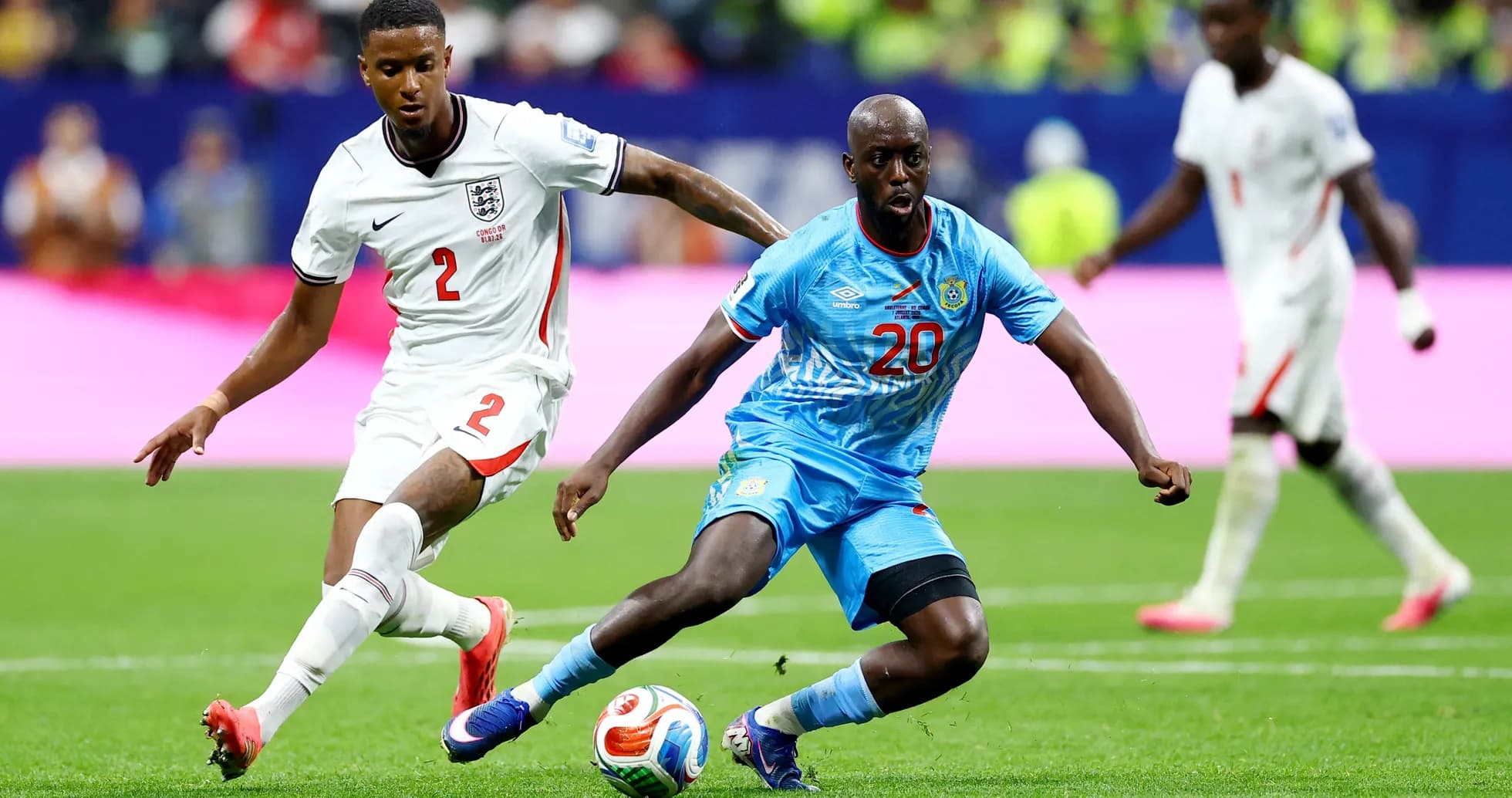
Congo DR’s opening approach was clear: a compact 4-3-3 mid-block designed to spring quickly into space behind England’s advanced full-backs. With England holding 60% possession and committing both Djed Spence and Nico O’Reilly high in the first phase, Sebastien Desabre’s side tried to attack the vacated channels through direct vertical passes into the front three. The early goal for Brian Cipenga, assisted by Chancel Mbemba, underlined that plan: Congo DR needed few touches to threaten, finishing with only 7 total shots but 2 on target and an xG of 0.8.
England’s rest defence in the first half was the key vulnerability. Declan Rice and Elliot Anderson formed the double pivot, but with Jude Bellingham, Noni Madueke and Marcus Rashford all positioned high between the lines, the distances in defensive transition were large. When England lost the ball, Congo DR could break before Rice could screen effectively, forcing Ezri Konsa and Marc Guéhi into backward running duels. That dynamic produced Congo DR’s early joy, but it also contained the seeds of their later fatigue: too many sprints, too little ball.
With the ball, however, England’s structure was coherent. The 4-2-3-1 often morphed into a 2-3-5 in possession: Spence and O’Reilly pushed on, Rice held the central lane, Anderson rotated to support the right half-space, and Bellingham operated as a free 10 behind Harry Kane. England’s 517 passes at 91% accuracy (468 accurate) speak to a controlled, circulation-heavy approach, repeatedly moving Congo DR’s 4-3-3 side to side to open pockets for Kane to receive between the lines or for wide players to isolate full-backs.
Despite that control, England’s first-half threat profile was too sterile. They generated volume – 16 total shots, 13 from inside the box – but the timing and spacing of runs into the area were not sharp enough. Rashford and Madueke often attacked similar zones, and Kane was sometimes left to receive to feet rather than attacking crosses. The cancelled penalty via VAR for Harry Kane at 44' was emblematic: England were probing, but clear separation in the box was rare, forcing them to rely on marginal contacts rather than clean chance creation.
Congo DR’s defensive discipline in the first half was reasonable. Noah Sadiki’s booking for “Foul” at 27' came from an attempt to break up an England progression through midfield, a necessary tactical foul given how easily Bellingham was starting to turn. The back four, anchored by Mbemba and Axel Tuanzebe, stayed narrow, conceding space in wide zones but protecting the central corridor and limiting England to crosses that were mostly manageable for Lionel Mpasi Nzau.
The game’s tactical hinge came around the hour mark with Tuchel’s double substitution. At 60', Bukayo Saka (IN) came on for Noni Madueke (OUT), and Anthony Gordon (IN) replaced Marcus Rashford (OUT). These changes sharpened England’s wide dynamics. Saka’s tendency to hold width and attack on the outside forced Arthur Masuaku deeper, while Gordon’s direct, vertical running from the left gave Kane a consistent partner attacking the box line. England’s attacking shape became more balanced: Saka wide right, Gordon wide left, Bellingham central, Kane as a hybrid 9/10.
From that point, Congo DR’s 4-3-3 increasingly collapsed into a 4-5-1. Their front three, including Yoane Wissa, were dragged back so deep that counterattacking distances became enormous. Desabre tried to refresh his front line at 64' with Meschak Elia (IN) for Nathanaël Mbuku (OUT), and later at 76' with Théo Bongonda (IN) for Brian Cipenga (OUT), but the structural problem remained: without enough sustained possession (365 passes, 82% accuracy), they could not relieve pressure or connect their forwards to midfield.
England’s equaliser at 75' showcased the impact of the substitutions and the refinement of their attacking patterns. Anthony Gordon, now a key conduit, provided the assist for Harry Kane, who exploited a central channel as Congo DR’s midfield line failed to track his movement. The goal reflected England’s xG of 2.04: sustained pressure, repeated entries into the box, and eventually, the breakdown of Congo DR’s compactness.
Defensively, England tightened as the game progressed. The introduction of Eberechi Eze (IN) for Djed Spence (OUT) at 71' subtly altered the balance, with England more willing to control the ball higher and accept less full-back overlap in exchange for better counter-pressing structure. Rice’s late substitution at 90', with John Stones (IN) for Declan Rice (OUT), was a game-management move: adding an extra natural defender to protect the 2-1 lead and dominate aerials in the closing minutes.
In goal, Jordan Pickford (England) had a relatively quiet but controlled evening, officially making 1 save. That low number, against Congo DR’s 2 shots on target, underlines how effectively England limited high-quality attempts after the early setback. At the other end, Lionel Mpasi Nzau (Congo DR) made 5 saves, a reflection of England’s growing territorial and shooting dominance as they piled up 7 shots on goal. The negative “goals prevented” value of -0.04 for both keepers suggests that finishing roughly matched the underlying shot quality; neither goalkeeper dramatically outperformed expectation.
Kane’s second goal at 86', again assisted by Anthony Gordon, was the logical outcome of England’s evolving attacking geometry. Congo DR’s back line, fatigued and repeatedly forced to defend their box, failed to track Kane’s late movement. Gordon’s delivery exploited the half-space channel, and Kane, operating between centre-backs and full-back, attacked the gap with clinical timing. The Bellingham yellow card for “Foul” at 19' remained England’s only disciplinary mark, a testament to their control of tempo; Congo DR’s single booking for Sadiki reflected their need to disrupt England’s rhythm rather than any systemic ill-discipline.
Statistically, the verdict is clear. England’s 60% possession, superior passing volume and accuracy, and 16-7 shot advantage aligned closely with the 2.04 vs 0.8 xG split. Congo DR’s game plan was coherent and initially effective, but unsustainable under such sustained pressure. England, after an uncertain opening, used structure, ball circulation, and well-timed substitutions to progressively squeeze the game into Congo DR’s half, turning a precarious knockout tie into a controlled, data-backed comeback victory.