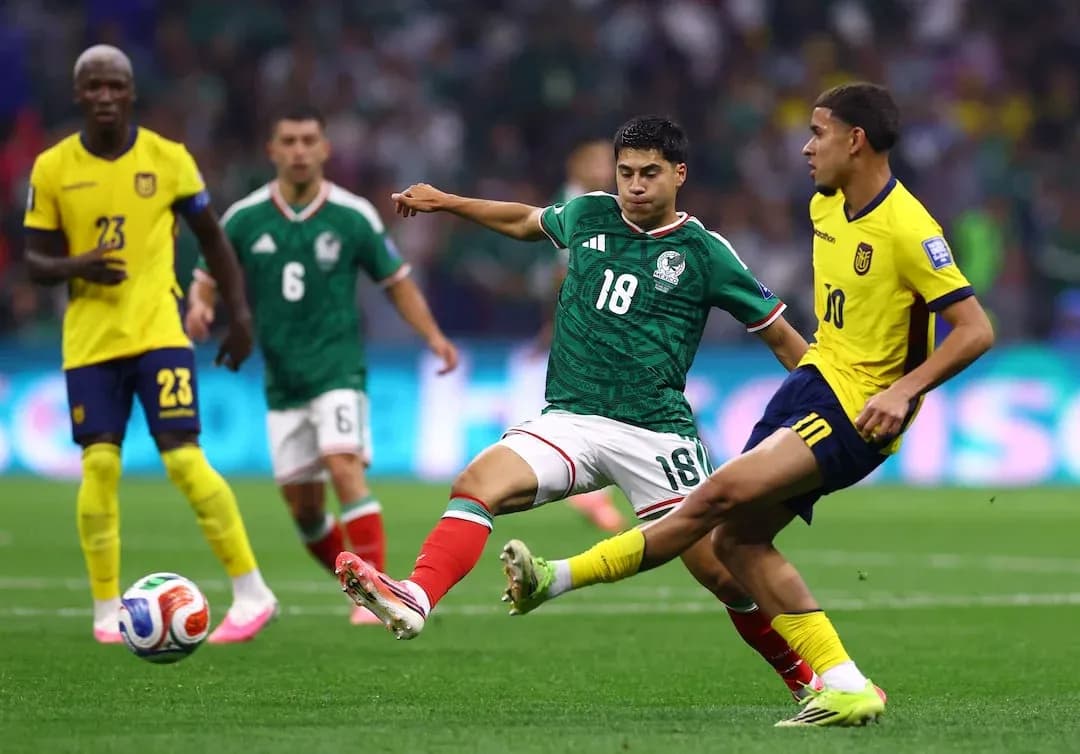
Mexico Outplays Ecuador 2-0 in World Cup Round of 32
Mexico’s 2-0 win over Ecuador at Estadio Banorte in this World Cup Round of 32 tie was a clinic in using structure and verticality to outplay a side that actually saw more of the ball. Javier Aguirre’s 4-3-3 ceded possession (43% to Ecuador’s 57%) but controlled the key spaces, struck twice in the first half, and then managed the game with intelligent substitutions and compact defending.
I. Executive Summary
Mexico built their victory on a direct, well-coordinated front three and a disciplined midfield triangle that consistently broke Ecuador’s lines despite having fewer passes (319 to 407). Ecuador’s 4-4-2 under Sebastian Beccacece produced territorial dominance, more corners (8 to 3), and cleaner passing (84% to 78%), but lacked incision and became increasingly disjointed after half-time adjustments and late indiscipline, finishing with three yellow cards and a red. The xG split – 1.02 for Mexico against 0.73 for Ecuador – underlined a match where Mexico created the better chances from fewer attacks, while Ecuador’s possession remained largely sterile.
II. Scoring Sequence & Disciplinary Log
The match’s tactical story is anchored in an efficient Mexican first half. On 22', Julián Quiñones converted Mexico’s early pressure into a 1-0 lead, finishing a move supplied by Roberto Alvarado. The pattern was clear: Mexico’s wide forwards attacked the half-spaces early, using quick combinations to bypass Ecuador’s double pivot.
On 31', the same front line inverted roles. Raúl Jiménez made it 2-0 after a well-timed assist from Quiñones, punishing Ecuador’s back four for failing to track runs between centre-back and full-back. By half-time, Mexico led 2-0, exactly matching the scoreline at 45'.
Ecuador’s frustration began to surface in added time of the first half. At 45+1', Alan Franco received a yellow card for “Tripping”, the first sign of a side struggling to cope with Mexico’s transitions.
The second half saw Ecuador chase the game, but their discipline further eroded late on. At 90+3', Kendry Páez was booked for “Tripping”, reflecting late, stretched defending high up the pitch. Two minutes later, at 90+5', Piero Hincapié was sent off with a straight red card for “Unsportsmanlike conduct”, leaving Ecuador to finish with ten men. Finally, at 90+9', Moisés Caicedo was also booked for “Tripping”, closing a card sequence that summed up Ecuador’s increasing tactical and emotional unraveling: Ecuador 3 cards, Mexico 0; total cards 4, with one red.
III. Tactical Breakdown & Personnel
Mexico’s 4-3-3 was built on clear vertical lanes. The back four of Jorge Sánchez, César Montes, Johan Vásquez, and Jesús Gallardo stayed relatively narrow, prioritizing central compactness over aggressive full-back overlaps. This allowed the midfield trio of Gilberto Mora, Erik Lira, and Luis Romo to press in a staggered shape, with Lira anchoring and Mora/Romo stepping to Ecuador’s interiors.
In possession, Mexico were selective but incisive. Their 319 passes, with 249 accurate (78%), were used to play quickly into the front three rather than circulate endlessly. The shot profile – 15 total shots, 10 inside the box, 3 on goal – shows a team that only attacked when they had structural superiority. Both goals came from classic Aguirre patterns: win the ball in midfield, find the wide forward early, then attack the channel between full-back and centre-back.
Quiñones was central to this plan. Starting from the left of the front three, he constantly drifted inside to receive between the lines, combining with Alvarado on the opposite side and Jiménez centrally. The first goal (22') came from Alvarado exploiting Ecuador’s right side and feeding Quiñones in a pocket. The second (31') flipped the dynamic: Quiñones’ movement drew defenders and allowed him to slide Jiménez through, exploiting Ecuador’s high line.
Ecuador’s 4-4-2, with Gonzalo Plata and Enner Valencia up front, and a midfield of John Yeboah, Moisés Caicedo, Pedro Vite, and Nilson Angulo, was intended to dominate the ball and control territory. They succeeded in possession and passing accuracy – 407 passes, 340 accurate (84%) – but failed to convert this into high-quality chances. Their 7 total shots, only 1 on goal, and 5 inside the box indicate that Mexico’s block consistently forced them into crowded central areas or harmless wide deliveries.
Defensively, Mexico were content to let Ecuador’s centre-backs and deeper midfielders have the ball, then sprang into a mid-block trap. Lira’s positioning screened passes into Valencia and Plata, while the wingers dropped to form a 4-5-1 without the ball. This structure is reflected in Ecuador’s modest xG of 0.73 and just 1 shot on target.
In goal, Raúl Rangel (Mexico) was largely protected by his structure, needing to make only 1 save. His “goals prevented” figure of -0.57 suggests that the single on-target effort Ecuador produced was of reasonable quality, but overall he faced little sustained pressure. At the other end, Hernán Galíndez (Ecuador) also recorded 1 save, yet conceded twice; Ecuador’s own “goals prevented” at -0.57 indicates that the finishing quality from Mexico slightly exceeded the expectation of the underlying chances.
Substitutions reinforced the tactical trends rather than changing them. Ecuador’s double change at 46' – Yaimar Medina (IN) came on for Alan Franco (OUT) and Ángelo Preciado (IN) came on for Joel Ordóñez (OUT) – aimed to refresh the back line and add more thrust on the right. Later, Kevin Rodriguez (IN) for Enner Valencia (OUT) on 59', and the attacking introductions of Jordy Caicedo (IN) for John Yeboah (OUT) and Kendry Páez (IN) for Nilson Angulo (OUT) at 79' pushed Ecuador into a more chaotic, forward-heavy shape. However, this only increased their exposure to counters and contributed to late fouls and cards.
Mexico’s changes were more conservative and game-state driven. Brian Gutiérrez (IN) for Gilberto Mora (OUT) at 58' and Obed Vargas (IN) for Luis Romo (OUT) at 73' refreshed the midfield legs to maintain the block. Santiago Giménez (IN) for Raúl Jiménez (OUT) at 74' preserved the pressing trigger up front, while Orbelín Pineda (IN) for Julián Quiñones (OUT) and Israel Reyes (IN) for Roberto Alvarado (OUT) at 80' added control and defensive security on the flanks, effectively locking down Ecuador’s late wide thrusts.
IV. The Statistical Verdict
The numbers align closely with the tactical impression: Ecuador had more of the ball (57% possession), more passes, and more corners (8 to 3), but Mexico created the more dangerous situations and managed the game more intelligently. Mexico’s 15 shots to Ecuador’s 7, and the xG edge of 1.02 to 0.73, underline that Aguirre’s side turned fewer phases of possession into higher-quality opportunities.
Mexico’s 10 fouls versus Ecuador’s 14, combined with Ecuador’s three yellow cards and one red, show a side increasingly reactive and forced into riskier defensive actions as they chased the game. Both teams’ goalkeepers made 1 save each, but the context matters: Mexico’s defensive structure limited Ecuador to low-yield shooting zones, while Ecuador’s back line allowed two high-quality finishing situations that decided the tie.
In sum, this was a controlled, strategically mature performance from Mexico: concede territory, dominate the key spaces, strike efficiently, and then close the game down with disciplined structure and targeted substitutions, while Ecuador’s possession-heavy approach lacked the vertical threat and composure to truly threaten the outcome.