France Dominates Sweden 3-0 in World Cup Round of 32
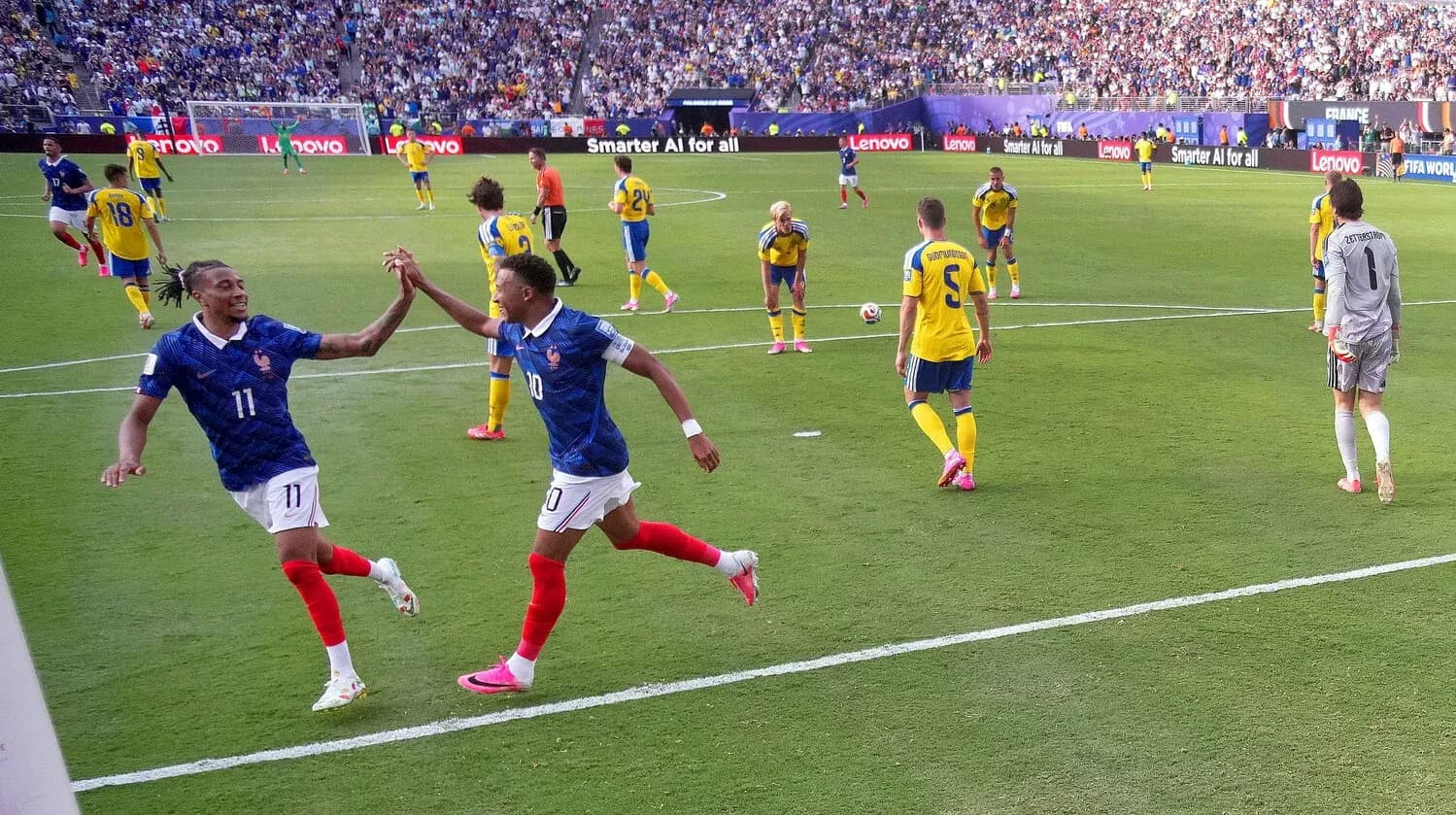
France’s 3-0 win over Sweden at MetLife Stadium was a controlled, system-led dismantling built on structural superiority between the lines and ruthless exploitation of wide spaces. Didier Deschamps’ 4-2-3-1 consistently overloaded Sweden’s 4-4-2 in midfield, translating 61% possession and a 25–8 shot advantage into a one-sided Round of 32 tie that broadly matched the underlying numbers (xG 3.17 to 0.65).
France’s positional play was the platform. With Aurélien Tchouaméni and Adrien Rabiot as the double pivot, the back four of Jules Koundé, Dayot Upamecano, William Saliba and Lucas Digne could stay relatively high and compact, compressing the pitch and keeping Sweden pinned. France completed 551 passes to Sweden’s 352, but the key was the quality: 485 accurate passes at 88% created stable circulation, allowing them to patiently move the block until a lane opened for Kylian Mbappé, Ousmane Dembélé, Michael Olise or Bradley Barcola between full-back and centre-back.
First Goal
The first goal on 45' encapsulated the plan. France had already established territorial dominance, with 16 shots inside the box across the match underlining how often they penetrated the last line. Dembélé’s assist for Mbappé came from that right-sided dynamic: Koundé providing width, Dembélé attacking the half-space, and Mbappé drifting into the blindside channel to finish. Sweden’s flat 4-4-2 struggled to pass runners on; the wide midfielders were pinned deep by France’s full-backs, leaving the central pair exposed to late movements from the three attacking midfielders.
Second Goal
After the interval, France accelerated. The second goal on 53' from Barcola, assisted by Olise, stemmed from France’s ability to find the weak-side winger. With Sweden shifting heavily towards the ball, Olise’s positioning as an interior between the lines allowed him to receive in the right half-space and slide Barcola into the box. Again, the pattern was clear: France created numerical superiority in central zones, then released the far-side runner once Sweden’s back four were dragged narrow.
Third Goal
Mbappé’s second on 74', assisted by Olise, was the logical outcome of sustained pressure. By then, Sweden’s back line was repeatedly defending its own box, reflected in France’s 12 shots on goal and four blocked efforts. Olise’s influence grew as he operated almost as a second playmaker, and Mbappé’s freedom to roam across the front stretched Gustaf Lagerbielke and Victor Lindelöf beyond their comfort zones. France’s shot profile – 16 inside the area, nine from distance – showed a side prioritising high-value chances rather than speculative efforts.
Defensive Structure
Out of possession, France were equally structured. The front four pressed in a 4-4-2/4-2-3-1 hybrid, with Mbappé and the No.10 line screening Sweden’s double pivot and forcing longer passes. Sweden managed just eight shots, only three on target, and generated 0.65 xG; most of their threat came from transitions when Anthony Elanga or Viktor Gyökeres could briefly isolate a defender. However, France’s rest defence – Upamecano and Saliba holding aggressive starting positions with Tchouaméni in front – limited the space in behind and forced Swedish forwards to receive with their back to goal.
The full-backs’ roles were decisive in locking Sweden in. Koundé and Digne stepped high to compress Sweden’s wingers, which, combined with France’s nine corners to Sweden’s one, indicated territorial dominance and repeated entries into the final third. When Deschamps turned to his bench – Malo Gusto for Koundé and Désiré Doué for Dembélé on 75', Theo Hernández for Digne on 78', then Jean-Philippe Mateta for Olise and Rayan Cherki for Mbappé on 85' – the structure remained intact. Fresh legs maintained the press and preserved the intensity of wide runs, rather than changing the system.
Sweden's Adjustments
Graham Potter’s adjustments for Sweden – Besfort Zeneli for Elliot Stroud and Taha Abdi Ali for Lucas Bergvall on 66', Benjamin Nygren for Yasin Ayari and Mattias Svanberg for Daniel Svensson on 82', and Gustaf Nilsson for Alexander Isak on 89' – were aimed at adding energy and ball-carrying in wide and central zones. But with Sweden limited to 39% possession and only one corner, these changes could not alter the fundamental pattern: their 4-4-2 remained outnumbered centrally and too deep to mount sustained pressure.
Goalkeepers' Performances
In goal, Mike Maignan (France) had a relatively controlled evening. France’s defensive block restricted Sweden to three shots on target, and Maignan’s three saves, combined with a goals prevented figure of 1.16, underline that when Sweden did break through, the chances carried some quality. His interventions preserved France’s clean sheet and allowed the back line to hold an assertive starting position.
At the other end, Jacob Widell Zetterström (Sweden) faced a barrage. France produced 12 shots on goal; Widell Zetterström made nine saves, with Sweden’s statistics also crediting him with 1.16 goals prevented. That figure, together with the sheer volume of on-target attempts, suggests that without his performance the scoreline could have been heavier. He was repeatedly exposed by France’s ability to play through and around the Swedish block, yet still managed to delay the inevitable on several occasions.
Statistical Verdict
The statistical verdict aligns closely with the tactical story. France’s 3.17 xG against Sweden’s 0.65 accurately reflects a match where Deschamps’ side controlled territory, tempo and chance quality. Their 551 passes, 485 of them accurate at 88%, show a team comfortable circulating under minimal pressure, while Sweden’s 352 passes at 80% accuracy point to more rushed, vertical phases rather than sustained possession. France’s 25 total shots to Sweden’s eight, combined with a 12–3 edge in shots on goal and a 16–7 advantage in efforts inside the box, highlight a gulf in both volume and danger of attempts.
Discipline was relatively clean: 14 fouls for France and 10 for Sweden, with no cards shown. That absence of bookings fits a game where France rarely had to resort to emergency defending and Sweden seldom reached advanced zones in numbers. Corner kicks (9–1 to France) further underline how often the French attack pinned Sweden back. Overall, the data confirms a comprehensive, tactically coherent performance: France’s structure maximised their attacking talent, minimised Sweden’s transition threat, and produced a result and underlying metrics worthy of a dominant World Cup Round of 32 display.