Žilina's Tactical Bravery Secures Comeback Win Against Hajduk
Žilina’s 2-1 comeback at Štadión pod Dubňom in this UEFA Europa League 1st Qualifying Round first leg was built on structural courage and second‑half adjustments rather than statistical dominance, because almost all granular metrics beyond card counts are absent. With the home side overturning a 0-1 half-time deficit against HNK Hajduk Split, the tactical story is written in the formations, substitutions and the timing of key interventions.
From the outset, Pavol Stano committed Žilina to a bold 3-4-3. The back three of J. Minarik, A. Narimanidze and T. Hranica was protected by a central pairing of X. Adang and M. Kacer, with K. Bari and the advanced wide presence of F. Kosa providing width. Up front, the trio of M. Roginic and P. Ilko, with Kosa stepping high from midfield, was clearly designed to stretch Hajduk’s back four horizontally and pin their full-backs.
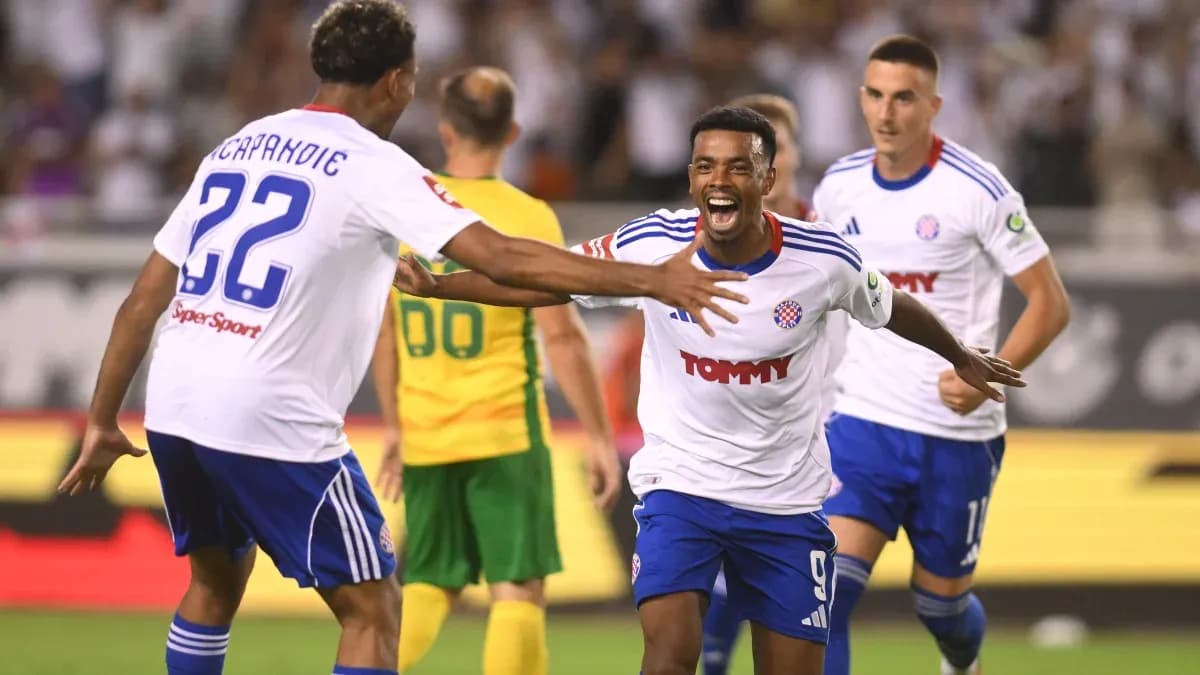
Hajduk, under Gonzalo Garcia, lined up in a 4-2-3-1 that looked, on paper, more stable and control-oriented. The double pivot of R. Pukstas and A. Pajaziti sat behind an attacking midfield line of R. Brajkovic, N. Skoko and the advanced left-sided D. Melnjak, with M. Sego as the lone forward. This structure gave Hajduk early control of central zones and facilitated their first-half lead: Alec Van Hoorenbeeck’s goal at 45' (confirmed by VAR at 45+3') came from a set-piece-type situation where the centre-back could step into a decisive attacking role, assisted by Šimun Hrgović.
The first half thus tilted towards Hajduk’s organisation. Their back four, with Hrgović and M. Acapandie as full-backs, coped relatively well with Žilina’s front three, and the double pivot shielded central spaces effectively. The early yellow cards for Hrgović (21', “Foul”) and Van Hoorenbeeck (30', “Foul”) suggest an aggressive, front-foot defensive approach, stepping into duels rather than retreating. That risk was initially rewarded by the 0-1 interval scoreline.
Stano’s key adjustment arrived immediately after the break. At 46', M. Okal (IN) came on for T. Paliscak (OUT), effectively refreshing the right side of the back line. This allowed Žilina to push their wing presence even higher without sacrificing defensive coverage. The payoff was almost immediate: at 52', M. Roginic finished a move assisted by F. Kosa to level at 1-1, a goal whose legitimacy was confirmed by VAR at 54'. Structurally, this equaliser reflected Žilina’s ability to generate overloads between the lines and in the half-spaces, especially as Hajduk’s double pivot was forced to cover more lateral ground.
The middle phase of the second half became a coaching duel through substitutions. At 64', D. de Almeida (IN) replaced N. Skoko (OUT), nudging Hajduk’s attacking midfield profile towards more ball-carrying and central presence. Stano responded two minutes later with a double change: at 66', F. Bzdyl (IN) for M. Kacer (OUT) and M. Fasko (IN) for F. Kosa (OUT). These moves re-energised Žilina’s midfield and front line, with Bzdyl adding fresh legs in the centre and Fasko offering a new reference in attack.
The yellow card for Xavier Adang at 67' (“Persistent fouling”) is telling tactically: Žilina’s central midfielder was repeatedly breaking up Hajduk’s attempts to play through the middle, accepting disciplinary risk to maintain territorial pressure. This was a conscious trade-off to keep Hajduk from settling into controlled possession after the equaliser.
On 72', Stano made another attacking shift: S. Datko (IN) for P. Ilko (OUT), injecting a different profile in the front line and sustaining the press and vertical threat. Garcia answered with a double substitution at 75': A. Sanyang (IN) for Šimun Hrgović (OUT) and A. Guram (IN) for R. Brajkovic (OUT). This rebalanced Hajduk’s right side and attacking midfield, but also subtly altered their defensive chemistry; removing Hrgović, who had been both aggressive and carded, reduced one source of front-foot defending on the flank.
The final phase saw Žilina tilt the game decisively. At 82', A. Florea (IN) replaced X. Adang (OUT), a significant tactical statement: withdrawing the carded holding midfielder for a more offensive profile signalled that Stano was prepared to risk some control in order to chase a winner. Florea’s later yellow at 90+2' (“Foul”) underlines how he operated on the edge, stepping into challenges high up as Žilina pushed.
Garcia’s last major change at 84' — M. Livaja (IN) for M. Sego (OUT) — was an attempt to swing the attacking pendulum back, bringing on a more experienced and creative forward presence. But by then Žilina’s momentum and structural aggression were dictating the rhythm. The decisive 90' own goal by D. Melnjak, credited to Žilina, encapsulated the pressure: a defender in a 4-2-3-1 forced into an error deep in his own box under late, high-intensity attacking waves.
Without shot, possession or passing data, the clearest quantitative lens on the game is discipline: both sides finished with two yellow cards (Žilina: Adang for “Persistent fouling” and Andrei Florea for “Foul”; Hajduk: Hrgović and Van Hoorenbeeck, both for “Foul”). That symmetry in cards contrasts with the asymmetry in tactical risk. Žilina progressively moved pieces forward — especially through their second-half substitutions and the late withdrawal of their holding midfielder — to transform a three-at-the-back system from a balanced 3-4-3 into a de facto 3-3-4 in the closing stages.
Hajduk, meanwhile, evolved from a compact 4-2-3-1 that controlled the first half into a side increasingly pinned back, their later substitutions unable to re-establish territorial control or protect their own penalty area from decisive pressure. The 2-1 scoreline, shaped by a well-constructed equaliser and a forced own goal, reflects a match where Žilina’s structural bravery and in-game coaching ultimately outweighed Hajduk’s initial organisation and set-piece efficiency.