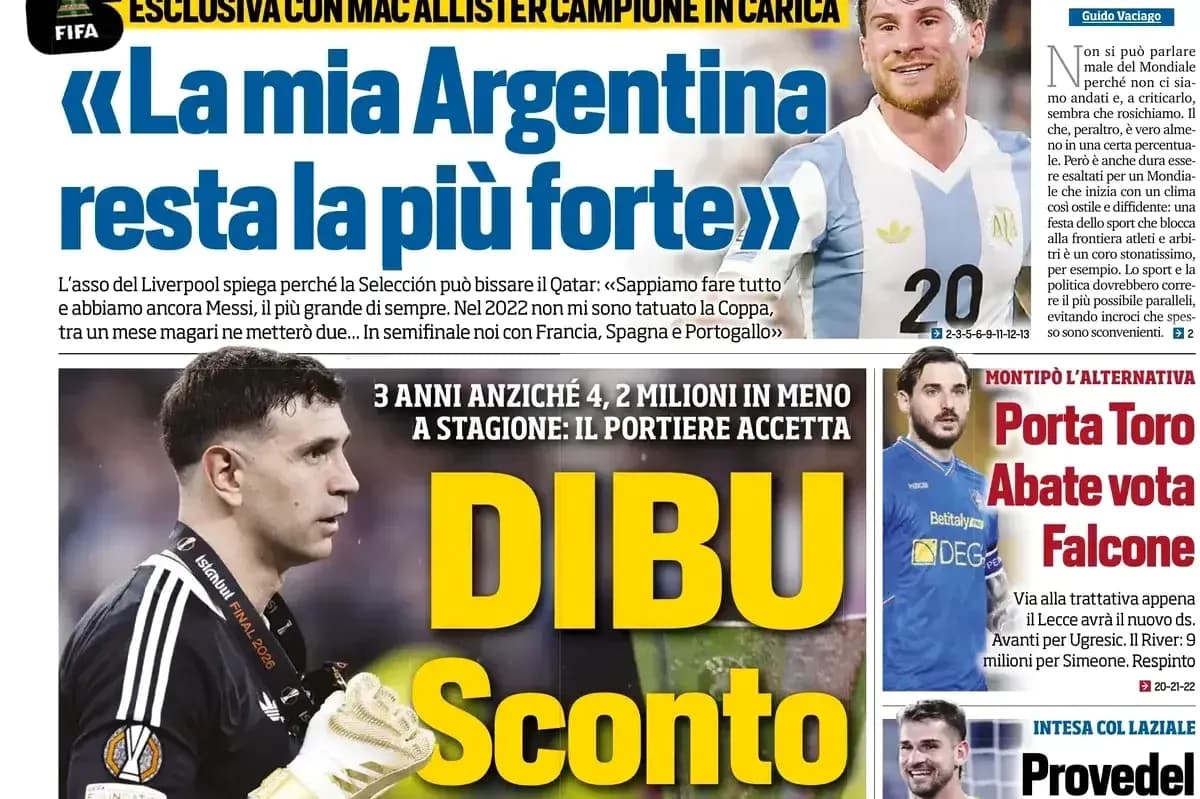
The World Cup That Leaves Italy Watching From Afar
At 20:00 tonight, the biggest World Cup in history kicks off at the Estadio Azteca. A legendary stadium, a new-era tournament, and a glaring absence: Italy are not there. The tricolour will only appear on the touchline, not on the pitch.
Mexico–South Africa opens this expanded, American World Cup, the first act of a 48‑team marathon that will end on 19 July. Three opening ceremonies, one colossal competition, and a cast of stars that stretches from Lionel Messi to the new prince of the game, Lamine Yamal, with Kylian Mbappé poised to take centre stage again.
Italy? They arrive as a coaching nation. Carlo Ancelotti, Fabio Cannavaro and Vincenzo Montella carry the flag, three benches on which a country’s football culture tries to remain relevant while the national team stays at home.
Messi, the Champions’ Warning
Argentina land as reigning champions and they do not hide. Messi has already set the tone: “It will be tough to beat us.” It is not arrogance, more the quiet certainty of a group that has walked through fire together.
Alexis Mac Allister, now a key figure at Liverpool and still a pillar of the Selección, explains why they believe in a repeat of Qatar. He calls Argentina “the strongest” and underlines the obvious but decisive detail: Messi is still there, “the greatest of all time.”
Mac Allister admits he did not get a tattoo of the World Cup in 2022. He may correct that omission. “In a month’s time, I might get two,” he says, drawing a line in the sand for the rest of the world. His bracket is clear: he sees Argentina, France, Spain and Portugal in the semi‑finals. It is a list that mirrors the bookmakers and the dressing rooms: the powerhouses are ready, the margins are thin.
Spain Raise Their Hand
Spain, in particular, arrive with a bold internal conviction. Rodri, the metronome of both Manchester City and La Roja, does not hide behind clichés. “The level has been raised, my Spain side are favourites,” he insists.
It is a statement that fits the mood around Luis de la Fuente’s squad: a group that mixes the experience of winners with the fearless talent of players like Lamine Yamal. The algorithmic models agree, placing Spain right up there with France and Argentina. On paper, it is a three‑way arm wrestle. On grass, the smallest detail will decide it.
France, meanwhile, travel with perhaps too much of everything. Depth in every line, superstars in every zone, an attack that intimidates before a ball is kicked. The question is the same as always with Les Bleus: can that galaxy of egos and brilliance move as one when it matters most?
The Last Dance for Two Icons
This is World Cup number 23, and it carries a whiff of farewell. For two of the game’s great icons, this looks like the last dance on the biggest stage. The sense of an era closing hangs over the tournament like a late‑evening shadow.
France and Argentina stand at the top of the pre‑tournament hierarchy, but the numbers lean towards Spain. Data models and algorithms point to La Roja. Emotion, history and narrative pull towards Messi and Mbappé. The pitch will decide who gets the final bow.
Italy on the Sidelines, But Not Silent
While the Azzurri stay home, Italian influence still seeps into the competition. Ancelotti, finally leading a national team at a World Cup, becomes a sort of global ambassador for Italian football. Cannavaro and Montella add their own tactical fingerprints, each trying to write a story that softens the pain of Italy’s absence.
The paradox is brutal. The “maxi” World Cup, expanded to 48 participants, makes room for almost everyone. Almost. Italy watch from the outside, represented by three coaches and a handful of players scattered across foreign squads, but without the blue shirt that defines their footballing identity.
Tonight, as the first of three opening ceremonies lights up the Azteca and Mexico–South Africa rolls the ball on this oversized, ambitious tournament, one question lingers over Italian football: how long can a country with this history accept being a guest at a party it once helped define?