Tottenham's Survival Instinct Falters After Leeds Draw
Tottenham’s survival instinct flickered, then faltered.
For a few minutes at Elland Road, it looked like they had finally seized control of their season. Mathys Tel, all confidence and clean technique, stepped in from 20 yards and bent a gorgeous curling strike beyond the goalkeeper shortly after half-time. It was the kind of goal that changes atmospheres, the kind that quietens a restless home crowd and loosens tight shoulders in an anxious away end.
At that moment, Spurs were heading four points clear of 18th-placed West Ham. Breathing space. At last.
Then came the chaos.
From hero to culprit
Tel’s afternoon turned on a single, reckless impulse. Defending inside his own box, he went for an ambitious bicycle kick that had no place in such a high‑stakes situation. Instead of clearing the danger, he caught Ethan Ampadu. The contact was clumsy, the risk needless.
Play continued briefly, but the VAR check was inevitable. The replay did not flatter Tel. After the review, the referee pointed to the spot.
Dominic Calvert-Lewin stepped up and did exactly what Tottenham feared. Calm run-up, firm finish. Leeds levelled, Elland Road roared back to life, and what had looked like a composed away performance suddenly felt fragile.
From there, Spurs wobbled. Leeds sensed uncertainty and poured forward, testing a defence that has been one rash decision away from disaster all season.
Tottenham, in the end, were saved from complete collapse by Antonin Kinsky. The goalkeeper produced a stunning late stop, the sort of reflex save that keeps a club’s fate in its own hands. Without him, this would have been far more than just two points dropped.
De Zerbi’s frustration with the whistle
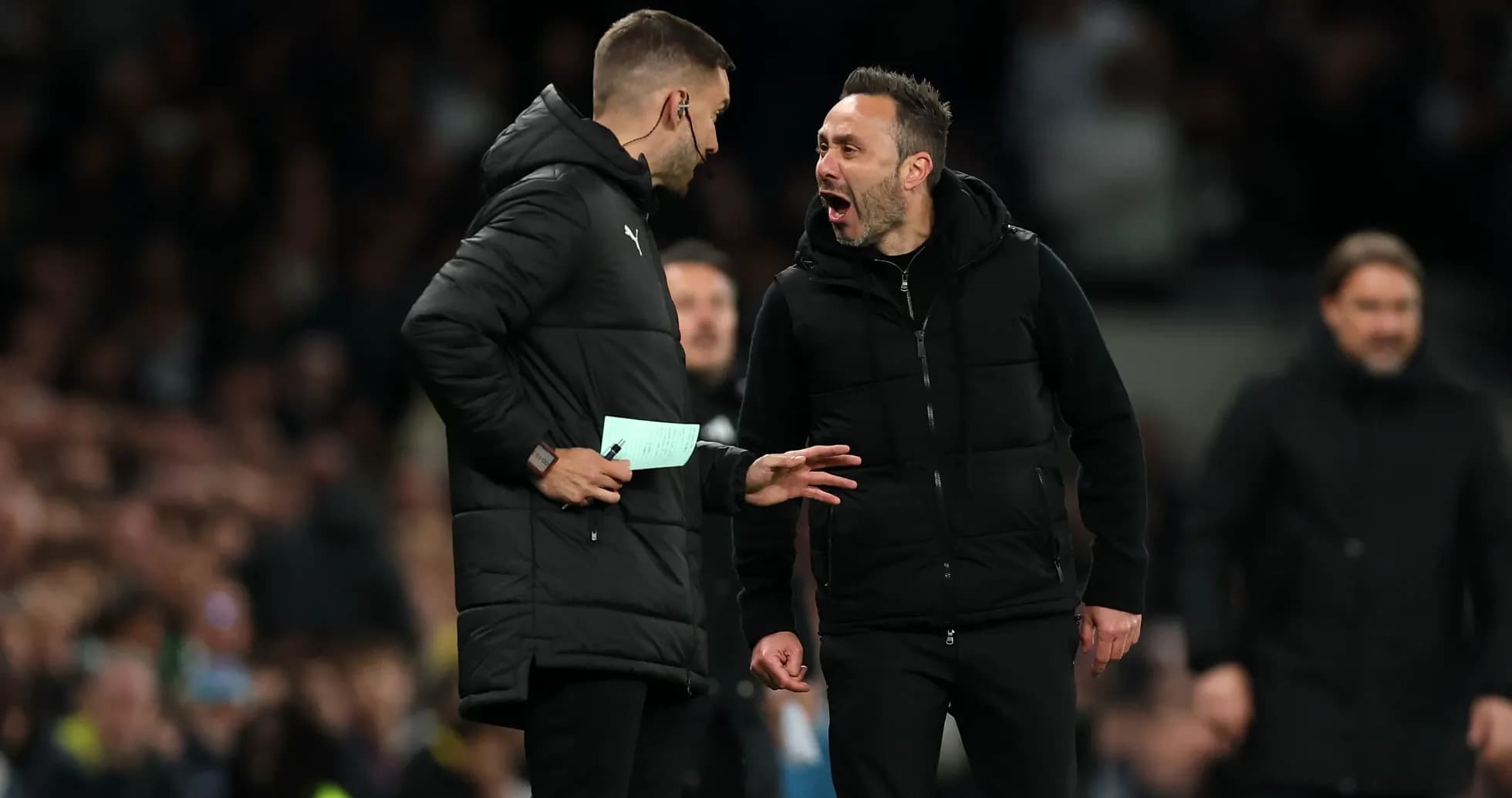
On the touchline, Roberto De Zerbi rode every decision. By full-time, his irritation with the officiating was obvious, particularly over a late penalty appeal for James Maddison that went Spurs’ way only in theory, not on the scoreboard.
The incident went to VAR, the check was made, but the claim was waved away. De Zerbi, speaking to BBC Match of the Day, drew a pointed comparison with West Ham’s controversial defeat to Arsenal.
He referenced the VAR call in that game as a “clear” foul, then admitted he had not watched back the Maddison incident. He acknowledged hearing from his assistant about it but refused to dive headlong into a full-blown argument over refereeing standards. Instead, he suggested the referee “was not calm” and might have “felt the pressure of yesterday,” a nod to the scrutiny swirling around officials after West Ham-Arsenal.
There was no full-scale attack, no incendiary outburst. De Zerbi insisted there was “no problem” and even said the referee “was good on the pitch.” Yet the subtext was obvious: in a relegation scrap this tight, every marginal call feels monumental.
Points on the board, danger on the table
The table does not care about frustration. It shows Tottenham just two points above the drop zone, having failed to fully exploit West Ham’s slip against Arsenal.
De Zerbi tried to frame the afternoon as part of a broader upward curve. He pointed to performance as well as result, highlighting that Spurs have taken eight points from their last four games. That is form that would normally pull a side clear, not leave it glancing nervously over its shoulder.
He also made sure to credit Leeds, praising their display and backing them to approach their final game at West Ham with the same intensity. For Tottenham, that fixture now looms large in the background. Their fate is not tied to it yet, but the permutations are starting to stack up.
What remains undeniable is that Spurs had the chance to create real daylight and let it slip. A moment of brilliance from Tel, undone by a moment of rashness. A composed away performance, dragged into a frantic contest by one ill-judged swing of a boot.
Chelsea away, and a brutal run-in
There is no gentle landing from here. Tottenham travel to Chelsea on 19 May, a trip that would feel daunting in any season, never mind one where a club of their stature is peering down at the trapdoor.
Any further dropped points at Stamford Bridge could drag them into the bottom three, depending on how results fall elsewhere. That is the reality now: a club accustomed to chasing European nights is counting single points and watching other scorelines with as much interest as its own.
There are positives, but they come with caveats. Maddison’s return to fitness is a major boost. He impressed in his first appearance since a major pre-season knee injury, adding craft and control in midfield that Spurs have sorely missed. His influence will be vital in the final two games.
Yet defensive discipline remains the glaring issue. Tel’s penalty concession was not an isolated lapse; it was a symptom of a team that still switches off, still takes unnecessary risks in the most dangerous areas of the pitch. At this stage of the season, that trait can be fatal.
Two fixtures remain. No more room for romantic bicycle kicks in your own box. No more squandered leads. No more relying on the goalkeeper to bail out structural flaws in stoppage time.
Tottenham still hold their destiny. The question now is whether this squad can finally match the urgency of their situation—or whether this draw at Elland Road will be remembered as the moment the slide towards the Championship became irreversible.