Tottenham vs Leeds: Tactical Stalemate Ends in 1-1 Draw
Tottenham and Leeds shared a 1-1 draw at Tottenham Hotspur Stadium in a match that quickly settled into a clash of structures: Roberto De Zerbi’s 4-2-3-1 against Daniel Farke’s 3-5-2. Tottenham had more of the ball and territory, but Leeds’ compact block and direct threat forced a tactical stalemate that the underlying numbers (xG 1.32 vs 1.26) reflect almost perfectly.
Tottenham’s shape was clear from the lineup. A. Kinsky in goal sat behind a back four of Pedro Porro and Destiny Udogie as aggressive full-backs, with Kevin Danso and Micky van de Ven as the centre-backs. João Palhinha and Rodrigo Bentancur formed the double pivot, with Randal Kolo Muani and Mathys Tel flanking Conor Gallagher in the band of three behind Richarlison.
Leeds opposed that with a back three of Joe Rodon, Jaka Bijol and Pascal Struijk ahead of K. Darlow. The wing-backs were Daniel James on the right and James Justin on the left, with a central trio of A. Tanaka, Ethan Ampadu and A. Stach, and a mobile front two of D. Calvert-Lewin and Brenden Aaronson.
With 57% possession and 426 passes (341 accurate, 80%), Tottenham controlled the rhythm, but the distribution of their 16 shots (only 3 on target, 6 blocked) shows how often Leeds forced them into crowded central zones. De Zerbi’s side tried to overload the half-spaces: Gallagher frequently pushed into the right interior lane, with Kolo Muani narrowing inside and Porro providing width. On the left, Udogie advanced high while Tel came inside to operate almost as a second striker. That gave Tottenham 13 shots inside the box, but Leeds’ back three plus Ampadu’s screening limited clear looks.
Leeds’ 3-5-2 without the ball often resembled a 5-3-2, with James and Justin dropping into the back line. Their 335 passes (240 accurate, 72%) and 43% possession underline a more direct approach. The visitors were selective in their pressing: they rarely engaged high, instead springing forward when Tottenham’s full-backs were caught high and the ball went into Palhinha or Bentancur with their backs to goal. From there, quick vertical passes into Calvert-Lewin and Aaronson allowed Leeds to generate 11 shots, 4 on target, with a more efficient shot profile relative to their possession.
First Half
The first half’s goalless scoreline reflected Tottenham’s territorial dominance but Leeds’ structural discipline. Kevin Danso’s 41' yellow card for Foul encapsulated Spurs’ main defensive risk: when the full-backs were advanced and the press was broken, the centre-backs were exposed to isolated duels against Leeds’ forwards.
Second Half
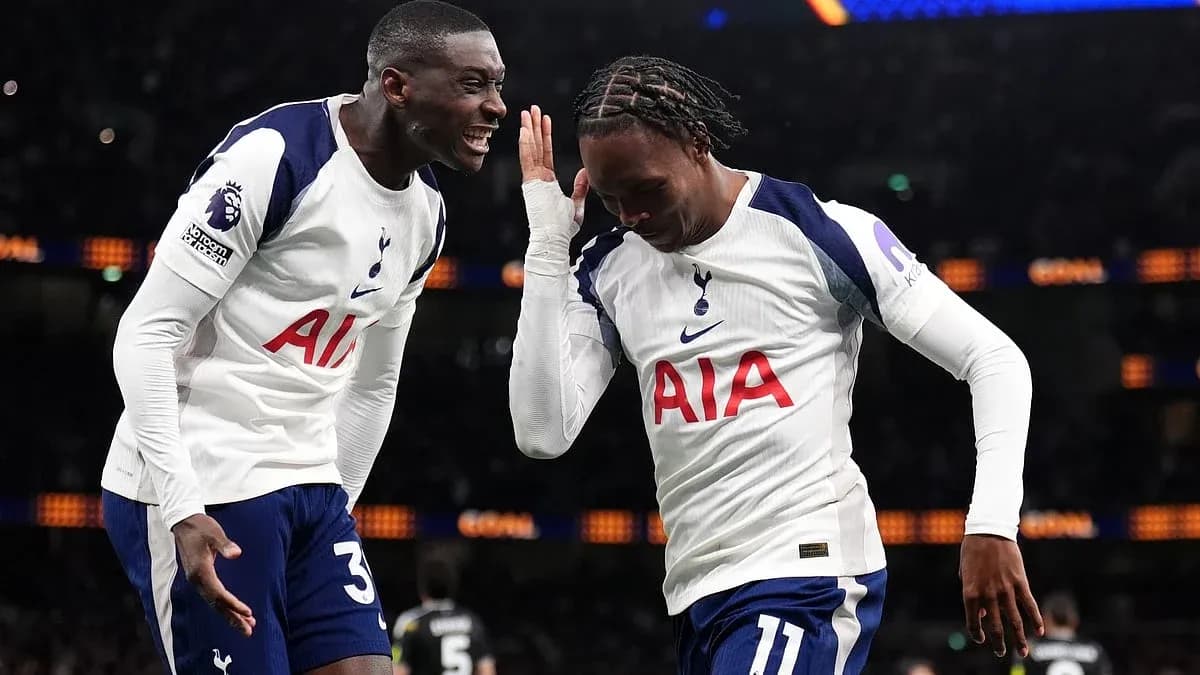
The game opened after the break. In the 50', Tel’s goal for Tottenham was the product of sustained pressure and the left-sided overload finally paying off. With Spurs pinning Leeds back, Tel’s positioning between the lines and inside the box exploited the space created by Udogie’s width and Richarlison’s central occupation. It was a classic De Zerbi pattern: circulation to move the block, then a decisive penetration through the inside channel.
Farke responded by reshaping his back line and wing dynamics. At 56', S. Bornauw (IN) came on for P. Struijk (OUT), maintaining the back three but refreshing legs and aerial presence. On 63', L. Nmecha (IN) replaced B. Aaronson (OUT), and W. Gnonto (IN) came on for D. James (OUT), turning the front line into a more direct, pace-heavy pairing and adding a runner who could attack the channels when Tottenham’s full-backs advanced.
João Palhinha’s 66' yellow card for Foul highlighted Tottenham’s increasing difficulty in controlling transitions as Leeds committed more bodies forward. The turning point came with the 71' VAR intervention: a penalty confirmed for Leeds involving Ethan Ampadu. That moment showed Leeds’ adjusted strategy working—more aggressive occupation of the box and second-ball pressure. D. Calvert-Lewin’s 74' penalty equaliser rewarded that shift and brought the xG battle back into balance.
From there, the match became a control-versus-threat equation. Leeds, with only 7 fouls and a single yellow card (Joe Rodon’s 79' Foul), stayed relatively clean while still defending aggressively in their box. Tottenham, on the other hand, accumulated three yellows—Danso, Palhinha, and Pedro Porro (82', Foul)—a sign of late, recovery defending as Leeds’ counters became more dangerous.
De Zerbi’s in-game adjustments aimed to restore fluency between lines. At 81', L. Bergvall (IN) came on for Bentancur (OUT), adding more forward thrust from midfield. On 85', J. Maddison (IN) replaced Tel (OUT), and D. Spence (IN) came on for Udogie (OUT). These changes tilted Tottenham towards a more attacking 4-2-3-1/4-1-4-1 hybrid, with Maddison as a creative 10 and Spence offering fresh width on the left. However, Leeds’ compact 5-3-2 block, now with Gnonto’s outlet speed and, from 90+3', S. Longstaff (IN) for A. Tanaka (OUT) to reinforce central energy, absorbed the pressure.
Goalkeeper dynamics were telling. A. Kinsky made 3 saves for Tottenham, but the goals_prevented figure of -0.49 suggests he slightly underperformed relative to the quality of shots faced—most notably the penalty, which is heavily weighted in xG terms. At the other end, K. Darlow faced only 3 shots on target and made 1 save, with the same -0.49 goals prevented figure pointing to a game where neither keeper decisively swung the outcome.
Statistically, Tottenham’s 14 corners to Leeds’ 2 underline how much of the game was played in Leeds’ third, but the visitors’ defensive index—low shots conceded on target despite volume, few cards, and well-timed structural tweaks—was strong. Spurs’ overall form with the ball (possession, passing accuracy, box entries) was good, yet their inability to turn that into more than 1.32 xG and a single goal shows a recurring issue: heavy reliance on wide overloads without enough central unpredictability once the opponent settles deep.
Leeds’ 1.26 xG from 11 shots, many coming after the structural and personnel changes, reflects a side that grew into the game and used its 3-5-2 platform intelligently. In the end, the 1-1 scoreline, mirrored almost exactly by the xG, feels like a fair tactical equilibrium: Tottenham the protagonists with the ball, Leeds the efficient spoilers and opportunists, each imposing their game plan for long stretches without ever fully breaking the other.