Tottenham and Leeds: A Tactical Snapshot of Rebuilding Teams
Under the lights at Tottenham Hotspur Stadium, this 1-1 draw felt less like a dead rubber in “Regular Season - 36” and more like a snapshot of two clubs at different stages of their rebuilds. Following this result, 17th‑placed Tottenham remain locked in a relegation stare-down, their overall goal difference of -9 (46 scored, 55 conceded) still a harsh ledger of a fractured campaign. Four places and six points better off, Leeds travel back north with the air of a side that knows exactly what it is: awkward, organised, and increasingly hard to beat.
I. The Big Picture – Systems under stress
Roberto De Zerbi doubled down on Tottenham’s season-long identity by rolling again with the 4-2-3-1 that has been his default (17 league uses). The shape was familiar: A. Kinsky behind a back four of P. Porro, K. Danso, M. van de Ven and D. Udogie; a double pivot of J. Palhinha and R. Bentancur; a fluid three of R. Kolo Muani, C. Gallagher and M. Tel supporting Richarlison.
Heading into this game, Spurs’ numbers painted a strange picture. Overall they had only 9 wins from 36, but their away record was far stronger than their home form. At home they had scored 21 and conceded 31, averaging 1.2 goals for and 1.7 against. On their travels, they averaged 1.4 goals for and 1.3 against. De Zerbi’s Tottenham have been a transition team trapped in a stadium that demands front‑foot dominance.
Leeds arrived with a 3-5-2 that has become one of Daniel Farke’s main templates this season (10 league uses): K. Darlow in goal, a back three of J. Rodon, J. Bijol and P. Struijk; a five‑man band of D. James, A. Stach, E. Ampadu, A. Tanaka and J. Justin; and a front two of D. Calvert-Lewin and B. Aaronson. Heading into this game, Leeds sat 14th with a goal difference of -5 (48 scored, 53 conceded), their season defined by compact home form and stubborn, low‑margin away draws: only 2 away wins from 18, but 9 away draws and an away goals‑against average of 1.8 that hinted at risk in the open field.
II. Tactical Voids – Injuries and discipline
Tottenham’s squad sheet read like a casualty list of key profiles. C. Romero, X. Simons, D. Kulusevski, M. Kudus, W. Odobert, D. Solanke, B. Davies and first‑choice keeper G. Vicario were all missing. This stripped De Zerbi of his most aggressive front‑foot defender (Romero), his most natural line‑breaking 10 (Simons), his wide ball‑carrier (Kulusevski), and his penalty‑box focal point (Solanke). The knock‑on effect was clear: K. Danso and M. van de Ven had to anchor the line with less built‑in chaos, while creativity between the lines shifted onto Gallagher and Kolo Muani.
Leeds’ absentees were less headline‑grabbing but structurally significant. J. Bogle, F. Buonanotte, I. Gruev, G. Gudmundsson and N. Okafor all missed out, robbing Farke of rotation options at wing‑back and in the half‑spaces. It forced a heavy load onto D. James and J. Justin to provide width and running power.
Disciplinary trends also shaped the tone. Tottenham have lived on the edge all season: Romero alone has 10 yellows, 1 yellow‑red and 1 straight red, while P. Porro has 9 yellows. Team‑wide, yellow cards spike between 61‑75 minutes (25.26%), with another surge from 31‑45 (16.84%). Leeds are calmer but not clean: E. Ampadu leads them with 9 yellows, and as a team their bookings peak between 61‑75 minutes at 23.33%. This is a fixture that statistically frays late, and the second half duly became a grind of tactical fouls and slowed restarts rather than open chaos.
III. Key Matchups – Hunter vs Shield, Engine Room vs Enforcer
Hunter vs Shield
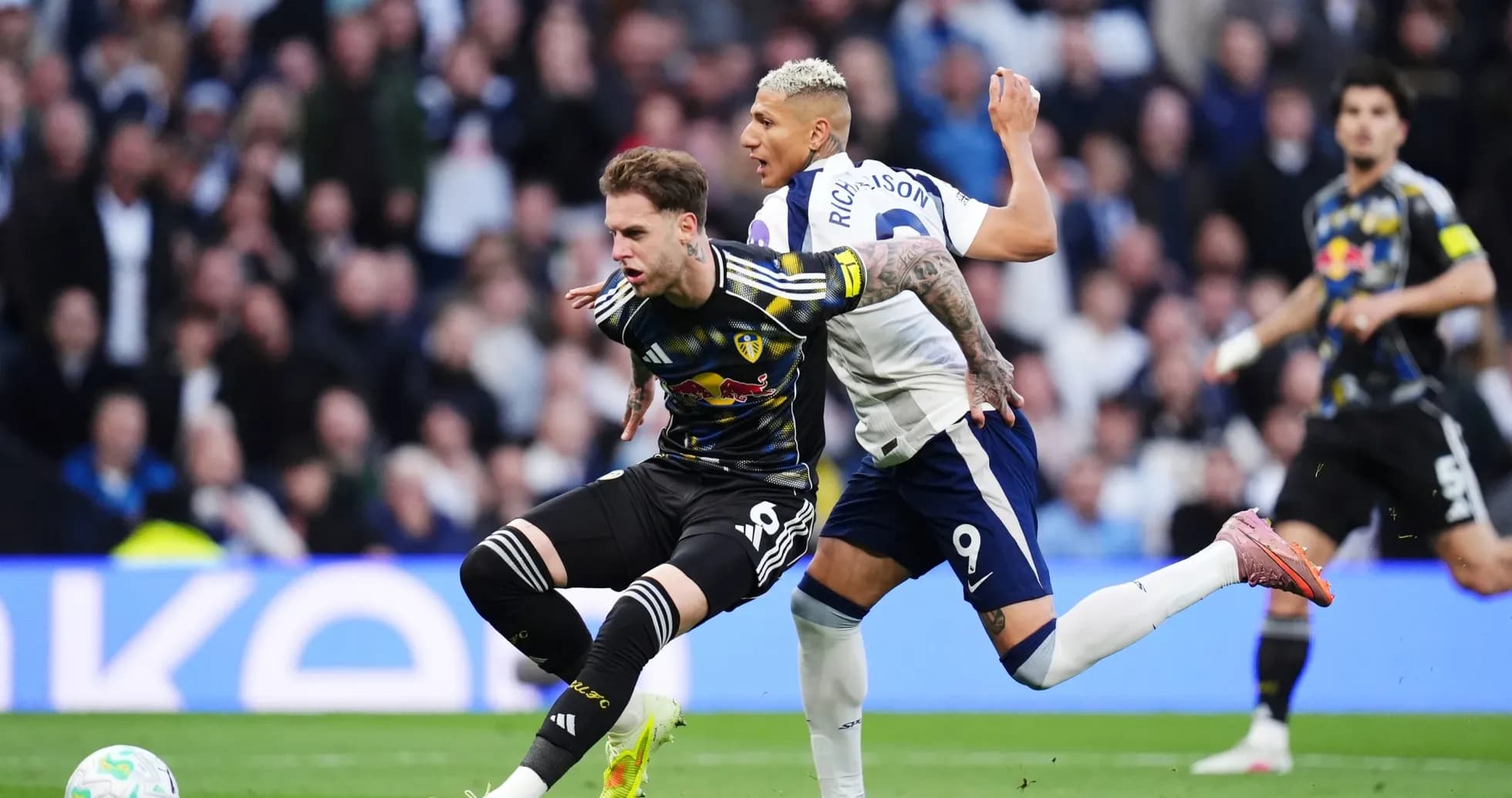
At one end, Richarlison carried Tottenham’s scoring burden. Heading into this game he had 10 league goals and 4 assists from 30 appearances, with 42 shots and 24 on target. His duel profile (294 total, 123 won) underlines a forward who thrives in collisions, backing into centre‑backs and contesting second balls.
Leeds’ defensive “shield” was a collective, but the back three of Rodon, Bijol and Struijk were protected by the relentless screening of Ampadu and Stach. Leeds’ away record – 32 conceded in 18, an average of 1.8 – suggests vulnerability when stretched, but the 3-5-2 here compressed the central lane, forcing Richarlison to drift wide or drop into pockets already crowded by Gallagher and Kolo Muani. The result was a lot of possession in front of Leeds’ block and fewer clear penalty‑box touches than Tottenham’s home crowd demanded.
At the other end, D. Calvert-Lewin arrived as Leeds’ cutting edge: 13 goals and 1 assist from 33 appearances, with 64 shots (32 on target). He is more than a finisher; 444 duels (174 won) and 37 fouls drawn show a classic reference point who can pin centre‑backs and win territory. Against a Spurs pairing of van de Ven and Danso – the former with 21 blocked shots and 22 interceptions this season, the latter stepping into Romero’s aggressive role – Calvert-Lewin’s job was to turn long Leeds clearances into platforms, especially when the visitors broke Tottenham’s first press.
Engine Room – Playmaker vs Enforcer
The game’s true axis lay in midfield. For Tottenham, C. Gallagher’s season profile (high key‑pass volume at club level, constant running) made him the natural connector between Palhinha/Bentancur and the front line. His remit: receive between Leeds’ midfield and defence, drag Ampadu or Tanaka out of the block, and feed diagonal runs from Tel and Kolo Muani.
Leeds’ enforcer was Ampadu. Across 33 appearances he has completed 1628 passes with 85% accuracy, made 78 tackles, 16 blocks and 50 interceptions, and committed 46 fouls while drawing 35. He is both metronome and bouncer. Here, his positioning was conservative: rarely vacating the central lane, always ready to step into Gallagher’s back or intercept early passes into Richarlison’s feet. Every time Spurs tried to speed up through the middle, Ampadu’s presence slowed the rhythm, turning potential breaks into static possession.
Around them, R. Bentancur and A. Stach formed the game’s secondary duel. Bentancur’s ability to play through pressure was essential against Leeds’ five‑man midfield, while Stach’s role was to jump out of the line to press Tottenham’s pivots, then quickly recover into the block. The effect was a midfield that often looked like 5v2 against Spurs in build‑up, forcing De Zerbi’s side to lean on Porro and Udogie to create width and overloads.
IV. Statistical Prognosis – xG tilt, but margins remain thin
Strip away the noise and the numbers still tell a story of two flawed but clearly defined teams. Heading into this game:
- Tottenham’s overall goals‑for average sat at 1.3, with 1.5 conceded. Their home split – 1.2 for, 1.7 against – explains why even with a more expansive style, they have only 2 home wins from 18.
- Leeds mirrored them almost perfectly overall, with 1.3 goals for and 1.5 against, but with a stark home/away split: 1.6 scored and 1.2 conceded at home, dropping to 1.1 scored and 1.8 conceded away.
Overlay expected‑goals logic on those patterns and the picture sharpens. Tottenham’s volume of shots and territorial dominance at home usually nudges their xG edge upward, but their defensive fragility and late‑game disciplinary spikes keep the door open. Leeds, by contrast, are built for xG‑neutral away days: low‑risk, low‑tempo, leaning on Calvert-Lewin’s finishing and Aaronson’s creativity (5 assists, 32 key passes, 80 dribble attempts with 28 successful) to steal high‑value chances rather than accumulate volume.
Following this result, a 1-1 feels almost mathematically pre‑ordained by those profiles: Spurs’ inability to turn home pressure into a steady flow of goals, Leeds’ knack for surviving and snatching something on their travels. If you ran this fixture ten times under the same conditions, the xG‑based verdict would likely shade marginally towards Tottenham at home, but the distribution of outcomes would be dominated by draws and one‑goal games.
For De Zerbi, the path forward is clear: restore missing difference‑makers like Simons, Kulusevski and Solanke, and turn that 4-2-3-1 from a possession shell into a chance‑creation machine, especially at home. For Farke, the template is already there: keep Ampadu healthy, keep Calvert-Lewin supplied, and continue to turn structurally sound, statistically modest performances into the kind of away results that make seasons feel stable rather than precarious.