Ronwen Williams Faces Online Abuse Ahead of World Cup Match
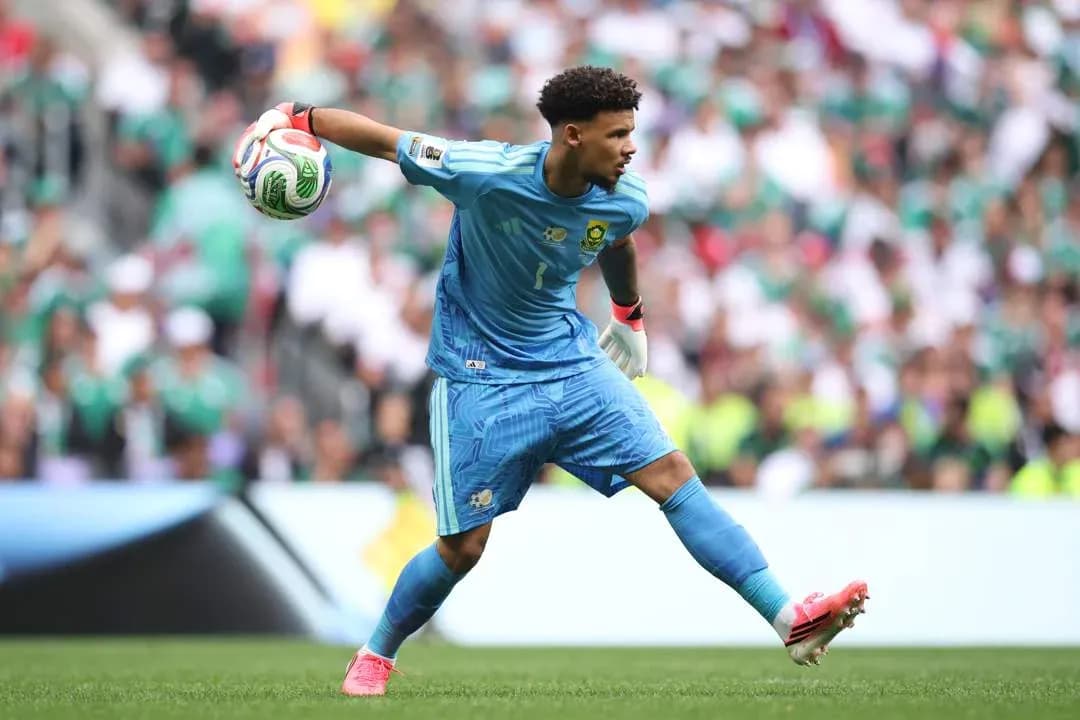
Ronwen Williams stands in the eye of a storm that has very little to do with football.
On Thursday in Atlanta, Bafana Bafana’s captain will walk out at Atlanta Stadium for a World Cup clash with Czechia that could define South Africa’s 2026 campaign. It also falls, with grim irony, on the International Day for Countering Hate Speech.
He will do so as one of the main targets of a tidal wave of online abuse.
World Cup dream, political nightmare
For this Bafana generation, many of whom were children the last time South Africa graced a World Cup in 2010, this tournament was supposed to be the dream reborn. Instead, it has been dragged into the country’s bitter immigration debate and a toxic digital backlash.
FIFA’s social media protection service has revealed that Bafana players have faced unprecedented levels of online abuse since the tournament kicked off. The volume of incidents detected across this World Cup has already passed the total recorded at Qatar 2022 – and that milestone was reached barely a week after the opening game at Azteca Stadium on 11 June, when Bafana lost 2-0 to Mexico.
That defeat lit the fuse. South Africa’s hardening anti-immigrant posture poured fuel on it.
What began as football criticism after a flat opening performance has turned into something far darker. Bafana players, and Williams in particular, have been hammered not only by their own supporters but also by angry voices from across the continent who see the national team as a symbol of South Africa’s politics.
“Players are human beings as well. We go through it. Sometimes it gets a lot,” Williams said.
Hate, fake quotes and a captain under fire
In recent days, Williams has watched his name dragged into a storm of misinformation. A fabricated quote, attributed to him and lamenting Africans who supported Mexico over Bafana – even claiming the team “almost shed a tear” – was picked up by reputable outlets and spread rapidly.
He is adamant it is a lie.
“We know how difficult it is now on social media, where everyone is attacking you,” he said. “Sometimes it’s because of false information. If you lose a game, and you don’t perform, you can take it as players. You can put your hand up. But when there’s false information that goes around, then it hurts.
“I have been a target over the last few days over things I didn’t say. I didn’t say anything about Africa, or people supporting Mexico. I have always said that as Africa, we are one. We support each other in good and bad moments.”
The abuse has not only questioned his words, but his country.
“We’ve all got our own politics, our own problems and our own fights that we deal with back home. Every country has that. I don’t know where that stems from. It does hurt. I have been attacked... my country as well, for things that are going on back home.”
Marches, deadlines and “hate watching” Bafana
The context is combustible.
The vigilante group March and March, which calls itself “a grassroots citizen movement addressing growing concerns about undocumented immigration in South Africa”, has become a loud and unsettling presence. Its rhetoric and marches have helped push immigration to the centre of South African politics, to the point that President Cyril Ramaphosa addressed the nation to announce measures to tighten the country’s porous borders.
March and March has even set 30 June as a deadline for undocumented migrants to leave South Africa. The group has not clearly stated what happens after that date, but the tone and scenes from their marches hint at the threat of violence.
Across the continent, anger has spilled into football. Some supporters have openly “hate watched” Bafana, waiting for them to fail. Others have gone further, weaponising fake news and directing vitriol at the players.
For Williams and his teammates, the line between sport and politics has blurred against their will.
“You want to focus on doing your job, which is being a footballer, but then you get involved in politics even though you don’t want to get into that space,” he said.
Old wounds, familiar consequences
This is not the first time Bafana have paid the price for South Africa’s fraught relationship with immigration and xenophobia.
In 2019, Madagascar and Zambia refused to play international friendlies against Bafana after a spate of xenophobic attacks in South Africa. That decision left then-coach Molefi Ntseki, newly appointed after Stuart Baxter, to launch the 2021 Africa Cup of Nations qualifying campaign without proper preparation.
The fallout was brutal. South Africa failed to qualify, finishing third in a group with Ghana, Sudan and São Tomé and Príncipe.
Six years on, the backlash has changed shape but not direction. Now, instead of cancelled fixtures, it is relentless online hatred. Instead of empty friendlies, it is a World Cup group stage that feels heavier than it should.
“Players have accepted it, that that’s how things are in the world now,” Williams admitted.
Blocking out the noise
Inside the Bafana camp, the response has been to close ranks.
“We’ve had meetings to discuss this as players,” Williams said. The message from coach Hugo Broos has been clear: strip everything back to football.
“You have an experienced coach in coach Hugo, who says that the most important thing is to analyse the game. That is the most important thing, to block out the noise, focus on how we can do better, learn from our mistakes and just stick together as a team.
“If you are going to listen to a million people’s opinions, then you will lose your mind. So, at this moment, the most important comment and the person to listen to is our coach and technical team. He knows us, and we know him. He knows our strengths and weaknesses.”
The stakes are obvious. The top two teams in each World Cup group advance automatically, with eight of the best third-placed sides from the 12 groups also reaching the last 32. Bafana’s route out of Group A will depend as much on their composure as their tactics.
The players know it. The captain feels it.
“We are there for one another. We came here together, and we will leave here together. So, let us stick together as a team and keep the focus.”
Football as fragile refuge
In Atlanta, the contrast is stark. Inside the National Centre for Civil and Human Rights, just a few kilometres from the stadium, FIFA officials laid out the numbers behind the abuse. Outside, the city hums with the colour and noise of a World Cup host.
“We are in Atlanta now, and I see so many Africans... so many South Africans and people from Mexico, in one room,” Williams said. “That’s the beauty of sport. That’s the beauty of football.
“So, let’s just enjoy and have a wonderful time, and we leave politics to the politicians. Let us just play football, and enjoy ourselves.
“Criticise us for what happens on the field, but off the field things – we can’t deal with that, and it has nothing to do with us. As Africans, let’s unite and keep going because we are all in this together.”
On Thursday, as Bafana step out against Czechia, the noise will still be there – the hate, the anger, the politics. The question is whether, for 90 minutes, South Africa’s players can make the ball louder than the abuse.