Kylian Mbappe: The Complex Legacy at Real Madrid
As Real Madrid’s players file through the tunnel at the Bernabeu, they walk past Alfredo Di Stefano’s words, etched into concrete and memory.
“No player is as good as all of you together.”
Right now, that sentence feels less like a slogan and more like an accusation.
Madrid are drifting towards the end of a second straight season without a major trophy. The crowd has turned on its idols. Vinicius Junior. Jude Bellingham. Kylian Mbappe. Even Florentino Perez, architect of the modern galactico era, has heard the whistles roll down from the stands.
The tension is not just in the seats. It spilled out onto the training pitch last week, when Aurelien Tchouameni and Federico Valverde clashed in a fight that exposed a dressing room fraying at the edges.
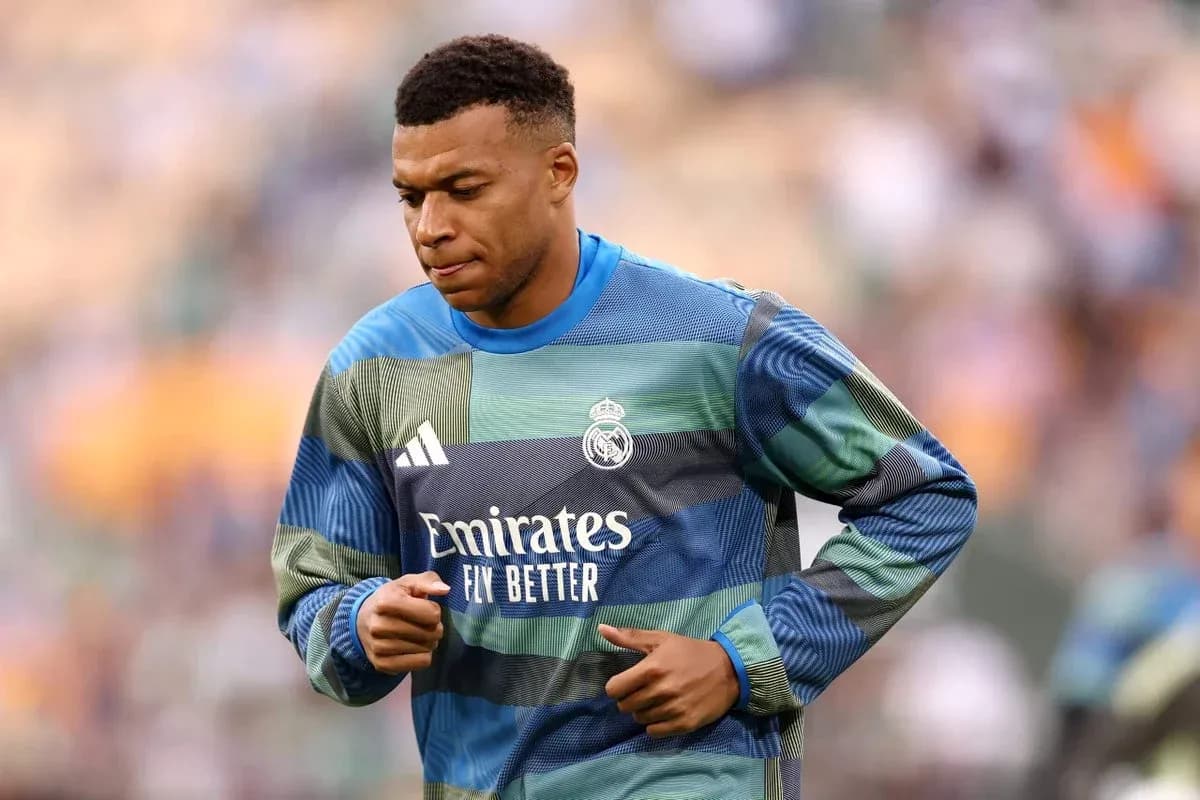
And in the middle of it all stands Mbappe — the superstar Madrid chased for years, the man they finally landed on a free in June 2024, with a signing fee that underlined his status as the centrepiece of a new dynasty. Two years on, the question hangs over the Bernabeu like a low cloud: has this journey been worth it?
A superstar under the microscope
On paper, the numbers scream yes.
Mbappe is Madrid’s leading scorer by a distance, with 77 goals in La Liga and the Champions League since he arrived. He took the Golden Boot in 2024-25. He has 15 goals in this season’s Champions League alone, bearing down on Cristiano Ronaldo’s record of 17 from 2013-14.
When Madrid fell to Bayern Munich in the Champions League quarter-finals last month, Mbappe was one of the few who met the occasion, scoring twice across the two legs. The tilemaps and shot charts tell a clear story: he dominates the team’s attacking volume, almost doubling the goal tally of any team-mate, and he has outperformed his expected goals by seven.
That still has not protected him from the sound that cuts deepest in this stadium: boos from his own fans.
In Madrid’s first home game after that Bayern elimination, Mbappe was singled out along with others. The frustration soon spread beyond the pitch. A report of a training-ground row between Mbappe and a member of the coaching staff before the trip to Real Betis on April 24 only fed the sense of unease.
Then came anger inside the club over his decision to travel to Italy with his partner while recovering from injury. His camp hit back with a statement stressing that criticism was “based on an over-interpretation of elements related to a recovery period strictly supervised by the club” and insisting it did not reflect his commitment or daily work.
The data says one thing. The mood around the club says another. Somewhere in that gap lies the real Mbappe debate.
The case against: goals with a cost
The doubts inside Valdebebas did not start this season.
When Mbappe’s move from Paris Saint-Germain was finally locked in two years ago, a member of Carlo Ancelotti’s staff pointed to one line of his profile that worried them most: his defensive work. Or rather, the lack of it.
They were already wondering how they would keep balance in a team that had just won a 15th Champions League, with Vinicius Jr and Bellingham shining and a deep, confident squad. It felt almost churlish to question the arrival of one of the game’s biggest stars. It does not feel that way now.
Across La Liga and the Champions League, Mbappe ranks as the Madrid player with the fewest tackles, interceptions and ball recoveries per 90 minutes. The picture becomes starker when you look at “true” tackle attempts — every time a player genuinely tries to win the ball, whether he succeeds, fails, or gives away a foul.
In La Liga, among 461 outfield players, Mbappe sits 461st. Dead last. Around 0.6 such attempts per game.
You can live with that from a star forward if the structure around him compensates. The problem is what happens when you drop him into a side already built around other attacking centrepieces — Vinicius Jr, Bellingham, Rodrygo — who also need freedom, touches, and licence to take risks.
Then comes the positional headache.
Mbappe’s natural habitat is the left half-space, cutting inside onto his right foot. Vinicius Jr lives there too. Touchmaps show them both drifting to the same flank in build-up, stepping on each other’s toes. There have been flashes of connection, moments when their speed and improvisation have torn opponents apart. But the chemistry has never reached the natural, almost telepathic understanding Vinicius Jr once shared with Rodrygo.
That overlap raises uncomfortable questions. Who thought stacking two dominant, left-sided attackers was a long-term solution? How many of Mbappe’s goals come at the cost of fluency for the rest of the team?
The scoring figures do not offer an easy defence. Madrid hit 78 league goals last season and sit on 70 with three games to play this time. In 2023-24, before Mbappe arrived and when the side lacked a clear No 9 — with Bellingham as a false nine and Joselu as an impact target man — they scored 87 in La Liga.
Mbappe has not dragged the overall attacking output to new heights. The structure has bent around him without yet finding a new equilibrium.
That imbalance does not only affect the present. Every future signing, every young forward of high potential, will have to fit around his positional demands. The club must ask whether the shape of the team is being defined by one man to a degree that becomes counter-productive.
And then there is the dressing room.
Mbappe arrived not just as a goalscorer but as a leader, a face of the project. Leaders are judged harshest when things turn ugly. Madrid have endured two barren seasons, a training-ground fight between team-mates, and a string of public flare-ups. The perception, fair or not, is that Mbappe has not always filled the void when the group needed a unifying figure.
The emotional baggage around his transfer does not help. Madrid chased him through several windows, only to be rejected in 2022. At his presentation in July 2024, Perez spoke of the “great effort” Mbappe had made to join. Many fans still remember the earlier “no”, and they see a player now on the highest salary in the squad, still without a Champions League in white.
In a club that demands not just brilliance but belonging, that matters.
The case for: talent, time and the Ronaldo echo
Strip away the noise and one truth remains: Mbappe is still one of the best players on the planet.
He is 27, in what should be the prime of his career, and is almost certain to be one of the central figures at this summer’s World Cup with France. History suggests that when he is clearly cast as the main man, he thrives. He did it at 19, winning the World Cup in 2018. He did it again in 2022, scoring a hat-trick in the final against Argentina, joining Geoff Hurst as the only men to score three in a World Cup final, even if he left the pitch on the losing side.
Madrid have seen flashes of that version. When Xabi Alonso, during his spell as coach, shifted the attacking hierarchy and pushed Mbappe ahead of Vinicius Jr in importance earlier this season, the Frenchman looked looser, more expressive, more consistently decisive.
There are clear areas to improve — starting with his defensive application — but the ceiling remains enormous. Three years left on his contract gives Madrid time to shape a team that leans into his strengths rather than fighting them.
The leadership argument also has another side. In a dressing room that has lost the calm authority of Karim Benzema, the metronomic presence of Toni Kroos and the competitive genius of Luka Modric, someone has to carry the weight. Mbappe does that by default every time he steps onto the pitch. Talent is its own form of leadership here.
He has also shown he can speak for the group. Despite some media missteps, he has handled mixed zones and interviews with poise. When Vinicius Jr alleged racist abuse from Benfica winger Gianluca Prestianni during their Champions League play-off first leg in February, Mbappe stood in front of the microphones and delivered a strong, articulate defence of his team-mate. Prestianni denied racism and was later given a six-game UEFA ban for homophobic conduct, not racist abuse, but the episode underlined Mbappe’s willingness to take a stand.
For Perez and chief executive Jose Angel Sanchez, there is a precedent in how to navigate a storm around a superstar forward. They have lived this before, with Mbappe’s childhood idol.
Cristiano Ronaldo’s first two seasons in Madrid yielded only a Copa del Rey. The Champions League, the trophy he had been signed to reclaim, did not arrive until 2014, five years after his arrival. There were turbulent moments along the way. In September 2012, after scoring twice against Granada and refusing to celebrate, Ronaldo said: “I’m sad and the people at the club know it.”
The noise around him was deafening at times. The payoff was historic: four Champions League titles, a mountain of goals, and an exit in 2018 as the club’s all-time leading scorer.
That story does not guarantee Mbappe will follow the same path. It does show that Madrid have seen this kind of tension before — the uneasy early years of a superstar era that only makes sense when you look back from the finish line.
Right now, Di Stefano’s words on the tunnel wall feel like a rebuke to a fractured squad and a restless fanbase. Mbappe is both symbol and symptom of that fracture: a forward who scores relentlessly, yet still stands accused of giving too little.
The question for Madrid is not whether he is good enough. The numbers have already answered that. It is whether they are willing to build, suffer, and wait long enough for his story in white to justify the upheaval that brought him here.