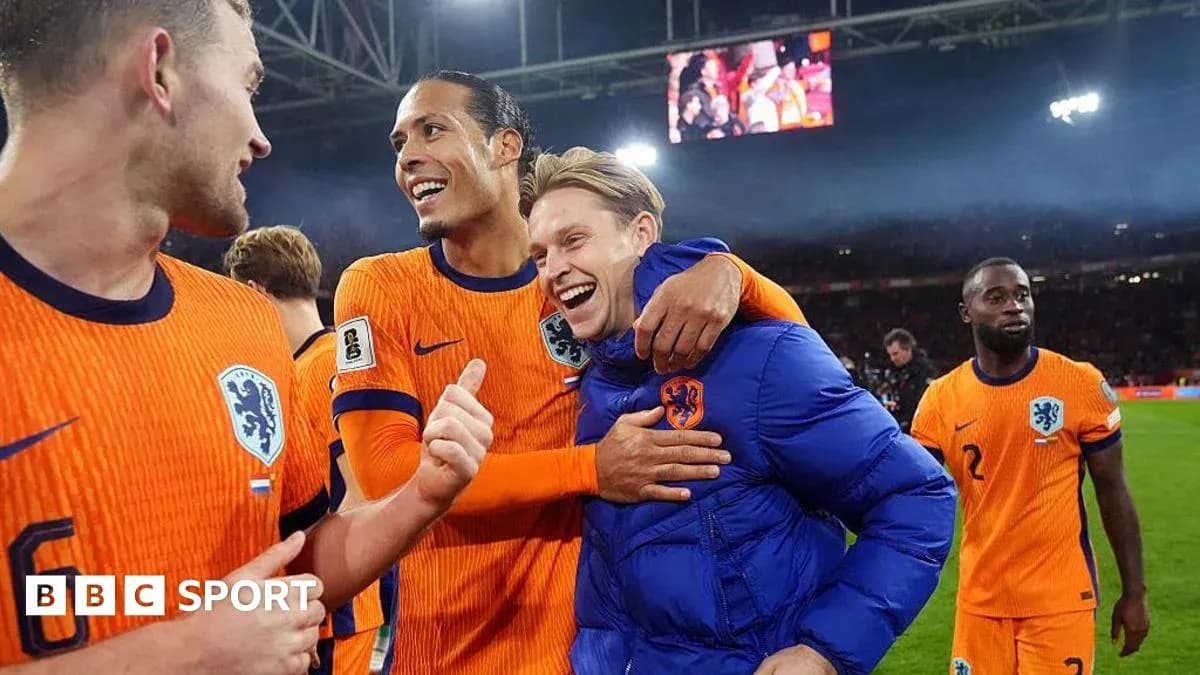
Klement's Model Predicts Netherlands to Win World Cup 2026
Paul the Octopus needed nothing more than a tank, a couple of boxes and a dead fish to become a World Cup phenomenon. Joachim Klement needs a spreadsheet.
Fourteen years on from South Africa 2010, the tentacled oracle has long since passed into football folklore. In his place stands a German economist with a model that has quietly done something far more impressive than pick Germany’s results: it has nailed the World Cup winner three tournaments in a row.
- Germany in 2014.
- France in 2018.
- Argentina in 2022.
Now, with a straight face and a stack of data, Klement says the Netherlands are next.
The economist who keeps beating the World Cup
Klement, a strategist at investment bank Panmure Liberum and a self-described “pessimist”, never set out to become football’s numbers guru. His original aim was almost the opposite.
“This started as an exercise in showing the world a hubris of economists who think they can forecast stuff that they actually have no clue about,” he says. “And now it's become an exercise in how, if you're lucky often enough, people will think you're a guru.”
The idea was simple enough. Take the known, measurable forces that shape international football – population, national wealth, climate, Fifa world rankings – and see how far they go in explaining who ends up holding the trophy.
In 2014, he ran the numbers. Out came Germany. His home nation lifted the cup in Rio and the model walked away with a perfect record after one attempt. A curiosity, nothing more.
Then Russia 2018 rolled around. Klement tried again, expecting the spell to break. France. Again, the model was right. By 2022 in Qatar, the exercise had become a ritual. The forecast spat out Argentina. Lionel Messi did the rest.
Three tournaments. Three winners. Suddenly, this wasn’t a quirky academic diversion. It was a streak.
Netherlands on the line
For 2026, the model points to the Netherlands. Should they lift the trophy in July, Klement’s statistical prophecy would stand at four out of four. No octopus, no mysticism. Just data, probabilities and a man who keeps warning people not to take him too seriously.
The model does more than pick a champion. It sketches the entire 48-team landscape: who should stumble, who might spring a shock, where the giants could fall.
In Klement’s forecast, Japan stun Brazil in the second round. Scotland, back on the biggest stage, fail to escape their group. England grind their way to the semi-finals, only to run into an old scar.
Portugal again. Two decades after that night in 2006, the numbers say the Portuguese knock England out once more. The model does not dare to specify penalties, but the echo is clear enough.
Across the bracket, the Dutch path emerges, step by step, as the likeliest route to the trophy.
Half numbers, half chaos
Klement is the first to insist this is not destiny dressed up as maths.
“It is true that World Cup success is partly determined by known ‘systemic’ factors,” he explains – the structural advantages that richer, larger, football-obsessed nations tend to enjoy. Those elements form the backbone of his work.
Then comes the bit no model can tame.
“The other 50% is luck,” he says. “Every match – especially when you have these high-quality teams playing against each other that are very similar in skills and quality – it really depends on the form of the day, a ref call, a piece of luck in the sense of hitting the post versus the ball going in. Things like that are completely unpredictable.”
That is the tension at the heart of his project. The model is built to show how far rational analysis can take you – and where it runs out of road. The more it gets right, the harder it becomes for people to hear the second part of the message.
A distraction in a darkened world
Each World Cup year, Klement’s forecast has grown in reach and expectation. What began as an internal curiosity is now a quadrennial event, circulated and debated far beyond the walls of his bank.
The timing, he admits, helps. “In particular in 2026, when there are so many crises, wars and things going on, it is something that makes me feel good and hopefully the readers feel good and gives them a little bit of a distraction from all the kind of bad stuff that is going on in the world.”
For a few weeks, the questions change. Instead of bond yields and inflation, colleagues want to know how an injury to a Dutch midfielder filters through a probabilistic model.
In the office, they come at him with specifics: what does Xavi Simons’ ACL injury mean for the Netherlands’ chances? How much does one absence bend the curve? These are not idle questions. Some of them have money riding on the answers.
“I've got several colleagues who bet some money on the Netherlands in response to me publishing that note,” Klement says. He has told them, repeatedly, about the role of luck. The warnings don’t always stick.
Living with the streak
With every successful tournament, the weight on the next prediction grows. Three winners in a row has turned a playful exercise into a test of an unlikely record.
“Because I was right three times in a row, people now think that this model is unbeatable and that I obviously will have to be right as well next time,” he says. The irony is not lost on him. The whole project was designed to puncture certainty, not create it.
So he braces himself for kick-off. If the Netherlands go deep, the legend of the economist who cracked the World Cup will swell again. If they fall early, the spell breaks and the model returns to what it always was: an educated guess in a sport that delights in shredding them.
There is one scenario Klement has already mapped out, though. Not in his spreadsheet – in his diary.
“If the Netherlands get eliminated from the World Cup,” he says, “I think the next day I have to work from home.”