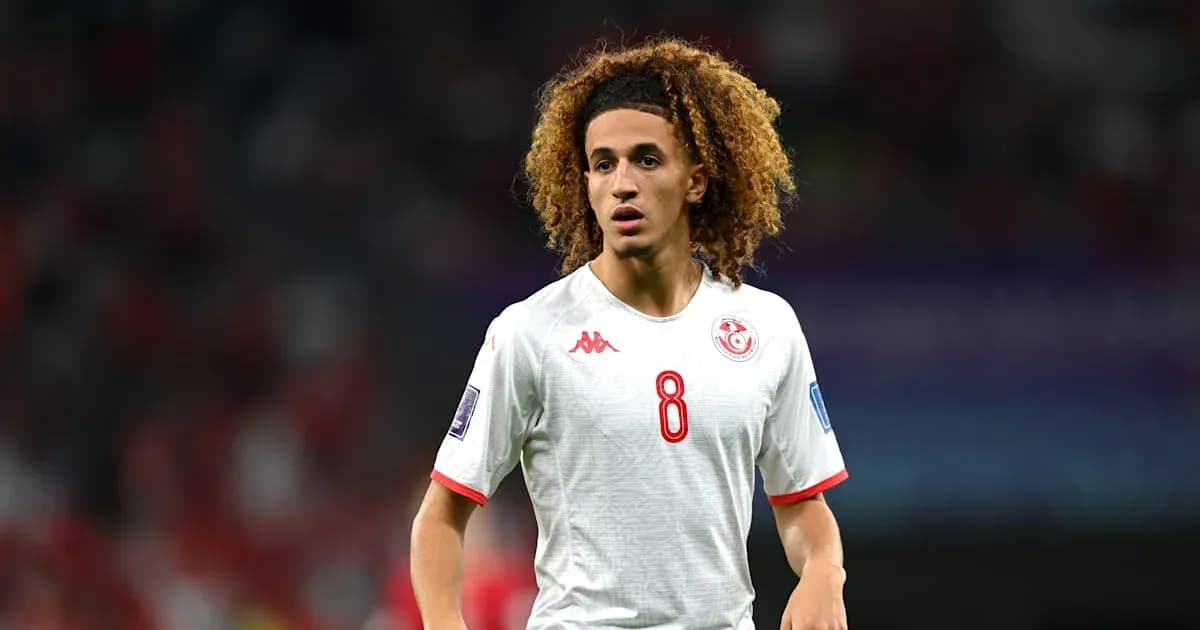
Hannibal Mejbri: Tunisia's Rising Star at the 2026 FIFA World Cup
The Eagles of Carthage have always carried one of football’s great nicknames. Now they have a player whose very name drips with history.
Hannibal Mejbri, 23 years old and already the beating heart of Tunisia’s midfield, steps into the 2026 FIFA World Cup with a burden and a story that stretch far beyond the white lines. His parents named him after Hannibal Barca, the Carthaginian general who dragged war elephants across the Alps and brought Rome to its knees, only to fall short at the gates.
Two thousand years on, another Hannibal is trying to finish the job. His mountain is the group stage. Tunisia have never climbed over it. He intends to.
From La Banane to the world
The journey starts in Paris, not Tunis. Mejbri was born in the French capital and raised in the 20th arrondissement, a dense, working-class sprawl where concrete courtyards double as football pitches and the soundtrack is a mix of French, Arabic and West African dialects.
He calls it a neighbourhood of “many Tunisians, many Algerians, many Moroccans, lots of Senegalese, Malians as well” — a place where backgrounds differ but the ball unites everything.
At the heart of that area sits a curved block of flats nicknamed La Banane. It’s not glamorous. It is, however, where a future international was shaped.
“Instead of going straight up to my house, I used to stay out and play football until night fell,” Mejbri recalls in the series *World at Their Feet*, which tracks emerging talents on the road to the 2026 World Cup. “I was a normal boy, there was no master plan. I had my friends, I was focused on my life as a kid.”
On those pitches, one boy was impossible to miss. Childhood friend Hubert Mbuyi remembers the hair first, then the football.
“He had a unique style, with big hair, big blonde hair. So everyone knew him and had a lot of expectations for him,” Mbuyi says. “Where you could find a pitch and a ball, you will find Hannibal.”
The look made him recognisable. The touch made him unforgettable.
Paris, Monaco, Manchester: a fast-track education
Paris FC spotted him early. Mejbri joined their academy at six and spent almost seven years there, learning the basics in a club that sits in the shadow of Paris Saint-Germain but has long been a proving ground for rough-edged talent.
A short spell at Boulogne-Billancourt followed. Then came the first major leap.
In 2018, Monaco paid €1 million to bring the 15-year-old into their academy. It was a move that dropped a kid from La Banane into the rarefied air of the principality.
“I could feel the richness of Monaco,” he says. “So yeah, it was a little bit of a shift, a little dream, and I learned a lot there.”
The experience on the pitch did not always match the dream. Still, his talent refused to stay quiet. Scouts from Europe’s elite circled: Bayern Munich, Paris Saint-Germain, Barcelona. They all saw the same thing — a wiry, combative midfielder with vision, bite and personality.
When the decision came in August 2019, Mejbri went a different way. At 16, he chose Manchester United, the three-time Champions League winners, and threw himself into the unforgiving ecosystem of Old Trafford.
The climb through the ranks was brisk. By 2021 he had made his Premier League debut. Two years later came the moment that still sends a shiver down his spine: his first top-flight goal, in a 3–1 home defeat to Brighton in September 2023.
“I still get chills,” he says. “I don’t know why I started to celebrate when we were losing 3–0, and you can see in my celebration that I had a certain rage in me and that I let go of everything when I scored.”
It was a strike that meant nothing to the scoreline and everything to the player. A release. Proof that the kid from La Banane could leave a mark at one of the game’s most demanding clubs.
Choosing a flag: heart over logic
For years, the question hovered: France or Tunisia?
Mejbri had already worn the blue of France at under-16 and under-17 level. The pathway to the world champions looked clear. Yet when Tunisia called in 2021, the answer came from somewhere deeper than career planning.
“I joined Tunisia because I chose with my heart,” he explains. “Even though I lived in France, it doesn’t take away the love I have for France. But I find that the love I have for Tunisia is greater.”
That decision turned him into a symbol. For a diaspora spread between North Africa and Europe, he became a bridge — a Paris-born playmaker carrying Carthage on his back.
The caps piled up quickly. He is already 44 games into his international career and has twice been named African Revelation of the Year at the Africa d’Or awards. His role in this Tunisia side is no longer speculative. He is central, trusted, expected to set the tone.
Yet every time he pulls on the red shirt, his mind goes back to that curved block in the 20th arrondissement.
“When I represent my country, I also represent my neighbourhood,” he says. “Because I know that I will represent them, and so all of that, it’s a bit related to pride.”
Mbuyi sees what that means on the ground.
“All Tunisians are proud of him,” he says. “Because in the end, he’s a kid from the neighbourhood. When he plays matches, everyone focuses on the match. We’re all watching Hannibal’s hair on the pitch. We try to spot him every time.”
Giving back to La Banane
Fame has not loosened his grip on home. Every summer, Mejbri returns to La Banane and stages a football tournament for the community. It is not a token visit. It is a ritual.
Last year, he handed out around 100 shirts. The impact is immediate and visible.
“You can just walk around here and find two or three people wearing his shirt,” Mbuyi says.
For the kids sprinting across the same concrete where Mejbri once played until the light disappeared, he has become more than a player on television. He is proof.
“Hannibal is a great example of what the people look for in this area,” Mbuyi adds. “Because of him, the young kids can dream.”
Now those dreams stretch all the way to the World Cup. The Eagles of Carthage have long carried the weight of a glorious past. With Hannibal Mejbri driving them, they are chasing something the old empire never quite managed: a breakthrough that changes how the world sees them.