Guillermo Ochoa Retires: A Legendary Era in Mexican Football Ends
Guillermo Ochoa has finally done what Mexico never truly wanted him to do. He has stopped.
On Tuesday, the goalkeeper who became a World Cup ritual and a national reference point announced his retirement from elite football, confirming that the 2026 World Cup really was his last dance. For months, there had been a lingering hope that he might squeeze out one more short-term deal, one more season, one more tournament. He chose closure instead.
He did it in his own voice, on his own terms. On social media, Ochoa wrote: “I gave it my all; I left everything on the field for my clubs and the national team, and today I hang up my gloves. Being a goalkeeper means knowing you might wait 90 minutes for a single moment when everything depends on you. And when that moment arrives, you cannot hesitate.”
Those moments defined him. So did the years.
Six World Cups and a place among giants
Longevity is what truly separates Ochoa from almost everyone who has stood between the posts for Mexico. He went to six World Cups, a figure that places him in the most exclusive of company, alongside only Ronaldo and Messi in the men’s game.
At first, he was the kid carrying bags, the understudy who watched and learned. Then he took the job and refused to let it go. He became Mexico’s starting goalkeeper at three straight tournaments: Brazil 2014, Russia 2018 and Qatar 2022, delivering the kind of performances that turned him from a domestic idol into a global cult hero.
The hair, the headband, the flying saves. In every World Cup cycle, there was a fresh debate about Mexico’s ceiling. There was never a debate about the man in goal.
A farewell on sacred ground
By 2026, the story had shifted. Ochoa arrived as the veteran presence, no longer the automatic starter but still the emotional anchor. Raul Rangel wore the No. 1 tag on the team sheet; Ochoa carried it in the stands and in the dressing room.
Javier Aguirre understood what was at stake. In Mexico’s final group-stage match against Czechia, with the result decided and the clock running down, the manager made the change that everyone inside Estadio Azteca had been waiting for. Ochoa stepped off the bench for the final 13 minutes of his international career.
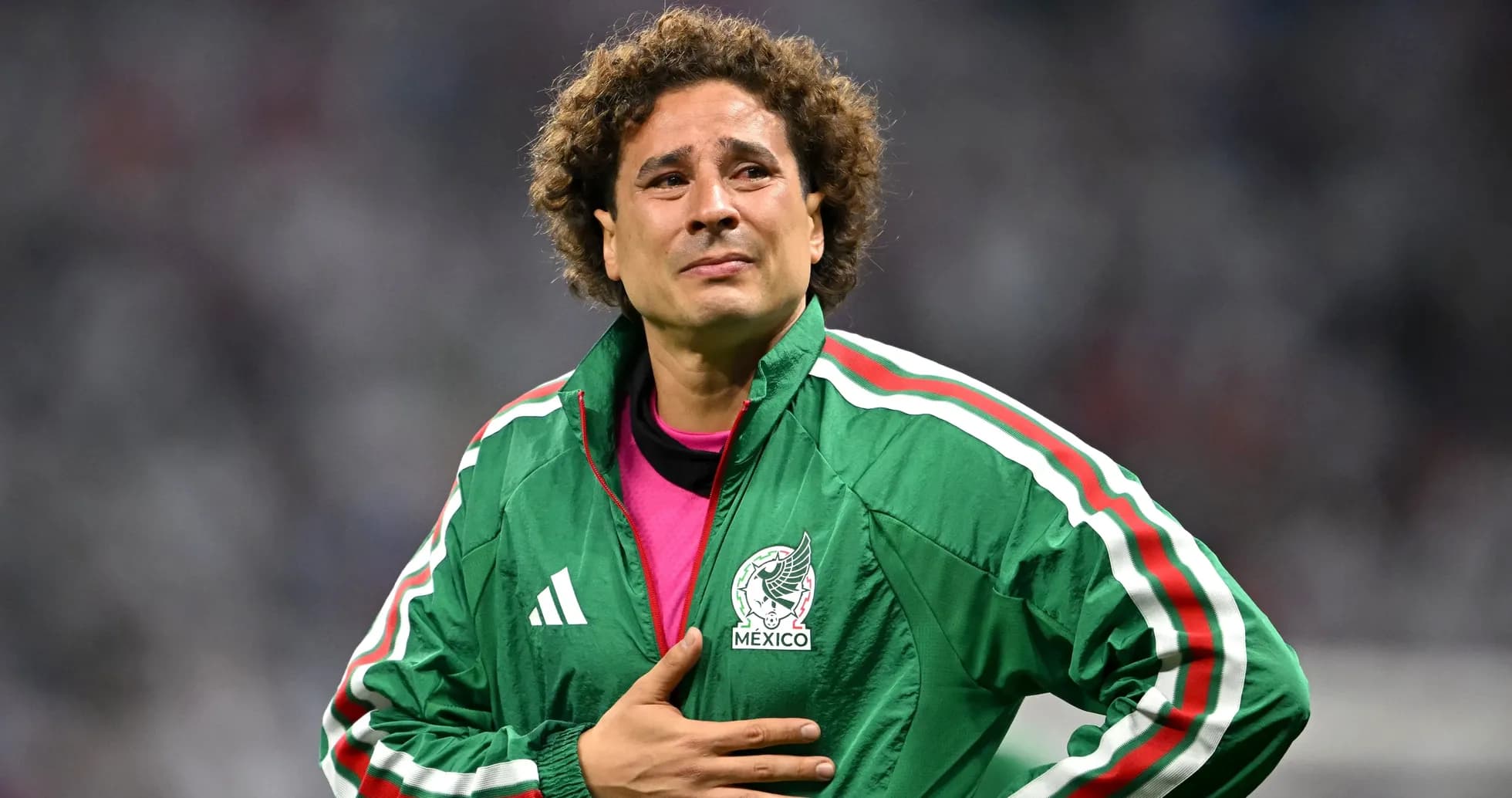
The roar told its own story. It was not a polite ovation. It was a release – of memories, of gratitude, of three generations who had grown up with the same man in goal.
When the whistle went, the theatre became a chapel. Ochoa walked to his posts, kissed them one by one, and then sank to his knees as teammates wrapped their arms around him. It happened on the same pitch where his career had started, under the same towering stands that had watched him grow.
Later, when the crowd had drifted away and the stadium lights began to soften, he returned alone to the centre circle. No speeches. No ceremony. Just a final, private look at the grass that had shaped his life.
From Mexico City to Europe’s fringes and back
The journey had begun in February 2004, when a young goalkeeper made his top-flight debut for Club América and immediately looked like he belonged. His reflexes were sharp, his positioning bold, his confidence obvious. Within a year, he had a league title – the 2005 Clausura – and a reputation as the next great Mexican No. 1.
Seven seasons with América turned promise into proof. Then came the leap. In 2011, Ochoa joined Ajaccio and wrote his name into history as the first Mexico-born goalkeeper to play in Europe. It was not the glamour move many had imagined, but it was a pioneering one. A keeper from Mexico, in Ligue 1, facing the likes of PSG and Marseille week after week.
That European chapter never followed a straight line. It twisted through Malaga and Granada, where he battled for minutes and respect, then on to Standard Liege, where he lifted the Belgian Cup. Later came Salernitana, AVS Futebol and AEL Limassol, a late-career tour that showed he was still willing to pack a suitcase and chase minutes rather than fade quietly at home.
Between those trips, he came back to where he was most adored. His three-year return to Club América from 2019 to 2022 felt less like a transfer and more like a homecoming. He did not need to prove anything by then, but he did anyway, reasserting his status as a club legend and a standard-bearer for Mexican goalkeeping.
Leaving with a full heart
As he reflected on a career that stretched from the youth fields of Mexico City to the biggest stages in world football, Ochoa chose gratitude over nostalgia. “I never imagined how far a dream could take me. Today, I can only look back with pride and say: Thank you,” he wrote. “I take with me the affection of millions and the peace of mind that comes with knowing I gave everything for Mexico.”
The medals do not tell the whole story, but they underline it: a league crown with América, a Belgian Cup with Standard Liege, and a World Cup record that places him alongside the game’s greatest names.
The gloves are off now. The posts he kissed at Azteca will welcome someone else. The question is no longer what Ochoa can still give Mexico, but how long it will take before the country truly realises what it had.