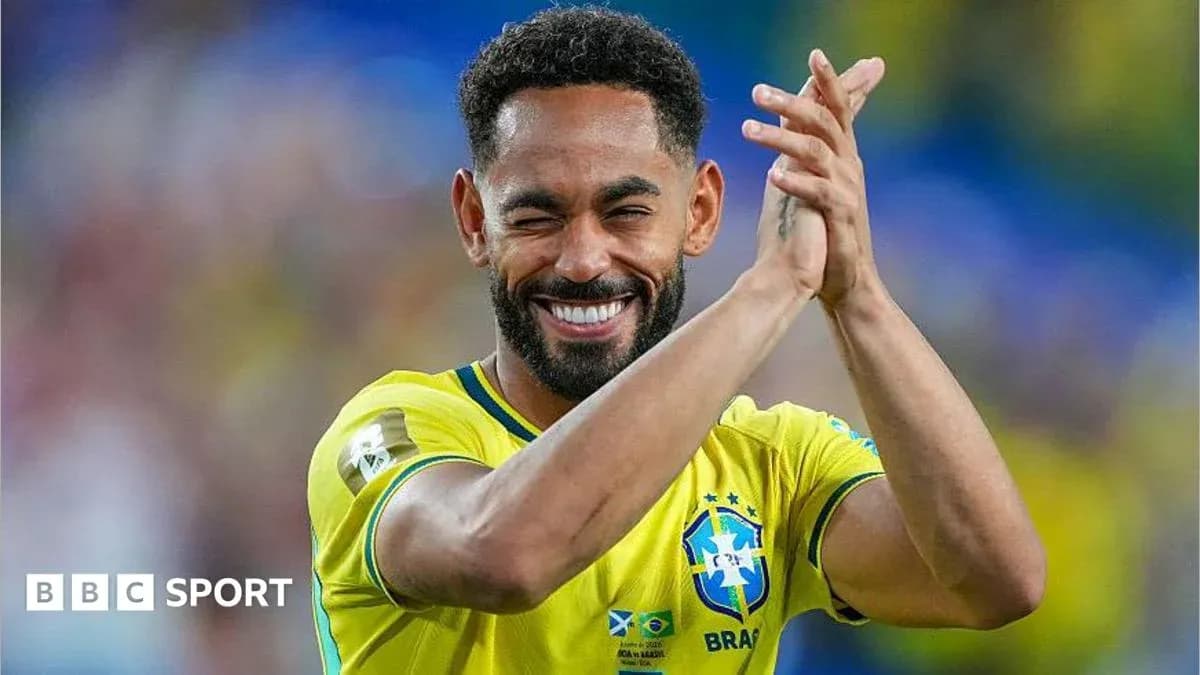
Brazil’s World Cup Evolution: Matheus Cunha Redefines No 9 Role
Brazil’s World Cup machine is starting to hum – and, crucially, so is its centre‑forward.
Carlo Ancelotti appears to have settled on his best XI, the pieces finally locking into place as the group stage has rolled on. Performances have sharpened, confidence has grown, and Brazil head into the last 32 with momentum and a clear identity. Japan, waiting in the knockouts, will test all of that.
At the heart of this new-look side stands Matheus Cunha, a striker who doesn’t quite fit the old Brazilian template but might just be redefining it.
A different kind of No 9
Brazilian fans are used to a certain silhouette leading the line: the classic No 9. Ronaldo. Adriano. Romario. A penalty-box predator, shoulders broad, stationed between the posts, living off service and half-chances.
Cunha is not that. He is something in between roles, a hybrid. A nine-and-a-half.
He can play as a conventional striker, occupy centre-backs, finish chances – his three goals at this tournament prove that – yet he also drifts into the pockets usually owned by a No 10. He links play, creates angles, knits attacks together. He is neither pure finisher nor pure playmaker, and that is exactly what makes him so awkward to contain.
In some movements he evokes Roberto Firmino, the former Liverpool forward whose intelligence without the ball was as important as anything he did with it. Cunha drops off the front line, asking questions of his marker. Follow him, and space opens for Vinicius Jr and Rayan to dart into. Leave him, and he turns, receives between the lines, and suddenly Brazil are playing in the most dangerous area of the pitch.
He embraces the ugly work too. Cunha starts the press, harries holding midfielders, and at times almost becomes a No 6 out of possession, screening passes into the middle. That defensive graft has helped tilt the whole structure of the side. Brazil’s attack looks more balanced, less predictable, and far harder to pin down.
From uncertainty to clarity up front
This clarity did not exist a few weeks ago. Brazil arrived at the World Cup with an almost unthinkable question mark: who is the starting No 9?
Even as late as the Scotland game in the group, the position felt up for grabs. Ancelotti had shuffled through options – Cunha, Igor Thiago, Endrick, Joao Pedro, Richarlison – searching for the right blend. There was no obvious heir to the famous shirt.
Then football’s old accomplice, injury, intervened.
Raphinha, a gifted, roaming attacker who had started the tournament as a No 10 behind Igor Thiago and can operate on either flank, damaged his hamstring against Morocco. On came Rayan, a more traditional wide player, someone who naturally holds his position on the right.
That single change altered the geometry of Brazil’s front line. With Vinicius stretching the left and Rayan pinning the right, the central corridor opened up. Cunha suddenly found himself with room to operate, isolated in the zones he loves. He could drift, drop, spin, and still know the wings were occupied and threatening.
The result has been a front three that looks tailored to his strengths. Igor Thiago still offers a more physical, penalty-box option if Brazil need to chase a game or bully centre-backs, but for now the public mood at home is shifting. More and more voices see Cunha as the answer.
Defenders know about him now. They know the patterns, the drops, the little feints. Stopping a player that clever is another matter.
Ancelotti’s trap-setting Brazil
Behind all of this sits Ancelotti’s quiet revolution.
His reputation has long been built on man-management, his ability to handle stars and keep dressing rooms calm. Yet this Brazil side showcases another side of him: the tactician who adapts without ego.
This team does not cling to the ball for the sake of it. There is no obsession with 70% possession and sterile dominance. Ancelotti is perfectly happy to hand opponents the ball and the illusion of control, then lure them into trouble.
Scotland felt that sting. Brazil allowed them to build, guided their passes into certain zones, then sprang forward with coordinated pressure. The first goal came from that approach; a second, disallowed in harsh fashion, followed the same script. Those were not accidents. Brazil had rehearsed that trap in warm-up games against Panama and Egypt, scoring similar goals.
They might not have had the ball, but they had the plan. They dictated where Scotland played, then hit at the exact moment the press was triggered. It was control of a different kind – territorial, psychological, tactical.
This is not a side defined by one rigid “identity”. It bends to the opponent and to the moment. With players intelligent enough to adapt, Ancelotti has chosen flexibility over dogma.
A new Brazil, with the handbrake on the flanks
The changes are just as striking at the back.
For the first time at a World Cup in decades, Brazil do not rely on flying full-backs to provide width and chaos. No Roberto Carlos or Cafu charging into the final third. No Maicon, Marcelo or Dani Alves tearing up the touchline and leaving huge spaces behind them.
Instead, Douglas Santos, Roger Ibanez or Danilo offer something more measured. Their runs are conservative, their starting positions a little deeper. That restraint has a purpose: it keeps the defensive block solid and allows Vinicius to stay higher, conserving his energy for the moments that matter in transition.
The back four looks secure. Just one goal conceded so far backs that up. The midfield, too, has been recalibrated.
In the opener against Morocco, Casemiro was left exposed, patrolling the middle almost alone in a 4-2-3-1 that often looked more like a 4-1-4-1. Criticism followed, but the problem was structural, not individual. At 34, he was never going to cover the entire width of the pitch on his own, flying into every duel.
Ancelotti reacted. Brazil shifted into a 4-3-3. Now, when Bruno Guimaraes pushes on, Lucas Paqueta drops in alongside Casemiro, forming a sturdier platform. The spaces that Morocco exploited have been closed down. Against Haiti and Scotland, the midfield looked far more controlled.
That tweak will matter even more against Japan, a side far more fluid and dangerous between the lines than either of those group opponents. Brazil know they cannot afford to leave Casemiro isolated again.
Belief, numbers and the road ahead
Seven goals scored, one conceded. A striker in form, a structure that finally makes sense, a coach reading the tournament with a veteran’s eye. The mood in Brazil has shifted with it.
Before the first game, anxiety. After it, genuine worry. Now, three matches later, the tone has changed. The public are smiling again, daring to believe that this “new Brazil” can go deep.
The tests will get harder. Japan will probe the spaces, run relentlessly, ask different questions. Opponents will have more video of Cunha, more data on Ancelotti’s traps, more ideas about how to break that compact midfield.
But Brazil arrive at the knockout stage with something they did not have at kick-off in the opening game: clarity. A centre-forward who fits the system. A system that fits the squad. And a manager unafraid to rip up the script of how Brazil are “supposed” to play.
For a nation that measures itself in World Cups, the question is simple now: is this evolution arriving just in time, or just a little too late?