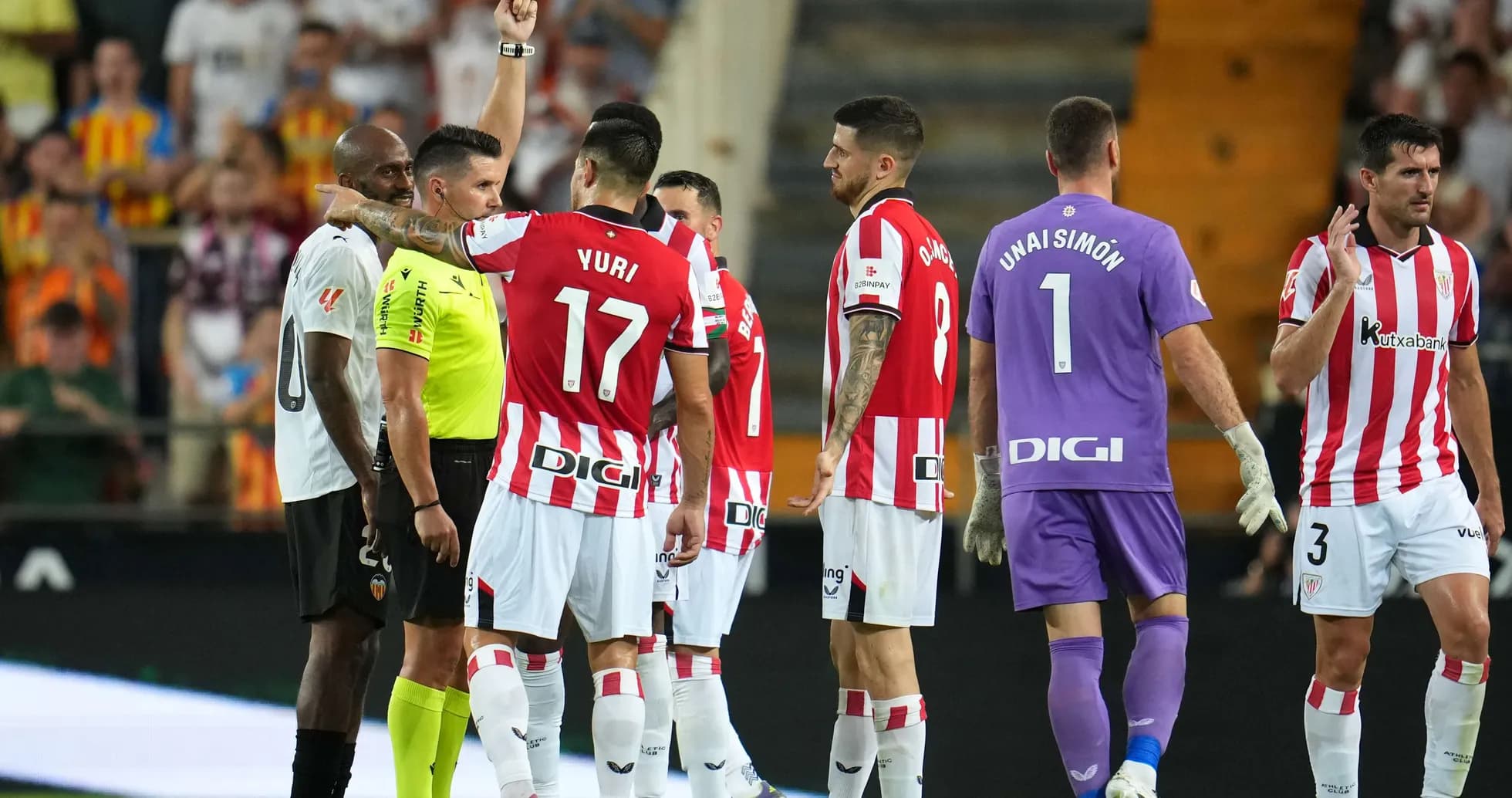
Athletic Club vs Valencia: Tactical Insights from La Liga's 1-0 Defeat
San Mamés has seen enough drama over the years to know that a 1-0 defeat can sometimes feel heavier than the scoreline suggests. Following this result, with Valencia escaping Bilbao with a 0-1 win, both sides remain locked in the mid-table trench warfare of La Liga’s Regular Season – Round 35, but the tactical stories beneath the surface are far richer than the bare numbers.
I. The Big Picture – Two 4-2-3-1s, Two Different Souls
Both coaches arrived with the same base shape on the teamsheet – 4-2-3-1 – but with very different intentions.
Ernesto Valverde’s Athletic Club leaned into their season-long identity: front-foot at home, aggressive in the press, and structurally loyal. Across the campaign they have used 4-2-3-1 in 34 of 35 league games, and their home record underlines why: at San Mamés they have won 9 of 18, drawing 2 and losing 7. Heading into this game, they were averaging 1.2 goals for at home and conceding 1.1, a narrow but positive edge that has underpinned a position in 9th with 44 points and a goal difference of -11 (40 scored, 51 conceded overall).
Carlos Corberan’s Valencia, by contrast, are the chameleons of this La Liga season. Overall they have deployed six different formations, with 4-4-2 their most common, but here they mirrored Athletic’s 4-2-3-1 and used it as a compact, counter-attacking shell. On their travels this season, Valencia have been conservative and often brittle: 4 wins, 4 draws and 10 defeats from 18 away games, scoring 15 and conceding 29, an away average of 0.8 goals for and 1.6 against. Yet in Bilbao, they bent but did not break, and found the one goal that mattered.
II. Tactical Voids – Who Was Missing, and What That Meant
Athletic came into the fixture with a notable hole in their midfield identity. Iñigo Ruiz de Galarreta, one of La Liga’s top yellow-card collectors with 10 bookings and a combative 58 tackles plus 4 blocked shots this season, was absent for personal reasons. His absence removed a key “tempo breaker” and ball-winner from the double pivot, leaving M. Jauregizar and A. Rego to anchor the midfield. Both are capable, but neither offers quite the same mix of aggression and passing security that Ruiz de Galarreta brings with his 1,117 passes and 82% accuracy.
Alongside him on the missing list were U. Egiluz (injury), B. Prados Diaz (knee injury) and M. Sannadi (coach’s decision). The cumulative effect was to thin Valverde’s options for rotating the engine room and for late-game tactical fouls or structural tweaks when chasing the match.
Valencia, meanwhile, were without a whole tier of defensive and midfield depth: L. Beltran (knee), J. Copete (ankle), M. Diakhaby (muscle), D. Foulquier (knee) and T. Rendall (muscle) were all ruled out. That forced Corberan to lean heavily on his starting back four and the double pivot of Pepelu and G. Rodriguez. The absence of Diakhaby and Copete in particular heightened the importance of C. Tarrega and E. Comert at centre-back, and of José Gayà as the experienced defensive leader on the left.
Disciplinarily, both teams carried baggage into this contest. Athletic’s season-long yellow-card distribution shows a pronounced spike between 61-75 minutes (22.37%) and another in the 46-60 window (18.42%), underlining how their intensity can tilt into rashness as the game opens up. Their red cards also cluster in the second half, with 28.57% between 61-75 minutes and another 14.29% in the 46-60 and 91-105 ranges. Valencia, for their part, accumulate yellows late: 23.19% between 76-90 minutes and 20.29% from 46-60, while their two reds this season have arrived early (50.00% in the 16-30 window and 50.00% in an unspecified range). This disciplinary profile framed a contest where the middle and late phases were always likely to be fractious.
III. Key Matchups – Hunter vs Shield, Engine Room vs Enforcer
With no top-scorers data available, the attacking “Hunter vs Shield” narrative had to be read from structure rather than names alone. For Athletic, G. Guruzeta led the line in front of a fluid three of N. Williams, O. Sancet and R. Navarro. The plan was clear: use Williams’ vertical threat from the left and Sancet’s half-space intelligence to pull Valencia’s back four apart, then feed Guruzeta in the box.
The “Shield” they faced was a Valencia defence that, across the season, has conceded 29 goals away and 50 overall, but which has also delivered 9 clean sheets, 5 of them on their travels. In Bilbao, the central duo of Tarrega and Comert, flanked by Renzo Saravia and Gayà, formed a narrow, compact line that funneled Athletic wide and trusted S. Dimitrievski’s positioning to deal with crosses. Gayà’s season profile – 67 tackles, 7 blocked shots, 22 interceptions – underlines how much defensive work he shoulders, and in this match he was again the hinge between back line and midfield, stepping out to confront N. Williams and doubling with L. Rioja when needed.
The “Engine Room” duel was even more decisive. Athletic’s Jauregizar–Rego axis had to cope with Pepelu and G. Rodriguez, with J. Guerra and D. Lopez floating ahead as Valencia’s interior threats. Pepelu, a metronome at the base, gave Valencia the calm they needed to play through the first line of Athletic’s press. Rodriguez’s more combative profile allowed Valencia to contest second balls and slow transitions, preventing Sancet from receiving on the half-turn between the lines as often as Valverde would have liked.
Higher up, Luis Rioja – one of La Liga’s top assist providers with 6 this season, 35 key passes and 60 dribble attempts (34 successful) – was Valencia’s primary creative outlet from the left. His duel with A. Gorosabel on Athletic’s right was a recurring theme: Rioja drifting inside to overload the half-space, Gayà overlapping, and H. Duro occupying the centre-backs. Every time Rioja received, Athletic’s defensive structure had to make a choice: step out and risk space behind, or hold and risk the cross or cut-back. In a game decided by a single goal, that constant probing from the left flank felt like a slow, tactical squeeze.
IV. Statistical Prognosis – xG Logic vs Scoreboard Reality
Even without explicit xG numbers, the season data offers a strong inferential lens. Heading into this game, Athletic’s overall goals for and against profile – 40 scored and 51 conceded in 35 matches, with averages of 1.1 goals for and 1.5 against – paints them as a side whose attacking volume at home often just about offsets a leaky defence. Valencia’s totals – 38 scored, 50 conceded, with 1.1 goals for and 1.4 against overall – suggest a team that lives on the knife-edge of low-scoring, marginal games, especially away where their 0.8 goals for points to a conservative, risk-averse approach.
On paper, then, the “expected” script at San Mamés was a tight contest with Athletic carrying slightly more attacking initiative, Valencia threatening in moments and the match tilting on small details: a transition, a set-piece, or a lapse in concentration. That is exactly how a 0-1 away win reads in the context of these numbers – not as a wild upset, but as the logical extreme of Valencia’s away blueprint: defend compactly, trust their clean-sheet capacity (5 away shutouts in total), and steal a single decisive moment.
Following this result, the table barely shifts in narrative terms – Athletic remain a volatile, high-effort side whose home advantage is real but not absolute, while Valencia consolidate their identity as stubborn travellers who can suffocate games and lean on the creativity of players like Luis Rioja and the leadership of José Gayà.
From a squad-analysis perspective, the lesson is clear. Athletic’s dependence on Ruiz de Galarreta’s control and bite in midfield was brutally exposed; without him, their 4-2-3-1 lost a layer of protection and progression. Valencia, despite a long injury list, showed that structural cohesion and a clearly defined defensive identity can outweigh individual absences. In a league where margins are thin and xG edges are often small, this match at San Mamés was a textbook case of tactical clarity trumping theoretical firepower.