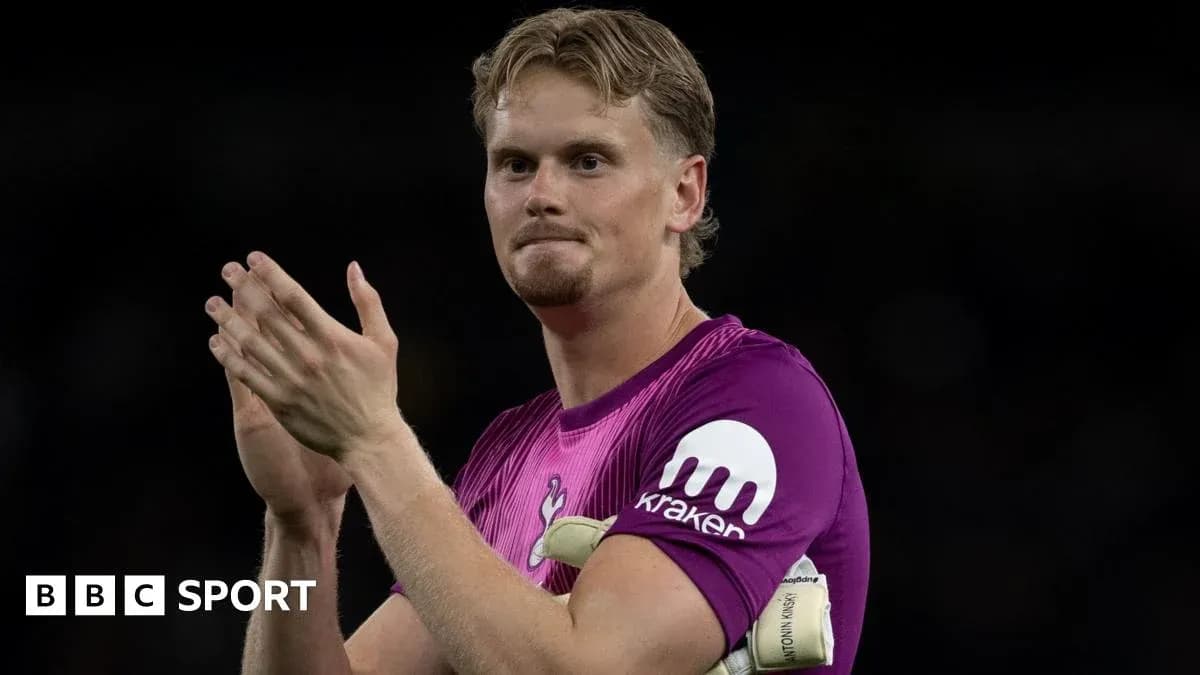
Antonin Kinsky's Redemption: From Madrid Nightmare to Spurs Hero
Two months ago, Antonin Kinsky walked off the pitch in Madrid looking like a man whose Tottenham career had just ended. On Monday night in north London, he walked around the same club’s home with his chest out, a grin carved across his face, and his name ringing around the stands.
Football doesn’t often hand out second chances this cleanly. When it does, you have to grab them with both hands. Kinsky did – quite literally.
From Madrid nightmare to Leeds defiance
That night at the Metropolitano felt terminal. Seventeen chaotic minutes in a Champions League last-16 tie against Atletico Madrid, three goals conceded, two slips, and the brutal hook from Igor Tudor. No arm around the shoulder. No consolation. Just a lonely walk past a furious away end and the sense that this was a young goalkeeper broken on the biggest stage.
The questions came quickly. Would he play for Spurs again? Should he?
He didn’t have to wait long for his answer. Guglielmo Vicario’s hernia surgery ripped up the goalkeeping pecking order and thrust the 23-year-old Czech back into the firing line at the most unforgiving time imaginable – a relegation battle.
On Monday, with Tottenham’s Premier League status on the line against Leeds United, Kinsky produced the kind of performance that can rewrite reputations.
Tel strikes, Calvert-Lewin punishes, tension rises
For a while, it looked like Spurs might spare themselves the late drama. Mathys Tel’s sharp finish five minutes after the break gave them the lead, a composed strike that briefly loosened the tension inside Tottenham Hotspur Stadium.
Then he undid his own work.
Midway through the second half, Tel’s high boot caught Ethan Ampadu in the box. No debate, no escape. Penalty. Dominic Calvert-Lewin stepped up, stayed calm, and drilled Leeds level. One-1, and the anxiety returned in waves.
The game broke open. Spurs, desperate to drag themselves clear of West Ham in the relegation scrap. Leeds, smelling the chance to land a heavy blow. Attacks came in flurries, mistakes lurked in every hurried pass, every loose touch.
Thirteen minutes of added time only stretched the nerves thinner.
The save that could define a season
Deep into stoppage time, the decisive moment arrived.
Leeds sliced Spurs open down the middle. James Justin slid Sean Longstaff through, and the midfielder drove into the box, angle tight but inviting. He went for power at the near post, trying to rip the roof off the net from close range.
This was it. Ninety-ninth minute. Season on a knife edge.
Kinsky exploded across his line, flung out a hand, and found just enough on the ball. Fingertips. Crossbar. Out.
Tottenham breathed again.
It was a stunning piece of goalkeeping – reflex, strength, and sheer refusal to be beaten. The ball cannoned away, the stadium erupted, and a goalkeeper once seen as a liability suddenly looked like the man keeping a club afloat.
Jamie Carragher did not hold back on Sky Sports, calling it “one of the saves of the season” and framing it as a moment that could yet keep Spurs in the Premier League. Coming from a former defender who has seen enough relegation fights up close, that carried weight.
Character under the floodlights
This was not a one-save cameo. Kinsky’s night had already been impressive before his stoppage-time heroics.
In the first half he produced a superb low stop from Joe Rodon’s close-range header, clawing the ball away right on the line. Throughout the match he looked assured with the ball at his feet, decisive in his positioning, and fully engaged in a contest that could easily have exposed any lingering scars from Madrid.
Phil McNulty, watching on at Tottenham Hotspur Stadium, noted the contrast. The same young goalkeeper who had trudged off in Spain to near-silence now heard his name echo around his home ground. That does not happen by accident. It comes from trust rebuilt in real time.
Matthew Upson, on BBC Radio 5 Live, captured the mood. Kinsky, he said, was “walking around the pitch with his chest out and with a massive smile on his face, and rightly so,” after a “massive game” in which he “made good decisions with the ball and made some fantastic saves.”
Five league starts since Vicario’s injury. One defeat, two wins, two draws. Only one clean sheet, but that hardly tells the story. The stop from Longstaff might end up mattering more than any shutout.
Spurs still in danger, but alive
The table still makes for uneasy reading. The 1-1 draw leaves Tottenham two points clear of West Ham in the relegation zone with two games left. Nothing is settled. Nothing is comfortable.
West Ham travel to Newcastle on Sunday, then host Leeds on the final day. Spurs go to Chelsea on 19 May before finishing at home to Everton. The margins are thin, the pressure suffocating.
Upson called it “100% a missed opportunity” for Spurs, arguing they could have put survival almost beyond West Ham’s reach with a win. He’s right. This was their chance to take control of their own fate and they let Leeds back in.
From the other side of London, the Irons will look at the fixture list and feel encouraged. They are “in touching distance,” as Upson put it, and the door remains ajar.
Yet Carragher pointed to the other side of the coin. Spurs will wake up, he said, feeling better about that point than they did at full-time. In a relegation fight, sometimes not losing is almost as important as winning, especially when defeat would have dragged you under.
The maths offers Tottenham a sliver of clarity. Four points from their final two games will be enough to guarantee survival, regardless of what West Ham do, thanks to Spurs’ superior goal difference.
Four points. Two games. One young goalkeeper who has already stared down his worst nightmare this season and come out swinging.
If Tottenham do stay up, they may look back on that 99th-minute leap, those fingertips on Longstaff’s shot, and recognise it for what it was: not just a save, but a turning point in a career, and perhaps in a club’s season.