Seattle Reign FC vs Washington Spirit W: Tactical Analysis of NWSL Group Stage Match
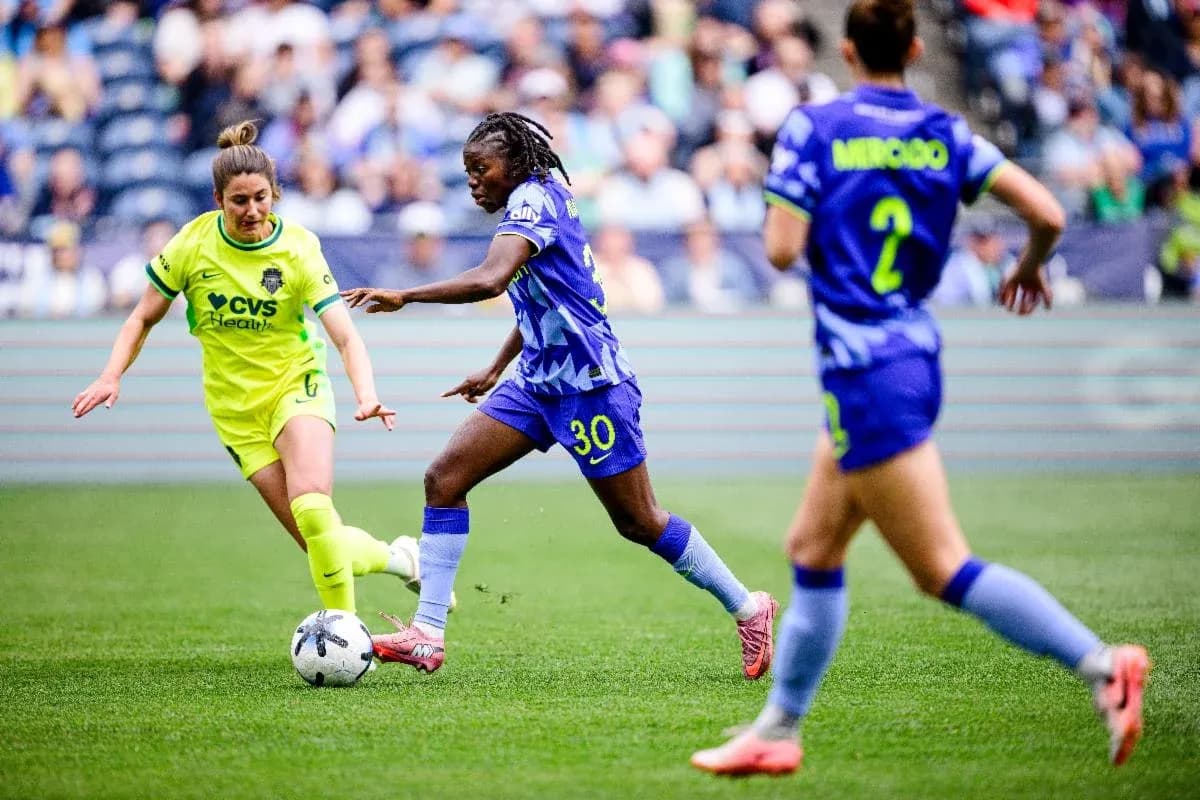
Under the Lumen Field lights, this Group Stage meeting in the NWSL Women between Seattle Reign FC and Washington Spirit W finished 0–1, a result that felt like a microcosm of where these two clubs stand in 2026.
Heading into this game, Seattle were 8th in the table with 11 points, their goal difference at -1 from 7 goals for and 8 against overall. Washington arrived as a side in full stride: 2nd place, 18 points, and a commanding overall goal difference of +9, built on 15 goals scored and just 6 conceded. The scoreline ultimately reflected that gap in efficiency and clarity of identity, even if the contest itself was tactically tight.
I. The Big Picture: Structures and Seasonal DNA
Laura Harvey set Seattle up in a 4-3-3, a shape they have used less frequently than their more common 4-2-3-1 this season. At home, Seattle had played 5 league matches heading into this fixture, with 2 wins, 1 draw, and 2 defeats, scoring 5 and conceding 5. The numbers tell a story of balance without bite: an average of 1.0 home goal for and 1.0 home goal against, but with 3 home matches where they failed to score at all.
That context framed the selection. C. Dickey anchored the side in goal behind a back four of S. Huerta, E. Mason, P. McClernon, and M. Curry. In midfield, A. McCammon, M. Mercado, and S. Meza were tasked with knitting play and protecting transitions, while a front line of N. Mondesir, M. Fishel, and M. Dahlien offered pace and vertical threat more than intricate combination play.
Across from them, Adrian Gonzalez’s Washington Spirit W stayed loyal to their season-long blueprint: a 4-2-3-1 that has started all 9 of their league fixtures. On their travels, Washington had been quietly ruthless heading into this game: 5 away matches, 3 wins, 2 draws, 0 defeats, with 9 goals scored and 4 conceded. That translates to 1.8 away goals for and 0.8 away goals against on average—title-contender numbers.
Sandy MacIver started in goal, shielded by a back four of G. Carle, E. Morgan, T. Rudd, and K. Wiesner. The double pivot of H. Hershfelt and R. Bernal provided the platform, freeing an aggressive line of three—R. Kouassi, L. Santos, and T. Rodman—behind central forward S. Cantore.
II. Tactical Voids and Discipline
There were no listed absences or questionable players, so both coaches had their full squads available, making the tactical decisions even more revealing. Harvey’s move to a 4-3-3 was an attempt to add stability against one of the league’s most balanced sides, but it also risked isolating her front three, especially given Seattle’s overall attacking record of just 7 goals in 8 matches (0.9 goals per game overall).
Disciplinary trends added another layer. Seattle’s season-long yellow card distribution shows a pronounced late-game edge: 27.27% of their yellows have arrived between 91–105 minutes, with additional spikes at 46–60 minutes (18.18%) and 76–90 minutes (18.18%). That profile hints at a team that often ends up chasing games, pressing higher and fouling more as fatigue and urgency rise.
Washington’s yellow cards, by contrast, cluster in regulation time but with a clear late tilt: 33.33% of their yellows come between 76–90 minutes, with 16.67% in each of the 0–15, 16–30, 31–45, and 61–75 windows. They rarely lose control, but their aggression ramps up in closing stages—often when they are protecting narrow leads, as they did here.
Neither side has missed a penalty this season because neither has taken one; both show 0 total penalties, 0 scored, 0 missed. That removed one potential high-variance factor from the tactical equation.
III. Key Matchups: Hunter vs Shield, Engine Room Battles
The headline duel was always going to be Washington’s attacking trio against Seattle’s defensive structure.
Hunter vs Shield
For Washington, the “hunter” role is shared. L. Santos, T. Rodman, and S. Cantore each came into this fixture with 3 league goals. Santos, with 3 goals and 1 assist, is the high-volume connector: 367 passes at 78% accuracy, 10 key passes, and 10 successful dribbles from 15 attempts. Rodman, also on 3 goals and 3 assists, adds directness—23 shots (12 on target) and 20 dribbles attempted—while Cantore’s 3 goals from 13 shots underline her penalty-box sharpness.
They were up against a Seattle back line that, at home, had conceded 5 goals in 5 matches (1.0 per game) but had also posted 2 home clean sheets. The defensive plan hinged on the full-backs. S. Huerta and M. Curry had to decide when to step to the ball-side 10 or winger—often Santos or Rodman—without exposing the channels to Cantore’s runs. With Seattle conceding 8 goals overall in 8 matches (1.0 per game) but struggling to control territory against high-functioning attacks, any hesitation was likely to be punished.
Engine Room
The midfield battle pitted Seattle’s trio—McCammon, Mercado, Meza—against Washington’s double pivot plus the roaming Santos and Kouassi. Kouassi, in particular, is the Spirit’s enforcer-playmaker hybrid: 3 assists, 20 key passes, 169 total passes at 79% accuracy, and 20 tackles with 5 interceptions. Her 112 duels with 57 won tell you she thrives in chaos, winning second balls and immediately turning them into attacking platforms.
For Seattle, the creative burden fell heavily on Mondesir. Across the season, she has 1 goal and 2 assists, with 9 key passes and 21 dribbles attempted. From the left of the front three, she needed to drop into half-spaces to overload Washington’s double pivot, giving McCammon and Mercado shorter options and trying to drag E. Morgan or G. Carle out of the back line.
On the other side, E. Morgan was a defensive cornerstone for Washington. Across 9 appearances and 731 minutes, she has made 15 tackles, 11 interceptions, and crucially blocked 8 shots—those are 8 successful interventions that directly shut down attempts on goal. Her duel with Fishel and the inside movements of Mondesir was central to Washington’s ability to keep Seattle scoreless.
IV. Statistical Prognosis and Tactical Verdict
Heading into this game, the raw numbers leaned heavily Washington’s way. Overall, the Spirit were averaging 1.7 goals for and conceding just 0.7 per match, with 5 clean sheets in 9 games. Seattle, by comparison, were at 0.9 goals for and 1.0 against overall, with 3 clean sheets but 5 matches where they failed to score.
Translate that into an Expected Goals-style outlook, and Washington’s consistent chance creation—embodied by Santos’s and Rodman’s shot and key pass volumes, plus Kouassi’s 20 key passes—suggests they were more likely to generate multiple high-quality opportunities. Seattle’s more modest attacking profile and high rate of failing to score indicated a narrower margin for error; they needed efficiency, set-piece threat, or transition moments to tilt the balance.
Following this result, the 0–1 away win fits the statistical and tactical script. Washington’s compact 4-2-3-1, anchored by MacIver and a disciplined back four led by Morgan, once again produced an away performance with control and resilience. Their late-game card spike hints at a familiar pattern: get ahead, then defend aggressively in the final quarter-hour.
Seattle, meanwhile, embodied their season-long tension: structurally solid enough to stay in the game, but lacking the sustained attacking fluency to break down one of the league’s most organised defensive units. The 4-3-3 gave them defensive cover but left their forwards starved of clean service against a side that concedes only 0.8 goals per game on their travels.
In narrative terms, this was the meeting of a team still searching for its attacking identity and another that already knows exactly what it is. The single-goal margin flatters Seattle’s resilience, but the broader tactical and statistical landscape underlines Washington Spirit W as a side built for the sharp end of the NWSL Women season.