Rayo Vallecano vs Girona: Tactical Analysis of 1-1 Draw
Rayo Vallecano’s 1-1 draw with Girona at Campo de Futbol de Vallecas unfolded as a territorial siege from the hosts against a compact, risk-managed visiting side. Inigo Perez’s 4-3-3 dominated the ball and territory, but Michel’s 4-2-3-1, reshaped through the second half, maximized moments rather than volume of attacks. The late exchange of goals — Alemao on 86' for Rayo and Cristhian Stuani at 90' for Girona — encapsulated a match where structural control and game-state management mattered as much as individual actions.
I. Executive Summary
Rayo Vallecano controlled possession (59% to Girona’s 41%) and volume (18 total shots to 9) but could not convert their structural superiority into a decisive advantage. Girona, with fewer attempts but similar efficiency on target (5 shots on goal each), leaned on compact spacing and late-game adjustments to steal a point. Both sides produced moderate xG — 1.09 for Rayo and 0.86 for Girona — mirroring the 1-1 outcome and underlining a contest defined more by tactical discipline than chaos.
II. Scoring Sequence & Disciplinary Log
The first half was tight and tactical, punctured only by a single booking: at 44', Pedro Díaz (Rayo Vallecano) received a Yellow Card — Foul, a reflection of Rayo’s aggressive attempt to disrupt Girona’s rare forays through midfield. The interval arrived at 0-0, consistent with the cautious balance of the opening period.
Early in the second half, Girona briefly thought they had a breakthrough platform: at 56', VAR intervened for a potential penalty, but a review concluded with “Penalty cancelled” against Álex Moreno, denying Girona a crucial set-piece opportunity and reinforcing the theme of marginal gains rather than clear dominance.
The disciplinary narrative resumed late. At 90+4', Cristhian Stuani (Girona) was shown a Yellow Card — Argument, an emotional response in a high-tension finale as Girona chased parity. No reds were issued. Final card count: Rayo Vallecano 1 yellow, Girona 1 yellow, total 2.
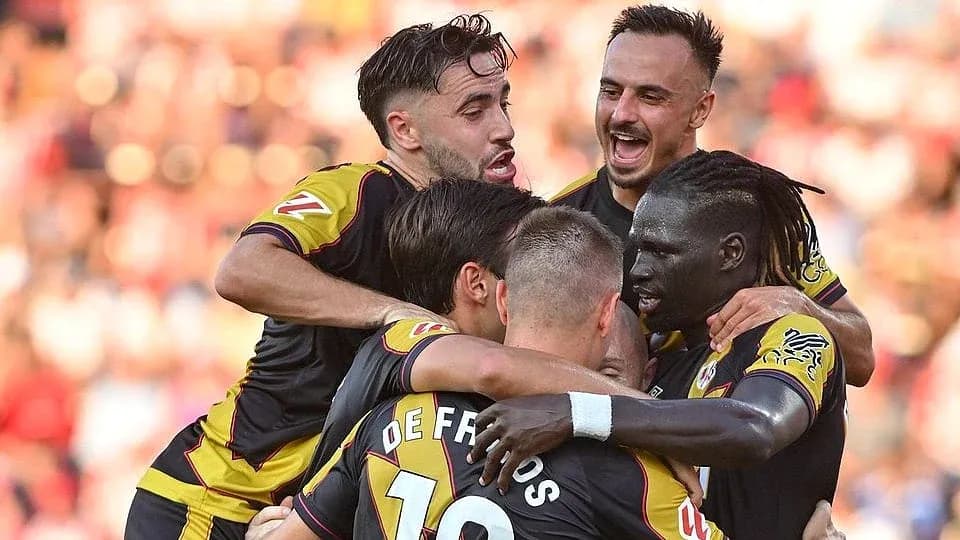
The goals arrived in the final minutes. On 86', Alemao (Rayo Vallecano) scored a Normal Goal, assisted by Unai López, rewarding sustained pressure and Perez’s attacking substitutions. Yet Girona struck back almost immediately: at 90', C. Stuani (Girona) converted a Normal Goal from a pass by Viktor Tsygankov, punishing Rayo’s late-game defensive management and ensuring the match finished 1-1.
III. Tactical Breakdown & Personnel
Rayo Vallecano set up in a 4-3-3 that was clearly designed to pin Girona deep and circulate patiently. The back four of A. Ratiu, P. Ciss, F. Lejeune and P. Chavarria pushed relatively high, enabling the midfield trio of Pedro Díaz, Óscar Valentín and Unai López to control central zones. With 486 total passes and 405 accurate (83%), Rayo’s structure emphasized short-to-medium circulation, using the full-backs and López as primary distributors.
The front three — J. de Frutos, Sergio Camello and F. Perez — worked to stretch Girona horizontally. De Frutos and F. Perez provided width, while Camello operated as a mobile reference between the lines. However, Girona’s double pivot of Axel Witsel and F. Beltran screened central access effectively in the first hour, forcing Rayo into a high volume of blocked shots (7) and attempts from outside the box (9 of 18 total).
Michel’s 4-2-3-1 had a clear defensive identity. The back four of A. Martinez, A. Frances, Vitor Reis and Álex Moreno stayed compact, with Witsel and Beltran protecting the half-spaces. Ahead, Tsygankov, Thomas Lemar and J. Roca supported Azzedine Ounahi, but the emphasis was more on defensive shape than sustained pressing. Girona’s 343 total passes with 271 accurate (79%) reflected a more selective use of possession, preferring to manage risk and wait for transitions or set-piece moments.
The substitution vector shifted the match’s dynamics. For Rayo, the double change on 58' — G. Gumbau (IN) came on for P. Diaz (OUT) and Alemao (IN) came on for F. Perez (OUT) — injected fresh energy and a more vertical threat. Gumbau’s left foot added range in distribution, while Alemao offered more direct penalty-area presence than F. Perez. On 68', Pacha (IN) came on for S. Camello (OUT) and C. Martin (IN) came on for J. de Frutos (OUT), effectively rebalancing the front line and maintaining intensity out wide. Finally, at 88', N. Mendy (IN) came on for U. Lopez (OUT), a move that slightly tilted Rayo towards protecting the lead and shoring up central spaces — a plan that ultimately failed to close out the game.
Girona’s changes were more about refreshing the attacking structure while keeping the defensive framework intact. At 60', C. Echeverri (IN) came on for T. Lemar (OUT) and I. Martin (IN) came on for A. Ounahi (OUT), reconfiguring the line of three behind the striker and adding more legs between lines. On 72', H. Rincon (IN) came on for A. Martinez (OUT), a defensive rotation to maintain intensity against Rayo’s wide pressure. The pivotal late move came on 85', when C. Stuani (IN) came on for F. Beltran (OUT). This sacrificed a holding midfielder for a pure penalty-box striker, signaling an all-in approach for the final minutes — and it paid off with Stuani’s 90' equalizer.
In goal, A. Batalla for Rayo and P. Gazzaniga for Girona both faced 5 shots on target. Rayo’s goalkeeper registered 3 saves; Girona’s 4. The goals prevented metric for each, at -0.15, indicates that both slightly underperformed relative to the xG of the shots they faced, consistent with each conceding once from moderate-quality chances.
IV. The Statistical Verdict
The statistical profile supports the narrative of Rayo as territorial aggressor and Girona as efficient opportunist. Rayo’s 18 total shots (5 on goal) against Girona’s 9 (also 5 on goal) underline the home side’s ability to generate volume, but the near-identical xG figures — 1.09 for Rayo, 0.86 for Girona — reveal that chance quality was relatively balanced. Girona’s lower shot count but similar accuracy and xG confirm that Michel’s team prioritized clearer looks rather than speculative attempts.
Rayo’s 59% possession and superior passing volume — 486 passes to Girona’s 343 — align with a game plan built on sustained pressure, territorial encroachment and repeated entries into the box (9 shots inside the area). Girona’s 41% possession and 5 corners to Rayo’s 9 reflect a side comfortable defending deep and countering selectively.
Discipline was minimal and controlled: Rayo Vallecano 1 yellow, Girona 1 yellow, total 2, with reasons explicitly tied to a Foul and an Argument, matching the game’s largely tactical, rather than emotional, tone. Ultimately, the 1-1 scoreline is consistent with the underlying metrics: Rayo’s structure and volume merited a goal, but Girona’s late attacking recalibration and the introduction of Stuani justified their equalizer, making the draw a numerically and tactically fair outcome.