Napoli vs Bologna Tactical Analysis: A 2-3 Away Victory
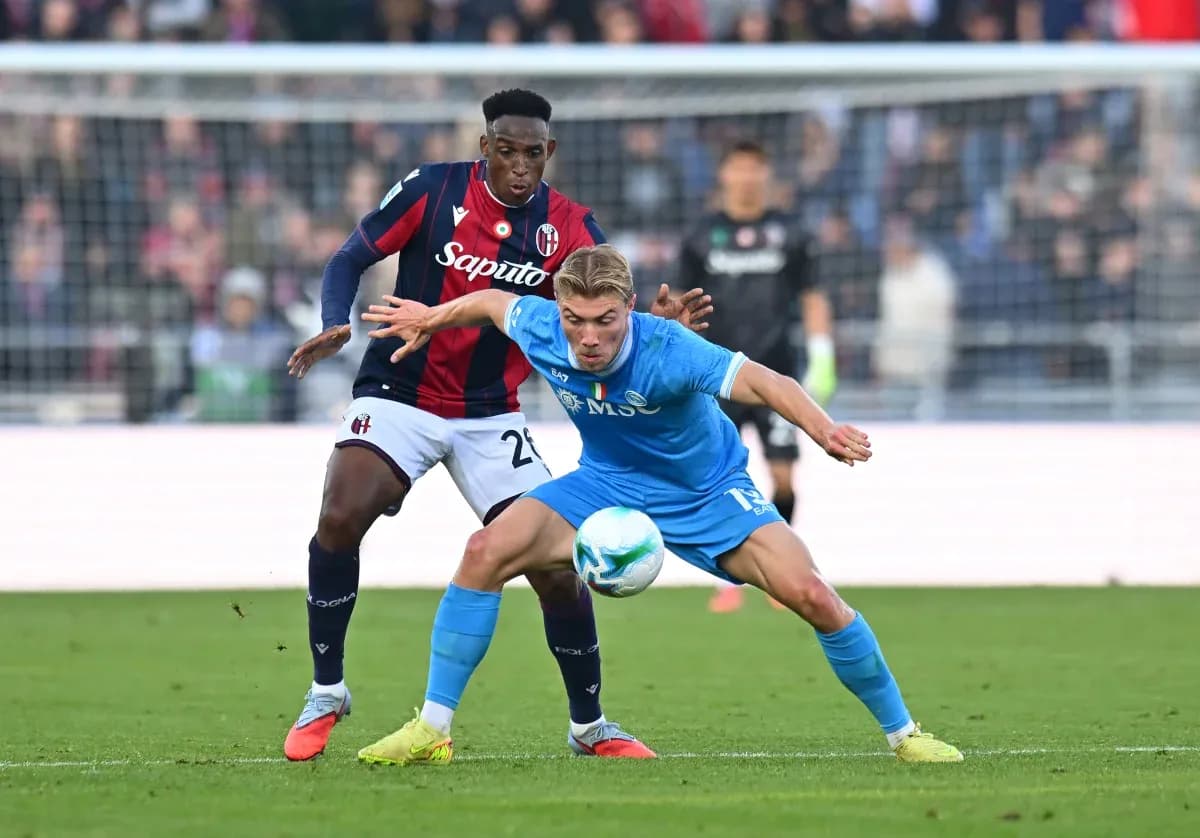
Napoli’s 3-4-2-1 against Bologna’s 4-3-3 produced a tactically complex contest at Stadio Diego Armando Maradona, ultimately tilting Bologna’s way in a 2-3 away win. Possession was almost even (52%–48%), but the game was defined by how efficiently Vincenzo Italiano’s side exploited transition moments and set the pressing traps for Antonio Conte’s build-up, rather than by volume of chances alone. The scoreline matched the underlying data: Bologna generated more threat (xG 1.32 to Napoli’s 0.75) despite taking fewer shots, and their structural balance without the ball proved decisive.
I. Executive Summary
Bologna struck first through Federico Bernardeschi and then via a penalty converted by Riccardo Orsolini, before Giovanni Di Lorenzo pulled one back to make it 1-2 at half-time. Napoli’s early second-half surge, capped by Alisson Santos’ equaliser, briefly suggested a Conte comeback, but the hosts never turned territorial control into sustained high-quality chances. Late on, Bologna’s bench made the difference: J. Rowe came on and delivered the decisive 90th-minute goal, punishing Napoli’s increasingly stretched rest defence. Discipline also played its part, with Bologna collecting four yellow cards to Napoli’s one, underlining how often the visitors had to foul to slow Napoli’s rhythm.
II. Scoring Sequence & Disciplinary Log
Goals (chronological, all verified against final score 2-3):
- 10' Federico Bernardeschi (Bologna) — assisted by J. Miranda Bologna’s left side overloaded Napoli’s right centre-back channel. J. Miranda advanced from full-back and delivered a measured ball into Bernardeschi, who exploited the inside-left pocket behind Matteo Politano to finish, exposing Napoli’s back three shifting too slowly across.
- 34' R. Orsolini (Bologna) — Penalty (no assist) Preceded at 33' by VAR: a “Penalty confirmed” decision involving Juan Miranda, this sequence highlighted Bologna’s willingness to attack the half-spaces. The confirmed spot kick allowed Orsolini to double the lead, with Napoli’s central block caught reacting late to a diagonal entry.
- 45' G. Di Lorenzo (Napoli) — (no assist) Di Lorenzo stepped aggressively into the right half-space, capitalising on a second ball after Napoli pinned Bologna deep. His goal, just before the interval, came from Conte’s wing-back and advanced centre-back rotations, finally breaking Bologna’s compact 4-5-1 defensive shell.
- 48' Alisson Santos (Napoli) — assisted by R. Hojlund Immediately after the restart, Napoli’s front three combined more vertically. R. Hojlund dropped off the last line to link play and slipped Alisson Santos into the channel, levelling at 2-2 and briefly validating Conte’s insistence on direct central connections.
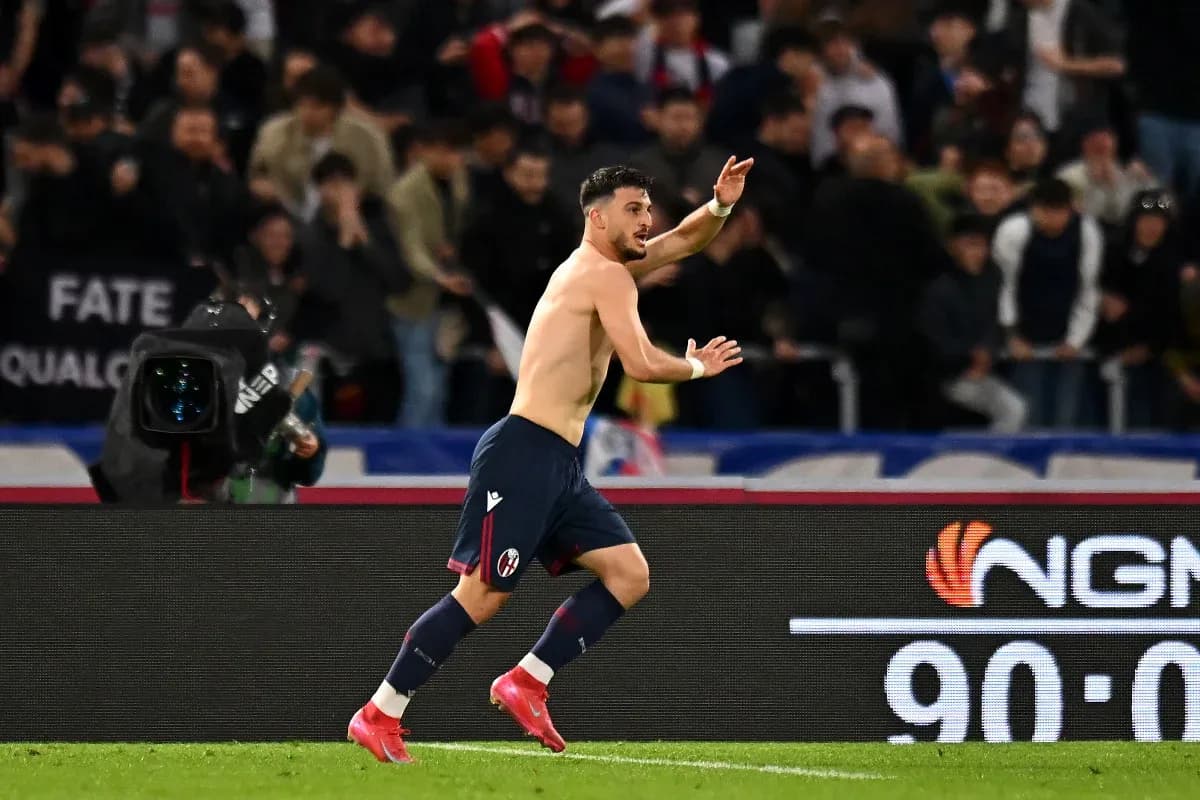
- 90' J. Rowe (Bologna) — (no assist) As Napoli pushed numbers forward, their 3-4-2-1 morphed into a de facto 3-1-6 in possession. Bologna broke from deep, and Rowe, operating from the right, attacked the space behind an advanced wing-back to restore the lead and seal the 2-3 away victory.
Disciplinary log (chronological, with exact reasons):
- 38' João Mário (Bologna) — Yellow Card — Foul
- 47' Federico Bernardeschi (Bologna) — Yellow Card — Foul
- 58' Eivind Helland (Bologna) — Yellow Card — Foul
- 69' Jhon Lucumí (Bologna) — Yellow Card — Foul
- 84' Matteo Politano (Napoli) — Yellow Card — Foul
Card totals: Napoli: 1, Bologna: 4, Total: 5.
III. Tactical Breakdown & Personnel
Conte’s 3-4-2-1 featured V. Milinkovic-Savic behind a back three of A. Buongiorno, A. Rrahmani and G. Di Lorenzo. M. Gutierrez and M. Politano operated as wing-backs, with S. Lobotka and S. McTominay central, and Giovane plus Alisson Santos supporting R. Hojlund. The idea was clear: three central defenders to control Bologna’s front three, with wing-backs pinning Bologna’s full-backs and two narrow attacking midfielders to overload the half-spaces.
Early on, however, Bologna’s 4-3-3 pressed asymmetrically. R. Orsolini and Bernardeschi narrowed onto Napoli’s wide centre-backs, while S. Castro sat on Lobotka’s line, forcing Milinkovic-Savic to build through the flanks. This pressure contributed to the 10' opener: Napoli’s right side (Di Lorenzo–Politano) was stretched, and the back three’s lateral cover was a fraction late, allowing Bernardeschi to attack the seam between Rrahmani and Politano.
In midfield, R. Freuler anchored a triangle with T. Pobega and L. Ferguson, forming a compact three that screened central passes into Hojlund’s feet. Bologna’s line of three stayed narrow, conceding width to Napoli’s wing-backs but protecting the zone in front of J. Lucumí and E. Fauske Helland. The penalty incident, confirmed by VAR at 33' and converted by Orsolini at 34', stemmed from Bologna’s willingness to run beyond Napoli’s midfield line, dragging the back three into uncomfortable recovery sprints.
Napoli’s response was to push Di Lorenzo more aggressively into midfield, effectively turning the shape into a 2-3-2-3 in possession, with Buongiorno and Rrahmani holding a very high line. Di Lorenzo’s 45' goal was the payoff: he arrived as an extra runner in the right half-space, untracked by Bologna’s midfield, to finish from a second phase.
The second half opened with Conte doubling down on verticality. Hojlund’s movement between the lines created the 48' equaliser, as he dropped to receive and immediately released Alisson Santos behind Bologna’s back four. At 2-2, Napoli’s structure looked more coherent: wing-backs high, dual 10s between the lines, and McTominay occasionally breaking into the box.
Substitutions then reshaped the game. For Bologna, N. Zortea (IN) came on for Joao Mario (OUT) at 64', adding fresher legs at right-back. Later, N. Moro (IN) for T. Pobega (OUT) and S. Sohm (IN) for L. Ferguson (OUT) at 81' re-energised the midfield screen, while T. Heggem (IN) for E. Fauske Helland (OUT) at 82' refreshed the back line. Crucially, J. Rowe (IN) replaced F. Bernardeschi (OUT) at 73', giving Bologna a more direct, transition-oriented wide threat, which ultimately decided the match.
Napoli’s changes came later: E. Elmas (IN) for Giovane (OUT) and B. Gilmour (IN) for S. Lobotka (OUT) at 76' shifted the midfield towards more ball progression but less defensive control. L. Spinazzola (IN) for M. Politano (OUT) at 85' and P. Mazzocchi (IN) for M. Gutierrez (OUT) at 87' meant both flanks were occupied by attack-minded full-backs, leaving McTominay often isolated in rest defence. That imbalance was exposed on Rowe’s 90' winner, as Bologna countered into the vacated wide channel.
In goal, V. Milinkovic-Savic made 1 save, with a goals prevented value of -0.82, indicating he conceded more than the shot quality suggested. On the opposite end, M. Pessina recorded 3 saves and the same -0.82 goals prevented, suggesting that while he was not overperforming his xG faced, Bologna’s defensive structure limited Napoli to low-quality looks.
IV. The Statistical Verdict
The numbers support the tactical story. Napoli’s 14 total shots to Bologna’s 10 and a 52% share of possession indicate territorial control, but their xG of 0.75 shows that Bologna largely pushed them into low-probability attempts, many from crowded central zones or wide angles. Bologna’s 1.32 xG from fewer shots reflects better shot selection, with the penalty and Rowe’s late chance both high-value opportunities.
Passing data underlines Napoli’s technical superiority in circulation: 484 passes, 425 accurate (88%), compared to Bologna’s 458 passes, 386 accurate (84%). Yet Bologna’s 12 Fouls and four yellow cards for Foul show a deliberate tactical edge: they disrupted Napoli’s rhythm at key moments, particularly when the hosts tried to accelerate through McTominay or the half-spaces.
Corner Kicks (7 for Napoli, 1 for Bologna) and Offsides (4 against Napoli, 0 against Bologna) further illustrate the pattern: Conte’s side camped higher and pushed the line, but often mistimed runs and failed to convert set-piece volume into clear chances. Bologna, by contrast, remained compact, chose their moments to break, and used their bench to tilt the final phases. In the end, the 2-3 scoreline aligned closely with both the xG profile and the tactical balance of the match.