Mexico's Tactical Mastery in 2-0 Victory Over South Africa
Mexico’s 2-0 win over South Africa at Estadio Azteca was a tactical demonstration of control, spacing, and game management, gradually amplified by numerical superiority. Javier Aguirre’s side imposed their structure from the opening minutes, using a 4-1-4-1 to dominate central zones and pin back Hugo Broos’s 5-3-2.
Mexico’s possession share of 61% was not sterile: it was built on a very clean passing platform — 520 passes, 467 accurate (90%) — and a clear positional framework. Erik Lira anchored in front of the back four, giving license to the advanced midfield line of Roberto Alvarado, Brian Gutiérrez, Álvaro Fidalgo, and Julián Quiñones to occupy and overload pockets between South Africa’s midfield and defence. Raúl Jiménez operated as a classic reference nine, constantly engaging the three central defenders to free the half-spaces.
South Africa’s 5-3-2 aimed for compactness, but it quickly became a reactive block. With only 335 passes (272 accurate, 81%) and just 39% of the ball, their structure was almost permanently in a low-to-mid block. Teboho Mokoena, Siphephelo Sithole, and Jayden Adams were tasked with screening central lanes, but Mexico’s numerical 4v3 in midfield — with Lira plus the advanced trio — forced them into lateral shifting, gradually stretching their compactness.
The opening goal at 9 minutes, Julián Quiñones finishing from an Erik Lira assist, encapsulated Mexico’s plan: win central control through Lira, then break South Africa’s lines with third-man movements from the advanced midfielders. Quiñones’s starting position as a nominal left-sided midfielder in the 4-1-4-1 was fluid; he frequently drifted inside, exploiting the space behind Jayden Adams and in front of the wide centre-back on that side. This forced South Africa’s wing-backs, especially Aubrey Modiba, into deeper starting positions, blunting any transitional threat.
Defensively, Mexico’s 4-1-4-1 morphed into a 4-5-1 without the ball, with Fidalgo and Alvarado tucking in to form a compact five across midfield. The front press was selective rather than frantic, designed to funnel South Africa’s build-up wide toward the wing-backs, then trap them. South Africa finished with only 3 total shots (2 on goal), underlining how effectively Mexico blocked central progression and limited Lyle Foster and Iqraam Rayners to sparse, low-quality touches in advanced areas. The xG numbers — 1.41 for Mexico versus 0.07 for South Africa — reinforce that South Africa never established consistent attacking patterns.
The match’s turning point structurally came at 49 minutes, when Siphephelo Sithole was sent off for a “Professional foul last man”. Reduced to ten, South Africa’s 5-3-2 effectively became a 5-2-2 or 5-2-1-1 depending on the phase, with the midfield line unable to cover the width Mexico generated. Broos responded with substitutions — Thalente Mbatha (IN) came on for Lyle Foster (OUT) at 56', and Themba Zwane (IN) came on for Jayden Adams (OUT) at 61' — in an attempt to regain some midfield ballast and ball security, but the numerical and territorial deficit remained.
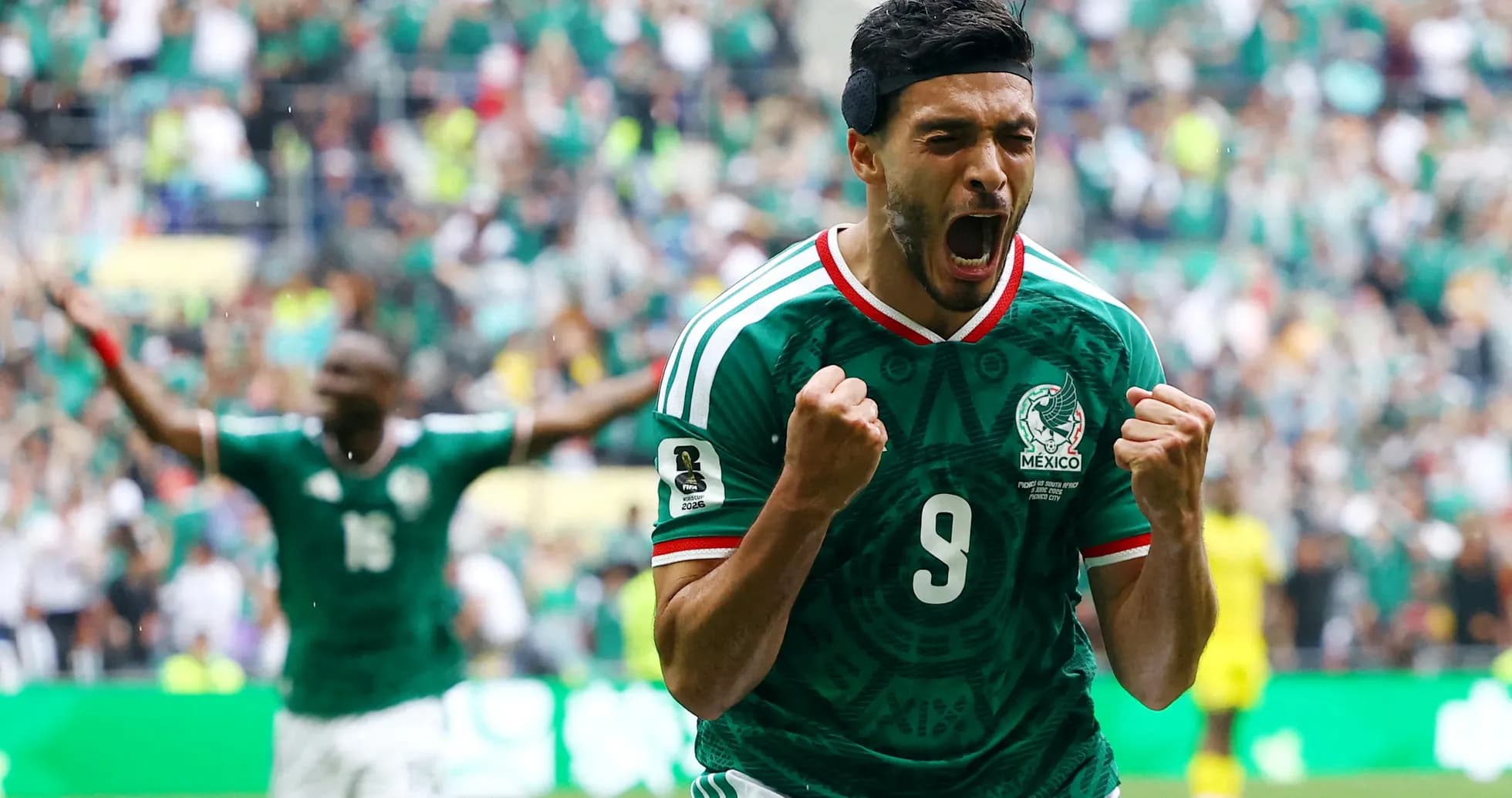
Aguirre’s in-game management was proactive and aimed at maintaining tempo and control rather than simply protecting the lead. At 66', Gilberto Mora (IN) came on for Álvaro Fidalgo (OUT), and Luis Chávez (IN) replaced Brian Gutiérrez (OUT), refreshing the interior lanes and keeping the passing quality high. The immediate payoff came at 67', when Raúl Jiménez struck Mexico’s second, assisted by Roberto Alvarado. Again, this came from structured occupation of the half-spaces and a well-timed vertical action into the box, exploiting South Africa’s stretched and undermanned midfield screen.
With a 2-0 lead and an extra player, Mexico continued to generate volume: 16 total shots, with 9 inside the box and 5 blocked, illustrating both their sustained pressure and South Africa’s desperate last-line defending. South Africa’s back five often ended up as a flat line, with limited support from the two remaining central midfielders, forcing last-ditch interventions rather than coordinated pressure.
Broos tried to introduce fresh legs and a different transitional threat: Oswin Appollis (IN) came on for Aubrey Modiba (OUT) at 77', and Evidence Makgopa (IN) replaced Iqraam Rayners (OUT) at the same minute. These changes hinted at a shift towards a more direct, counter-focused approach, but with only 1 shot inside the box and just a single corner, South Africa never translated these tweaks into sustained pressure.
Mexico’s later substitutions were oriented around game management and maintaining vertical threat. At 76', Armando González (IN) came on for Raúl Jiménez (OUT) and Edson Álvarez (IN) replaced Erik Lira (OUT), slightly stiffening the midfield base while preserving a focal point up front. At 79', Alexis Vega (IN) entered for Julián Quiñones (OUT), adding fresh pace on the flank for transition moments and to keep South Africa’s back line honest.
Discipline significantly shaped the final phase. South Africa accumulated two yellow cards and two red cards, including Nkosinathi Sibisi’s “Foul” caution at 74' and Themba Zwane’s dismissal for “Violent conduct” at 84', which had been preceded by a VAR “Card upgrade” review at 82'. Mexico themselves finished with one yellow and one red, with Césár Montes sent off at 90+2' for a “Professional foul last man”, preventing the match from tilting into a pure attack-versus-nine scenario for the closing minutes.
From a defensive perspective, Mexico’s control meant their back line was rarely exposed to sustained waves. The team recorded 12 fouls, a manageable figure given their territorial dominance, and conceded only 1 corner. Their structure in rest defence — with full-backs Israel Reyes and Jesús Gallardo staying connected to the centre-backs and the single pivot — was key in snuffing out South Africa’s rare counters before they developed into clear chances.
South Africa’s defensive metrics tell the story of a side under constant strain: 11 fouls, 2 red cards, and just 2 goalkeeper saves despite facing 4 shots on goal, a reflection of how many Mexican efforts were either blocked by defenders or missed the target. The negative goals prevented value for both teams indicates that, relative to the xG conceded, neither goalkeeper significantly outperformed expectation; the match was decided more by structural superiority and discipline than by goalkeeping heroics.
In sum, Mexico’s 4-1-4-1 delivered central dominance, clean progression, and controlled pressing, which, combined with South Africa’s indiscipline and limited attacking structure, produced a straightforward 2-0 outcome that aligned closely with the underlying numbers.