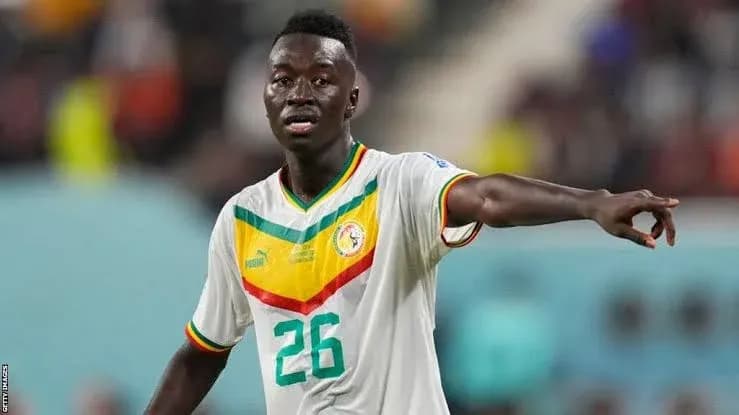
Gueye's Shocking Decision After Senegal's World Cup Exit
Senegal’s World Cup exit to Belgium was brutal enough. What followed from Pape Gueye turned it into a full-blown national shock.
Hours after the Lions of Teranga crashed out in a 3-2 extra-time defeat, Gueye announced he will no longer play for Senegal while the current coaching staff remains in charge. No press conference, no carefully worded statement. Just a stark Instagram story from a player who had been central to the campaign.
“I’ll be back to give you a few words regarding elimination… but I announce today that as long as it's this technical staff I’ll take a break from the selection,” he wrote.
In one post, a World Cup disappointment became a deep rupture between a key midfielder and the national setup.
From Cruise Control to Collapse
The context to Gueye’s outburst makes it even more incendiary.
Senegal were 2-0 up and seemingly coasting into a Round of 16 tie against the USA. Habib Diarra struck, Ismaila Sarr added another, and Pape Thiaw’s side looked in complete command. The African champions had Belgium on the ropes.
Then came the 64th minute.
Gueye, influential and experienced, was withdrawn for Lamine Camara. It was the first in a series of changes that drained Senegal of control and invited pressure. The mood shifted. So did the match.
Belgium sensed weakness. Romelu Lukaku pulled one back. Youri Tielemans found the equaliser in the final ten minutes. A 2-0 lead, shredded in the closing stages, sent the game to extra time and sent doubt rippling through a previously confident Senegal side.
The final blow arrived deep into extra time. In the 125th minute, after a VAR intervention, Tielemans stepped up and buried a penalty. From 2-0 up and dreaming of the last 16 to a 3-2 defeat and the exit door. A campaign that had promised a statement on the world stage ended in anguish.
Thiaw Under Fire
As soon as the whistle went, the inquest began. Thiaw’s substitutions, and in particular the decision to remove Gueye and other key figures while 2-0 ahead, came under immediate and fierce scrutiny.
The coach pushed back. He insisted this was not tactical self-sabotage, but a medical and physical necessity.
“They were tired and couldn’t continue. Leaving them on the field would have been unprofessional on our part. We had to replace them, like for like,” Thiaw said. “Of course, when you lose a match after leading 2-0, people inevitably talk about the substitutes. But you can't reduce everything to that. These changes were primarily dictated by fatigue, more than by tactical considerations.”
It was a logical explanation on paper. It did little to cool the anger outside the dressing room – or inside it, judging by Gueye’s reaction.
For a player of his stature to effectively go on strike from the national team, and to tie that decision explicitly to the “technical staff”, is a direct challenge to Thiaw’s authority and to the direction of the project.
A Team Already on the Edge
This is not a storm in isolation. Tension has been building around this Senegal side for months.
Thiaw was already a controversial figure after the Africa Cup of Nations final against Morocco. In that infamous night, he ordered his players off the pitch in protest at a refereeing decision. Senegal won the match on the field, but CAF later overturned the result and handed the title to Morocco.
That episode left scars. It raised questions about discipline, judgment and how far a coach should go in challenging authority. Those questions now resurface, sharpened by the World Cup collapse and Gueye’s rebellion.
Against Belgium, the pattern was different but the theme familiar: a team unable to manage the decisive moments, a bench under suspicion, a coach defending his choices against a rising tide of criticism.
“We just lost a match that was really important to us. We wanted to qualify for the Senegalese people, we thought we deserved it, but unfortunately, we are eliminated,” Thiaw said after the defeat. “I am sad, the players are sad too, because they really wanted this qualification.”
Sadness, though, is only part of the story. There is also anger, fracture, and a sense that something more profound is at stake than a single knockout tie.
A Rift That Won’t Quietly Disappear
Gueye has not retired from international football. He has drawn a line in the sand: no more call-ups while this staff remains.
For Senegal, that is a serious problem. This is not a fringe player or a fading veteran. This is one of the pillars of their recent success, a figure whose presence on the pitch and in the dressing room carries weight.
The federation now faces a stark dilemma. Back the coach and risk deepening the rift with a key player, or move in a different direction to preserve harmony and experience in a squad built to compete at the highest level.
The World Cup exit to Belgium hurt. Gueye’s declaration turns that pain into a crossroads. Where Senegal go next will define not just the fallout from this tournament, but the shape of the next cycle for a team that was supposed to be entering its prime.