England's Flawed Victory Over Croatia: A Defensive Dilemma
The scoreline will live happily enough in the record books: England 4-2 Croatia. Six goals, attacking verve, impact off the bench. On the surface, the kind of World Cup opener that settles a nation’s nerves.
Look a little closer and it tells a more complicated story.
Defensive cracks under the spotlight
Wayne Rooney saw it straight away. England’s first concession wasn’t a wonder goal, it was an avoidable mess.
“We could do so much better with the first goal,” the former England striker said, dissecting the sequence. Jude Bellingham, usually the heartbeat of England’s intensity, was “a bit flat-footed” as the challenge came in. John Stones, back in the side and trusted to build from deep, went to ground when he didn’t need to. Jordan Pickford, Rooney felt, gambled when the situation didn’t demand it.
“There’s no real danger and Pickford is in a good position, but he doesn’t stay on his feet,” Rooney argued. Once the goalkeeper committed, Nico O’Reilly was dragged across, Croatia worked the ball neatly, a sharp cut-back, a clean finish. From a Croatian perspective, it was a slick move. From England’s, it was a chain of small errors.
Rooney, ever demanding of goalkeepers, didn’t let Pickford off easily. The Everton man got a strong hand to the shot. “If Jordan is getting a hand on it like he does then he’ll be disappointed,” Rooney said. A reminder that even in a 4-2 win, the margins at this level are brutal.
Micah Richards went wider, seeing a pattern rather than an isolated lapse. Both Croatia goals, he argued, “could have been avoided”.
“What England did was played into their hands and allowed them to get their technical players on the ball and do what they wanted to do,” the former defender said. England had the legs, the running power, the energy. They just didn’t use it in the right areas often enough.
“If you get ten or fifteen yards further forward, you don’t even get into those situations,” Richards insisted. Push up, squeeze, suffocate. England had the tools to do it, but Croatia were allowed too many comfortable touches in dangerous zones. The win came, but the warning lights flashed.
Stones, Konsa and a question for Tuchel
At the heart of that defensive debate sits Thomas Tuchel’s centre-back pairing. John Stones and Ezri Konsa were given the nod, a combination of a ball-playing veteran and a trusted lieutenant from Tuchel’s time in charge.
It didn’t look settled.
Stones, short of minutes at Manchester City last season, saw plenty of the ball. He took responsibility, stepped out, tried to dictate England’s build-up. That is his game, and Tuchel clearly wants that kind of control from the back. It comes with risk. At times, Croatia pressed him into uncomfortable positions, and the assurance he shows at club level wasn’t always there.
Konsa, so often the picture of composure under Tuchel, showed glimpses of that calm. A well-timed interception here, a measured pass there. But next to Stones, in this new partnership, he looked short of rhythm. The understanding wasn’t quite there, the line not always in sync.
Two first-half goals conceded will sharpen the focus. Tuchel now faces the first big selection question of England’s campaign: does he stick with Stones and Konsa for Ghana, backing them to grow into the tournament, or does he turn to Marc Guehi to steady the back line?
Rip it up after one game and you risk panic. Leave it untouched and you gamble on lessons being learned quickly. Tuchel’s answer will say a lot about how he sees this team’s identity.
Gordon’s grounding and England’s collective edge
Amid the defensive scrutiny, Anthony Gordon’s night cut through with a different tone entirely.
“It has been a crazy couple of weeks and that just topped it off,” the forward told BBC Radio 5 Live after making his World Cup debut. A first game on this stage, the realisation of a childhood dream. He allowed himself to feel the moment, but only briefly.
“Special, but it is not about me. Self-centredness is a disease and I don’t want to be a part of that,” he said. No slogans, just a clear stance. For Gordon, this is about the collective.
He pointed to Marcus Rashford, Bukayo Saka and Morgan Rogers as proof. All came on, all made an impact. “It is about the team. Rashy came on and made an impact, Bukayo and Morgan. It is a collective.”
Gordon didn’t pretend the night was straightforward. “A difficult first half – their goal came from nowhere and stunned us a little bit,” he admitted. The response, though, pleased him. England emerged after the break with a different edge, pressed higher, attacked with purpose, and “got what we wanted”.
“They were really good and that can’t be underestimated when you look at the game,” he said of Croatia. No glossing over the quality of the opposition, no pretending the problems didn’t exist. Just a young forward speaking like a seasoned pro.
Rashford’s reminder and a club future in limbo
For Rashford, this was more than just another England cameo. It was a timely reminder.
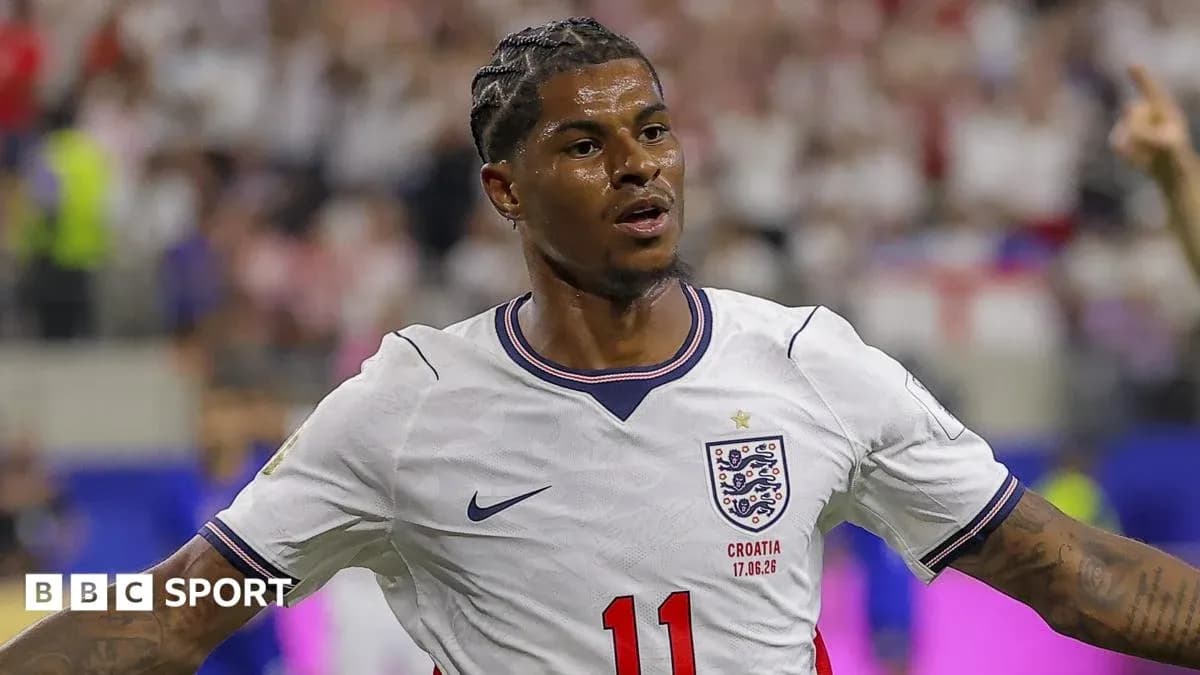
He came off the bench, scored, and brought a sharpness that changed the feel of the contest. Direct running, cleaner touches, a goal that underlined why elite clubs still circle when his name appears on a team sheet.
On 1 July, he reverts to being a Manchester United player. Barcelona have chosen not to trigger a £26m clause to buy the 28-year-old after his loan spell. United’s stance is clear: they want £40m for a player with two years left on a £325,000-a-week contract. They will not entertain another loan to Barcelona, no matter how much the La Liga side push.
Rashford holds a different kind of power. United cannot force him into a move he does not want, and his salary instantly narrows the market. Only a handful of clubs can even begin to talk in those numbers.
As it stands, United expect him back after his mandatory three-week post-World Cup break, just in time for a training camp in the Republic of Ireland. That is the plan on paper. Reality in the transfer window rarely stays still for long.
For now, performances like this matter. They shape perception. They influence boardrooms. They remind everyone – United, Barcelona, any potential suitors – what Rashford can still do on big nights.
England walk away from this 4-2 win with three points, four goals and a sense of momentum. They also leave with questions at the back, a selection dilemma brewing, and a forward rediscovering his edge while his club future hangs in the balance.
This was not a polished statement of dominance. It was something more honest: a thrilling, flawed opening that leaves Tuchel with work to do and a squad that knows it can cut loose – but must learn how to lock the door.