Deschamps' Legacy Ends with World Cup Defeat to Spain
ARLINGTON, Texas — The end came quietly for France, which somehow made it worse.
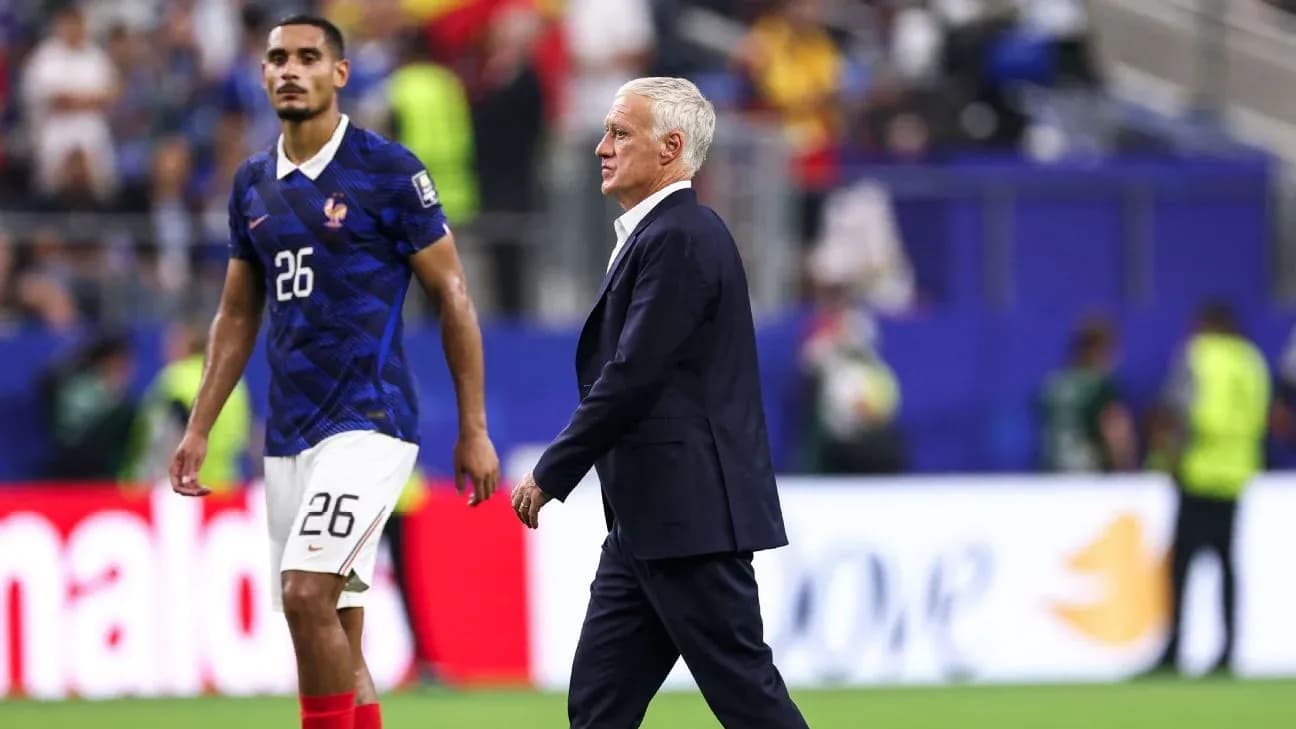
For a month they had carried the weight of favorites with the casual arrogance of a team that knew it was better than everyone else. They had not trailed once at this World Cup. Then Spain walked into Jerry Jones’ vast arena, scored first, and never let them up for air. A 2-0 defeat, comprehensive and cold, sent Les Bleus home and closed the book on the Didier Deschamps era.
Fourteen years. One hundred eighty-four games. Three major finals and a UEFA Nations League title.
It ended not with a furious last stand, but with a whimper.
Deschamps’ last stand falls flat
Spain didn’t spring a surprise. Luis de la Fuente’s team did exactly what they’ve done to France twice in the last three years: they took the ball, kept it, and squeezed the life out of Deschamps’ plan.
This was their third straight victory over him — the Euro 2024 semifinal, the wild 5-4 Nations League game in 2025 when Spain were 5-1 up at one stage, and now this World Cup semifinal. Three meetings, three lessons. Deschamps never seemed to learn any of them.
The pattern was obvious before a ball was kicked. Spain would dominate possession, circulate the ball, drag opponents out of position, and wait for the gaps to appear. The question was whether France would bend to that reality: add an extra midfielder, adjust the press, tweak the structure to avoid the two-versus-three in the middle that Kylian Mbappé had already flagged.
Deschamps refused. He backed his stars, stuck with his front four, and trusted that talent would bend the game his way.
It didn’t. It barely registered.
For 64 minutes, that vaunted attack produced 0.04 expected goals. That number is not just low. It’s an indictment. For a side this stacked — from back to front, arguably the most gifted squad at the tournament — it spoke of something deeper than a bad day. It spoke of a plan that never existed.
Spain took away the two things elite attackers need to matter: the ball and space. They owned possession and pressed high, shutting down passing lanes and denying runs in behind. Stripped of those conditions, France’s forwards looked ordinary. Michael Olise, so often a difference-maker, became a ghost in blue. On this stage, he was only marginally more effective than a sitcom boss with the same first name.
When that happens, when the game state screams for change, the best managers adapt. Deschamps never has. Not really.
His substitutions followed the same script. Manu Koné for Adrien Rabiot, Désiré Doué for Bradley Barcola. Logical, tidy, and utterly predictable. They felt less like bold moves than like what your phone suggests you type next. On a good night, that kind of continuity keeps a team calm and coherent. On a night like this, it only dragged out the suffering.
His loyalty has always been a double-edged sword. Rabiot, again, was central to his thinking. Olise stayed on through a nightmare. The very principles that brought Deschamps unprecedented longevity and success with France — trust the group, keep it simple, let the stars decide it — finally turned on him when he had his most gifted squad.
A glittering legacy, a brutal exit
Strip away the emotion of a semifinal collapse and the résumé remains extraordinary. Deschamps won the World Cup as a player in 1998 alongside Zinedine Zidane, Patrick Vieira and Thierry Henry. He then lifted it as a coach in 2018 and came within a Randal Kolo Muani finish — one moment, one chance — of becoming only the second man to win two World Cups from the dugout.
He reached another World Cup final in 2022, a European Championship final, and added the Nations League. He built a culture where egos were managed, the dressing room rarely exploded, and the tactical framework was simple enough to let superior talent decide tight games in a low-scoring sport.
There is a logic to that approach. In international football, you don’t have the time to drill intricate patterns or reinvent systems every month. Overcomplicate things and you risk confusion, paralysis, players thinking instead of playing.
But that logic only holds if your opponent doesn’t outnumber you in key zones, doesn’t suffocate your buildup, doesn’t turn your own strengths into weaknesses. Spain did all of that. They denied the ball, denied the space, and forced France into a slow, predictable rhythm. Deschamps’ refusal to bend, to sacrifice a little stardust for balance, left his team stuck between identities: too open to control the game, too blunt to threaten it.
The most damning part? You could see it coming.
Enter Zidane, with questions attached
So now, inevitably, the conversation swings to Zidane.
For years, his name has hovered over the France job like a promise. Three Champions League titles with Real Madrid. Two LaLiga crowns. A legend as a player, a proven winner as a coach, and a man who has never hidden his bond with the national team.
On paper, it looks irresistible. Then you look closer.
Zidane has not worked for five years. His last trophy came in 2020. His only job in management has been at Real Madrid, a club that operates on its own planet. At the Bernabéu, he dealt with superstars every day, could shape them on the training ground, and could lean on a recruitment machine that simply went out and bought someone else when a player no longer fit.
None of those luxuries exist in international football. You don’t get daily training. You don’t get a transfer window. You get what your country produces, and you make it work in short bursts under extreme pressure.
Zidane built his Madrid sides on clarity and man-management more than complex tactical schemes. That will sound familiar to anyone who has watched Deschamps over the last decade. They were teammates with France and Juventus, cut from similar cloth in terms of footballing education and dressing-room authority.
So the temptation is to assume that France will simply swap one minimalist for another. Same philosophy, different face.
That might not be a bad thing. Deschamps’ reign, for all its flaws, delivered more than almost any of his peers. But the lesson from this World Cup, and from Spain’s repeated dismantling of France, is that the next man cannot treat tactics as an afterthought. Not with this generation. Not against opponents this sophisticated.
Balance matters. So does the understanding that the other team is not a backdrop for your stars, but a problem to be solved. Sometimes you have to accept that less is more, that sacrificing one attacker for an extra midfielder or a different pressing structure is not a betrayal of talent, but a way of unleashing it.
Zidane knows this on some level. He won a World Cup with Stéphane Guivarc’h as his centre-forward. That France side thrived on structure, on collective effort, on the understanding that individual genius works best inside a coherent frame. Deschamps was on that team too. The irony is hard to miss.
The standard, and the challenge
If Zidane takes the job, he inherits a squad that most international coaches can only dream of. The attacking depth is absurd. The talent pipeline shows no sign of drying up. He will walk into a group that has already tasted glory, heartbreak and everything in between.
He has had years to watch this team from the outside, to study its patterns, its strengths and its blind spots. He will know, better than most, that this World Cup did not expose a lack of ability, but a lack of adaptation.
The bar is brutally clear. Match Deschamps’ achievements, and you are a success. Surpass them, and you reshape the history of French football.
The question now is simple, and unforgiving: with this much talent at his disposal, can Zidane move faster along the learning curve than the man he replaces?