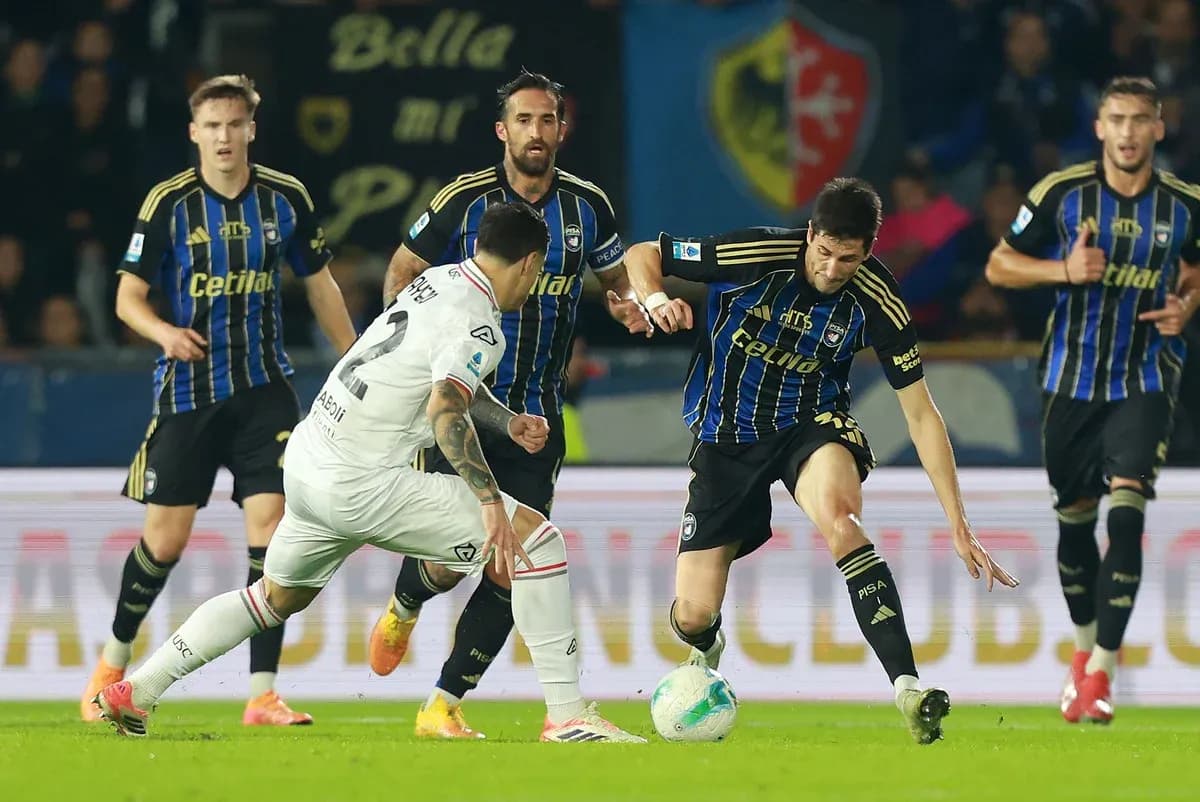
Cremonese vs Pisa: Tactical Analysis of a Crucial Serie A Clash
On a tense afternoon at Stadio Giovanni Zini, two relegation-trapped sides met with nothing left to hide. Cremonese against Pisa was less a tactical chess match and more a referendum on who could still impose an identity after a long, punishing Serie A season. Following this result, the table tells its own brutal truth: Cremonese sit 18th on 31 points with a goal difference of -23 (30 scored, 53 conceded), Pisa 20th on 18 points with a goal difference of -41 (25 scored, 66 conceded). Yet the 3-0 scoreline here suggests that, structurally, only one of these squads still has a coherent way forward.
Marco Giampaolo’s decision to lean into a 4-4-2, rather than his more habitual three-at-the-back shapes, was the first major storyline. Across the season, Cremonese have most often lined up in a 3-5-2 (24 times), with 4-4-2 used just 5 times heading into this game. Here, the flat back four of G. Pezzella, S. Luperto, M. Bianchetti and F. Terracciano gave E. Audero a cleaner defensive picture, while the wide midfield of J. Vandeputte and T. Barbieri stretched Pisa’s wing-backs and pinned them deeper than Oscar Hiljemark would have liked.
Opposite him, Hiljemark doubled down on Pisa’s three-centre-back identity, deploying a 3-4-2-1 that has been one of their core blueprints this season (they have used 3-4-2-1 in 12 league matches, alongside 19 with 3-5-2). On paper, the structure offered defensive security; in practice, it amplified their season-long fragility on their travels. Away from home, Pisa have conceded 43 goals in 18 matches, an average of 2.4 per game, and that vulnerability reappeared in Cremona as the back three of R. Bozhinov, A. Caracciolo and S. Canestrelli were repeatedly dragged into wide channels and exposed.
The tactical voids created by absences only sharpened the contrast. Cremonese were without F. Baschirotto (thigh injury), R. Floriani and F. Moumbagna (both muscle injuries), plus M. Payero (knock). Giampaolo therefore leaned heavily on his established spine: Audero in goal, Bianchetti–Luperto at centre-back, A. Grassi and Y. Maleh in central midfield, with F. Bonazzoli and J. Vardy up front. Pisa, for their part, missed F. Coppola, D. Denoon, C. Stengs and M. Tramoni, stripping Hiljemark of rotation options and some creative variety between the lines.
Discipline has been a season-long subplot for both clubs, and it framed the emotional tone of this contest. Cremonese, heading into this game, showed a clear pattern of late-game agitation: 27.27% of their yellow cards arrive between 76-90 minutes, and their red-card profile is unusual, with 66.67% of reds coming in the 91-105 minute window. Pisa mirror that late volatility, with 25.33% of their yellows also landing in the 76-90 stretch and a red-card spread that includes dismissals in four different intervals. That background made the stakes of every duel between Pezzella and Pisa’s forwards, or between Idrissa Touré and Cremonese’s creators, feel combustible even when the match was already tilting one way.
The “Hunter vs Shield” duel was embodied by Federico Bonazzoli. With 9 league goals and 2 penalties scored from 3 total attempts for Cremonese this season, he arrived as the clearest finisher on the pitch. Pisa’s away defensive record – 43 conceded on their travels at an average of 2.4 per game – offered him fertile ground. Caracciolo, Pisa’s defensive leader and one of Serie A’s most carded players this season with 9 yellows, has been a pure volume defender: 71 tackles, 24 successful blocks, 45 interceptions. Yet that workload is also a symptom of a back line constantly under siege. In Cremona, the pattern repeated. Bonazzoli’s movement between the right half-space and central channel pulled Caracciolo and Bozhinov into uncomfortable distances, opening seams for Vardy to dart into and for Vandeputte to attack from the left.
If Bonazzoli was the hunter, Vandeputte was the architect. With 5 assists in Serie A this season, 53 key passes and 887 total passes at 77% accuracy, he has quietly become Cremonese’s creative metronome. From his nominal left-midfield berth in the 4-4-2, he repeatedly found pockets behind Pisa’s wing-back M. Leris and in front of their wide centre-back. His delivery – both from open play and set pieces – was the mechanism that translated Cremonese’s territorial control into high-quality chances.
The “Engine Room” battle, meanwhile, revolved around Idrissa Touré and A. Grassi. Touré’s numbers capture his dual nature: 402 duels contested with 219 won, 42 tackles, 8 successful blocks and 24 interceptions, but also 1 red card and 4 yellows this season. He is Pisa’s disruptor, their enforcer, and his mandate was clear – break up Cremonese’s rhythm before Vandeputte and Maleh could turn and play forward. Grassi, less spectacular statistically, was crucial as the connector, dropping in to help the centre-backs progress play and shielding transitions when Barbieri or Vandeputte advanced.
Around them, Giuseppe Pezzella offered a reminder of his edge. With 48 tackles, 11 successful blocks and 11 interceptions this season, plus 8 yellow cards and 1 red, he plays permanently on the disciplinary tightrope. His aggression on the left made Pisa’s right flank a hostile zone, limiting service into S. Moreo and F. Stojilkovic and forcing Pisa’s attacks to funnel into congested central areas where Luperto and Bianchetti could dominate.
From a statistical prognosis standpoint, this match always leaned towards a home-side breakthrough. Heading into this game, Cremonese’s home attack was modest – 17 goals in 18 home matches at an average of 0.9 – but Pisa’s away defence has been among the league’s softest, and their attack on the road, while slightly better (16 away goals at 0.9 per game), has failed to compensate for defensive leaks. Pisa’s 9 away matches without scoring underline how quickly their structure collapses once they concede first.
The 3-0 scoreline fits the underlying patterns. Cremonese, with 10 clean sheets overall this season, have shown they can lock games down when they control territory and tempo. Pisa, with only 1 away clean sheet and 20 league matches in which they have failed to score, simply do not have the margin for error to chase games at this level. In Expected Goals terms, the gap in shot quality and territorial control that their seasonal numbers imply is consistent with a multi-goal home win: a side that concedes 2.4 away per match and creates 0.9 on average will, over time, be overrun by a team that can still generate enough volume and has a reliable finisher like Bonazzoli.
Following this result, the narrative is stark. Cremonese may yet fall through the trapdoor, but their squad architecture – a defined creator in Vandeputte, a focal scorer in Bonazzoli, aggressive full-backs like Pezzella and Terracciano, and a flexible tactical coach in Giampaolo – offers a blueprint for immediate response. Pisa, by contrast, leave Giovanni Zini as they have travelled all season: structurally brave, individually honest, but fatally porous, with their key enforcers overworked and their attacking trident starved of sustained, high-quality service.