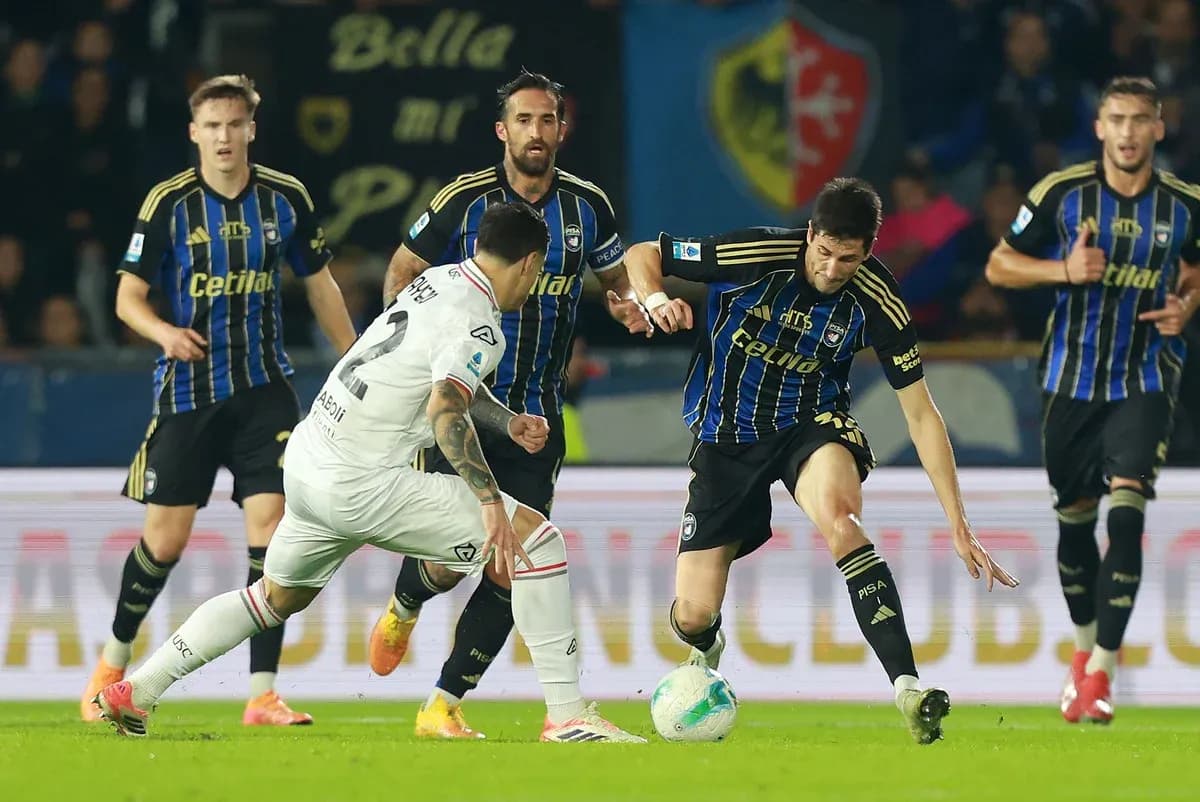
Cremonese Dominates Pisa 3-0 in Serie A Showdown
Cremonese’s 3-0 home win over Pisa at Stadio Giovanni Zini in Serie A’s Regular Season - 36 was a structural domination built on control, width and ruthless exploitation of Pisa’s numerical collapses. Marco Giampaolo’s 4-4-2 owned the ball (77% possession) and territory from the first whistle, while Oscar Hiljemark’s 3-5-2 never established a stable first pass, finishing without a single shot and reduced to nine men.
I. Executive Summary
The match split along a clear tactical fault line: Cremonese’s patient, high-volume passing game versus Pisa’s increasingly desperate low block. Cremonese produced 10 shots (6 on goal) from an xG of 1.15, turning sustained pressure into three well-timed goals. Pisa, by contrast, posted 0 shots and 0 xG, their entire attacking structure suffocated by Cremonese’s pressing and Pisa’s own disciplinary implosion. The 1-0 lead at half-time (via J. Vardy) became unassailable once Pisa went down to nine; F. Bonazzoli and substitute D. Okereke added second-half goals as Cremonese calmly circulated the ball and stretched a broken 3-3-2 block.
II. Scoring Sequence & Disciplinary Log
Disciplinary log (chronological, exact reasons):
- 16' Rosen Bozhinov (Pisa) — Foul
- 23' Rosen Bozhinov (Pisa) — Foul
- 23' Rosen Bozhinov (Pisa) — Foul
- 49' Arturo Calabresi (Pisa) — Foul
- 57' Felipe Loyola (Pisa) — Foul
- 89' Malthe Højlholt (Pisa) — Foul
Cremonese: 0 cards, Pisa: 6 cards (4 yellow, 2 red), Total: 6.
At 16', Rosen Bozhinov’s first yellow for “Foul” signaled Pisa’s reliance on last-ditch interventions to stop Cremonese’s wide combinations. His second yellow at 23'—again “Foul”—immediately followed by a red card for “Foul” left Pisa with 10 men, forcing Hiljemark to abandon any idea of a mid-block press and drop into a deep 5-3-1 variant.
Cremonese capitalized on the territorial lock: at 31', J. Vardy struck the opener for 1-0, punishing Pisa’s inability to clear under pressure. The interval arrived with Cremonese 1-0 up and in full control.
After the break, Pisa’s attempts to be more aggressive in duels only worsened their situation. At 49', substitute Arturo Calabresi was booked for “Foul”, emblematic of a back line constantly late to wide rotations. On 51', Cremonese doubled the lead: F. Bonazzoli finished a move assisted by J. Vandeputte for 2-0, the classic 4-4-2 pattern of wide service into the forwards.
The decisive structural break came at 57', when Felipe Loyola received a straight red card for “Foul”, reducing Pisa to nine. From that moment, Cremonese’s possession became almost training-ground sterile dominance. The final blow arrived at 86', with D. Okereke scoring the 3-0 after an assist from A. Zerbin, both substitutes combining against a disorganized, exhausted block. At 89', Malthe Højlholt’s yellow for “Foul” capped Pisa’s ill-disciplined afternoon.
III. Tactical Breakdown & Personnel
Giampaolo’s 4-4-2 was textbook: E. Audero in goal behind a back four of G. Pezzella, S. Luperto, M. Bianchetti and F. Terracciano; a flat but fluid midfield of J. Vandeputte, Y. Maleh, A. Grassi and T. Barbieri; and the strike pair F. Bonazzoli and J. Vardy. The structure aimed at width and overloads on Pisa’s wing-backs, repeatedly forcing the outside centre-backs into lateral duels they struggled to manage.
Cremonese’s build-up was calm and repetitive: 735 passes, 684 accurate (93%), with frequent recycling through the centre-backs and pivots to shift Pisa’s 3-5-2 horizontally. Once Pisa went down to 10, and then nine, the ball circulation became almost uncontested. The 7-1 corner advantage reflected how often Cremonese pinned Pisa deep and forced last-touch interventions.
The front pairing was key. Vardy constantly threatened the space between Pisa’s wide centre-back and wing-back, while Bonazzoli offered a reference for crosses and cut-backs. Vandeputte’s assist for the second goal underlined how Cremonese’s wide midfielder could receive facing forward, with Pisa’s midfield unable to screen passing lanes after the first red.
Substitutions were used by Giampaolo to maintain intensity rather than change structure. At 59', M. Thorsby (IN) came on for Y. Maleh (OUT), adding fresh legs and aerial presence in midfield. Simultaneously, A. Zerbin (IN) replaced G. Pezzella (OUT), pushing the left flank even higher. Later, at 72', A. Sanabria (IN) came on for J. Vardy (OUT), and D. Okereke (IN) replaced J. Vandeputte (OUT), turning the front line into a more transition-oriented unit against a tiring nine-man Pisa. At 85', F. Folino (IN) came on for S. Luperto (OUT), preserving defensive freshness.
Pisa’s initial 3-5-2—A. Semper in goal; R. Bozhinov, A. Caracciolo, S. Canestrelli at the back; M. Leris and I. Toure as wing-backs; E. Akinsanmiro, F. Loyola, I. Vural inside; S. Moreo and F. Stojilkovic up front—never stabilized. Their 218 passes, 161 accurate (74%), show a team forced into rushed clearances and hopeful balls. With Bozhinov’s dismissal, Hiljemark reacted by moving to a back four via substitutions: A. Calabresi (IN) came on for S. Moreo (OUT), and S. Angori (IN) came on for M. Leris (OUT) at 37', trying to rebuild the defensive line.
Subsequent changes were mostly damage limitation. At 65', M. Hojholt (IN) replaced I. Vural (OUT), and H. Meister (IN) came on for F. Stojilkovic (OUT), sacrificing attacking reference points for midfield legs. At 72', G. Piccinini (IN) replaced E. Akinsanmiro (OUT), but with nine men after Loyola’s red, Pisa could no longer contest central spaces. Semper’s 2 saves kept the scoreline from becoming heavier, despite a negative goals prevented figure (-1.18), suggesting Cremonese finished slightly above expectation.
Goalkeeper reality was starkly different. Audero recorded 0 saves because Pisa produced 0 shots; his primary role was as an extra outfield player in circulation, helping Cremonese maintain compact rest-defense and immediately counter-press any rare turnovers. Semper, by contrast, was under constant threat, and his defense’s numerical and positional disarray left him exposed on all three goals.
IV. The Statistical Verdict
The statistical profile underlines the tactical story. Cremonese’s 77% possession and 735 passes at 93% accuracy were not sterile: they generated 10 shots, 6 on target, and an xG of 1.15 that was converted into 3 goals through quality finishing and relentless positional pressure. Pisa’s 0 shots and 0 xG confirm that their attacking structure was completely neutralized; every possession phase was truncated either by Cremonese’s press or by Pisa’s own fouls.
Defensively, Cremonese’s Overall Form in this match was of total control, while their Defensive Index is highlighted by conceding no shots and no saves required. Pisa’s Defensive Index is severely damaged by 4 yellow cards and 2 red cards, all for “Foul”, and by conceding 3 goals despite facing only 1.15 xG. The 12-10 foul count against Pisa, combined with their card tally, reflects a side constantly arriving late into duels, structurally outnumbered and tactically outmaneuvered. This was not just a 3-0 scoreline; it was a systemic dismantling of Pisa’s 3-5-2 by Cremonese’s disciplined, high-possession 4-4-2.