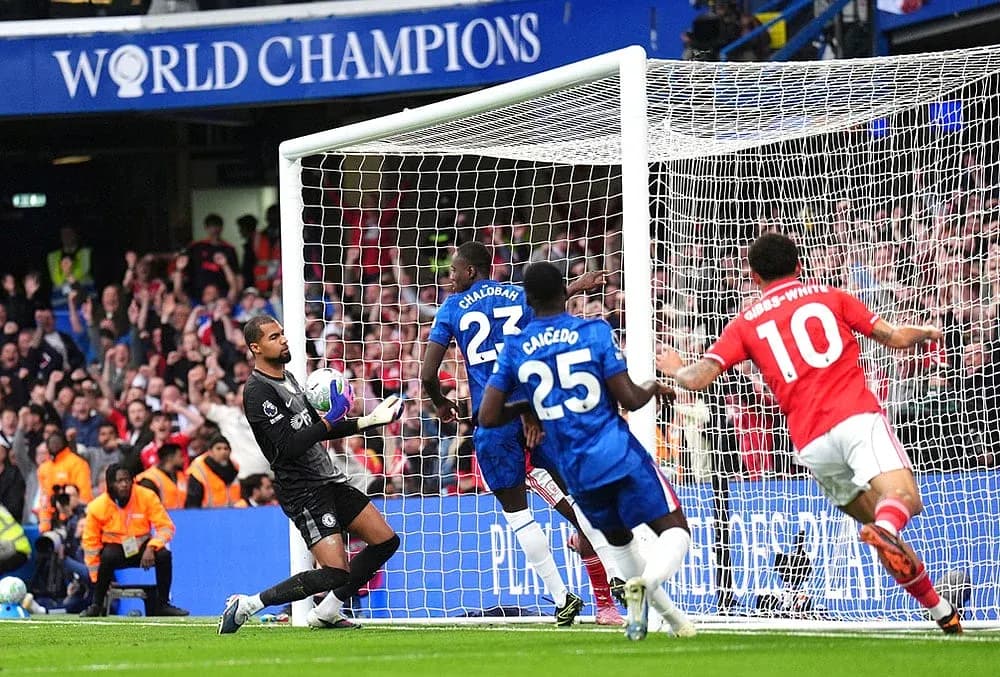
Chelsea's Fragility Exposed in 3-1 Defeat to Nottingham Forest
Stamford Bridge emptied under a grey London sky with a familiar, uneasy feeling. Following this result, a 3-1 home defeat to Nottingham Forest, Chelsea remain 9th in the Premier League table on 48 points, their overall goal difference locked at +6 from 54 goals for and 48 against. Forest, 16th with 42 points and an overall goal difference of -2 (44 scored, 46 conceded), walked away looking far more secure than their league position suggests.
I. The Big Picture – Structure vs Streetwise Edge
On paper, this was a clash between a possession-heavy, technically gifted Chelsea and a Forest side increasingly comfortable living off transitions. The numbers heading into this game told part of the story: Chelsea averaging 1.5 goals per game overall, Forest 1.3; Chelsea conceding 1.4 per match, Forest 1.3. What unfolded at Stamford Bridge was the tactical embodiment of those slim margins being brutally punished.
Calum McFarlane stayed loyal to Chelsea’s season-long identity with a 4-2-3-1, a structure they have used in 30 league matches. Robert Sánchez in goal sat behind a back four of Malo Gusto, Trevoh Chalobah, Tosin Adarabioyo and Marc Cucurella. In front, the double pivot of Romeo Lavia and Moisés Caicedo was tasked with both protecting the defence and feeding an attacking band of Cole Palmer, Enzo Fernández, J. Derry and lone striker Joao Pedro.
Vitor Pereira, by contrast, stepped away from Forest’s usual 4-2-3-1 (their most-used shape across 29 matches) and rolled out a 4-4-2 at Stamford Bridge. Matz Sels was shielded by Z. Abbott, Cunha, Morato and L. Netz. The midfield four of D. Bakwa, Ryan Yates, Nicolás Domínguez and J. McAtee played narrow and industrious, leaving Igor Jesus and Taiwo Awoniyi as a bruising, vertical front pair.
The half-time scoreline – Chelsea 0-2 Forest – crystallised the underlying problem for the hosts. Despite a side built to control and create, Chelsea’s season-long fragility resurfaced: at home they concede 1.3 goals per game and score 1.3, a balance that leaves no room for sloppiness. Forest, who on their travels average 1.4 goals for and 1.4 against, looked entirely at ease exploiting that narrow margin.
II. Tactical Voids – Absences and Discipline
Both squads arrived with significant absentees that reshaped the tactical script.
Chelsea were without A. Garnacho, J. Gittens, M. Mudryk and P. Neto, among others. The missing pace and one‑v‑one threat on the flanks forced McFarlane into a more central, combination-based attack with Palmer and Enzo operating between the lines rather than stretching the pitch. Without Mudryk’s direct running, Chelsea’s transitions lost a gear; Joao Pedro was often receiving to feet rather than attacking space.
Forest’s list was even longer: O. Aina, W. Boly, C. Hudson-Odoi, John Victor, Murillo, D. Ndoye, I. Sangaré and N. Savona all missed out. That stripped Pereira of both defensive depth and ball-winning security in midfield. Yet the back four of Abbott, Cunha, Morato and Netz held firm, protected by the hard-running axis of Yates and Domínguez.
Season-long card data hinted at the underlying tension. Chelsea’s yellow cards spike late, with 22.35% arriving between 76-90 minutes and a further 15.29% between 91-105 – a sign of a side that chases games and fouls when stretched. Their red cards are spread across the match, with a particular spike (28.57%) between 61-75 minutes. Forest’s yellows peak in the 46-60 and 61-75 ranges (both 23.21%), while their lone league red card arrives in the 31-45 window. This discipline profile matched the narrative: Chelsea again found themselves scrambling from behind, Forest again comfortable living on the edge of aggression in the middle third.
III. Key Matchups – Hunter vs Shield, Engine Room Battles
Hunter vs Shield was defined by Joao Pedro against a Forest defence that, on their travels, concedes 1.4 goals per game. Pedro’s season speaks for itself: 15 league goals and 5 assists, 48 shots with 28 on target, and 29 key passes. He is not just a finisher but Chelsea’s most dangerous connector in the final third. Yet Forest’s compact 4-4-2 narrowed the central lanes he thrives in. Morato and Cunha kept their distances tight, while Yates dropped into the half-spaces to suffocate the pass into Pedro’s feet.
On the other side, Forest’s main attacking reference across the season has been Morgan Gibbs-White, even though he started this one on the bench. With 13 goals and 4 assists, 54 shots and 46 key passes, he usually operates as the creative hinge. His presence among the substitutes signalled Pereira’s intent: this was to be a game of verticality and power first, artistry later if needed. Instead, the running of Awoniyi and Igor Jesus targeted Chelsea’s overall defensive record – 48 goals conceded in 35 matches – and a back line that, for all Chalobah’s composure (he has blocked 16 shots across the season) and Cucurella’s intensity, remains vulnerable when exposed in transition.
The Engine Room duel was ferocious. Caicedo, one of the league’s standout destroyers with 83 tackles, 14 successful blocks and 56 interceptions, was asked to extinguish counters before they ignited. His disciplinary profile – 10 yellows and 1 red – underlines the cost of that role. Opposite him, Yates and Domínguez were less about numbers and more about collective function: shuttling, doubling wide, and driving Forest out of pressure. With Lavia still finding rhythm, Chelsea’s double pivot was repeatedly dragged into wide areas, leaving central channels for Forest’s front two to attack.
IV. Statistical Prognosis – What This Result Tells Us
Following this result, the statistical arc of both seasons feels reinforced rather than rewritten. Chelsea, with 54 goals scored and 48 conceded overall, remain a side whose attacking quality cannot fully mask their structural fragility. Nine clean sheets overall and seven matches at home where they have failed to score highlight a volatility that makes them vulnerable to organised, counter-punching opponents.
Forest, whose away record now reads 7 wins, 3 draws and 8 defeats with 26 goals for and 25 against, continue to be more dangerous on their travels than at the City Ground. Their overall defensive record – 46 conceded in 35 – is not elite, but it is coherent enough to support a game plan built on suffering without the ball and striking quickly.
In xG terms, the underlying profiles suggest a narrow gap: Chelsea’s 1.5 goals-for and 1.4 against per game versus Forest’s 1.3 for and 1.3 against. But tactical clarity and game-state management made that margin look much wider at Stamford Bridge. Forest’s early 2-0 advantage allowed them to compress space, lean on their physical forwards and trust Sels and his back four to absorb waves of pressure.
For Chelsea, the path forward is clear but demanding. The spine – Sánchez, Chalobah, Caicedo, Joao Pedro – is strong enough to anchor a top‑six side, yet without better protection in transition and more reliable wide threat (especially with Mudryk absent), their 4-2-3-1 risks becoming a beautiful structure that opponents can run through.
For Forest, this 3-1 win is more than just three points; it is a validation of Pereira’s willingness to bend his system to the opponent. A season defined by survival instincts now carries the hint of something more stable: a team that knows exactly who it is when the pressure is highest and the margins are thinnest.