Canberra United's Future Secured: New Owners Plan Growth by 2028
Canberra United finally has what it has craved for years: security, ambition and a plan that stretches beyond the next season’s fixture list.
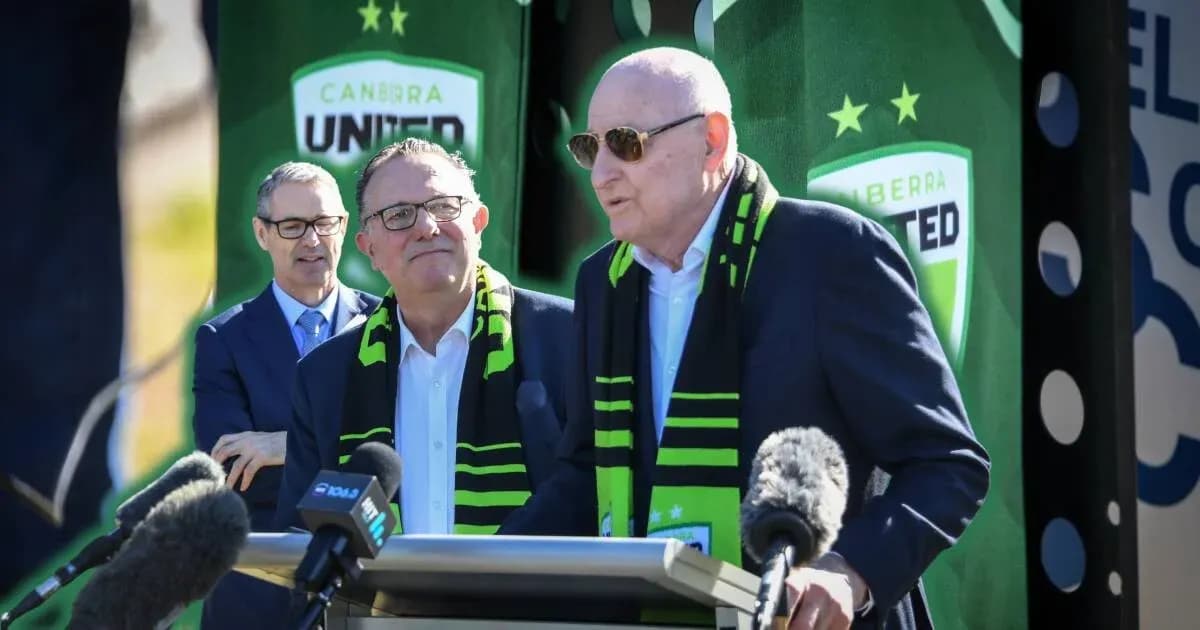
Australian Sports Group (ASG), unveiled on Friday as the club’s new private owners, has stepped in to guarantee Canberra United’s place in the A-League Women for 2026-27 and beyond, with a long-awaited A-League Men side now formally targeted for the 2028-29 campaign.
For a club that has lived season to season under Capital Football, it is a hard reset.
McKellar to remain “home” as base plan takes shape
The first message from ASG chief executive Theo Fotopoulos was simple: Canberra United stays at McKellar Park.
The club’s “spiritual home” will continue to host A-League Women matches, while the neighbouring Belconnen Soccer Club is set to become a “strategic partner” and the day‑to‑day hub. ASG is already exploring a full training base on the McKellar site, a project that would finally give United the kind of permanent football home the ACT has talked about for years but never quite delivered.
Capital Football and the ACT government once had grand plans for a high‑performance base at the Throsby Home of Football. That dream collapsed when the governing body could no longer afford it. ASG wants to pick up the idea, but plant it in Belconnen instead.
“It’ll come down to what we can get approved in terms of the facility here,” Fotopoulos told The Canberra Times, pointing out that McKellar is one of the few privately owned football grounds in the city, spanning roughly six hectares. He has already sounded out key stakeholders and says early discussions are “very positive”.
The ambition is clear: turn McKellar from a much‑loved suburban venue into a genuine professional base. “Football needs a home,” Fotopoulos said, “and it’d be great to be able to develop that here.”
Coaching call and player deals on the clock
Off the pitch, the clock is already ticking. Pre‑season is just six weeks away, the A-League Women draw lands next month, and the season kicks off on October 16.
ASG has moved quickly. Fotopoulos has already held talks with coach Antoni Jagarinec, who has steered Canberra United to the finals in each of the past two seasons and become a central figure in the club’s recent revival. The new hierarchy wants continuity, not upheaval.
“It’s never a no-brainer, but yeah, look, I think [Jagarinec’s] results speak for themselves,” Fotopoulos said. “We’re looking for continuity and consolidation. We’ll have those announcements out pretty soon.”
The same urgency applies to the squad. With the PFA working with players across the league, United’s new owners are keen to lock in contracts quickly and avoid a drawn‑out rebuild. Fotopoulos said they are “very confident” about the reaction from the current group and want deals “wrapped up quicker than later”.
The men’s team: option now, deadline set
The headline promise is the one Canberra has been waiting on for almost two decades: an A-League Men team.
ASG does not yet hold a men’s licence. What it has is an option, tied to the 2028-29 season. After 18 years of false dawns, shifting bids and political wrangling, a three‑season wait might sound like another delay. Inside ASG, it is framed as a timeline, not a maybe.
Fotopoulos was adamant that a men’s side is not a bolt‑on afterthought.
“That is part of our twin strategy,” he said. “When we started speaking to the APL ... that was part of our mix. We believe the strength comes from both. It would be almost discriminatory not to work with the men. It’s always been part of our plans.”
The message is pointed: the women’s team has been saved now; the men’s team has a clear runway.
United by name – with a new identity twist
One thing will not change. The badge.
Canberra United will remain Canberra United, across both women’s and future men’s teams. Eighteen years of identity will not be tossed away.
“The name will remain the same, Canberra United,” Fotopoulos said. “You’ve got 18 years of Canberra United. Why would you change it? Unless somebody or the general public have got a negative view towards the team – I don’t think that’s the case.”
What might change is the nickname. ASG wants the community to help shape a fresh layer of identity, potentially via a public campaign run through The Canberra Times. The Cosmos, Arrows, Greens, Lakers, Green Machine – Fotopoulos reeled off examples, but the idea is for Canberrans to decide what sticks.
“If the Canberra community want a nickname for their team, Green Machine, whatever they come up with, we’re happy to look at that,” he said.
Who’s behind the takeover?
ASG’s football push is being driven by chairman Morris McAlister and Fotopoulos, two figures with long histories in the Australian game.
McAlister comes from a commerce background. He is the governing director of Petron Plus 7 Australia and New Zealand, a company supplying lubricants and other engine and machine products, and serves as senior consultant at MEC Team Consultants, which links Australian businesses with Chinese markets.
Fotopoulos is a marketing executive and chief executive of FOS Group Australia. On the football side, he has been around the block: involved with Sydney Cosmos, where he served as chief executive, and previously chief executive at Sydney Olympic. Both he and McAlister also had roles with the Newcastle Breakers in the old NSL.
Their brief now is far bigger: secure Canberra United, build a men’s team within the agreed window, and deliver the infrastructure and pathways to make both sustainable.
From crisis to clarity
The scale of the shift should not be understated. Canberra United has moved from federation‑run to privately owned for the first time since its inception in 2008.
Capital Football has carried the club for 16 seasons, but the financial load became too heavy. Last season was its final campaign in charge, and the ALW side’s future was left hanging while the A-Leagues searched for a buyer.
ASG has now bought the licence, with the deal believed to be worth around $15 million across both the women’s team and the future men’s option, including a guarantee to underwrite Canberra United by up to $3 million over multiple years. The A-Leagues will formally confirm ASG as United’s new owner, locking in the club’s place in the 2026-27 A-League Women season.
The APL had initially hoped to introduce a men’s side sooner, but the due diligence and ownership process could not be completed in time for a 2026-27 start. The priority became clear: save the women’s team first, then build out.
APL chair Steve Conroy underlined the significance of the deal, thanking the ACT government and the local football community for their support. He hailed the ASG agreement as “an exciting next step for professional football in the ACT” and a marker of the growth potential in Canberra.
Pathways rebuilt, infrastructure promised
ASG’s plans stretch beyond first teams and fixtures. Fotopoulos has committed to re‑establishing Canberra’s academy pathways, three years after Capital Football controversially shut down United’s academy.
For a city that has produced Matildas and Socceroos but seen its elite pathways fractured, that pledge matters. Fotopoulos talked up a club “focused on community engagement, football excellence, commercial growth, new infrastructure and strengthening the football development pathways for boys and girls in the territory and the capital region”.
That includes investment in facilities in and around Canberra, with McKellar the obvious starting point.
A long wait, a new chapter
For Canberra football people, this feels like the end of one saga and the start of another.
Bid leader Michael Caggiano has spent the best part of eight years fighting for an A-League Men licence, only to watch Auckland, named alongside Canberra as a preferred expansion location three and a half years ago, enter the competition and win a championship while the capital remained on the outside.
Now the landscape has shifted. Canberra United is privately owned, its A-League Women future secured, its academy set to be rebuilt, its home ground earmarked for serious investment. An A-League Men team has a date circled on the calendar instead of a question mark.
The club’s name will stay the same. The colours will be familiar. The badge will still read “Canberra United”.
Everything else is up for reinvention – from the training base to the academy, from the men’s side still on the horizon to the nickname the city might soon choose for itself.