Cagliari vs Udinese: Tactical Analysis and Match Insights
The Unipol Domus had the look of a survival trench rather than a stage for spectacle. Following this result, Cagliari remain a side clinging to safety in 16th on 37 points, their goal difference of -15 a stark summary of a season spent under pressure. Udinese, by contrast, consolidate a top‑half presence in 9th with 50 points, their overall goal difference a narrow -1 but their football here far more assertive than that number suggests.
I. The Big Picture – Structures and Season DNA
Fabio Pisacane’s decision to go with a 5-3-2 underlined Cagliari’s pragmatic DNA. At home this season they have averaged 1.1 goals for and 1.2 against, and the shape reflected a team more concerned with damage limitation than expression. The back five of M. Palestra, J. Pedro, A. Dossena, J. Rodriguez and A. Obert sat in a deep, narrow block in front of E. Caprile, with the midfield trio of M. Folorunsho, G. Gaetano and M. Adopo tasked with plugging central lanes rather than dictating tempo.
Across from them, Kosta Runjaic’s Udinese arrived with a 3-4-3 that looked far more ambitious than their modest overall scoring average of 1.3 goals per game. On their travels they have been notably sharper, with 1.5 away goals for and 1.4 against, and the selection reflected that away personality: a back three of O. Solet, T. Kristensen and B. Mlacic, wing‑backs K. Ehizibue and H. Kamara stretching the pitch, and a front line of A. Atta, A. Buksa and N. Zaniolo designed to rotate and overload half‑spaces.
The 0-0 half‑time scoreline masked a clear tactical trend: Cagliari pinned back, Udinese dictating territory. Cagliari’s season‑long struggle to create – they have failed to score in 14 league games overall – again surfaced as they found it difficult to connect their lines or give S. Esposito and P. Mendy anything resembling service between the lines.
II. Tactical Voids – Absences and Discipline
The team sheets also told a story of what was missing. Cagliari were without a whole tier of attacking and creative options: G. Borrelli (thigh injury), M. Felici and R. Idrissi (both knee injuries), J. Liteta (thigh injury), L. Mazzitelli (injury) and the experienced L. Pavoletti (knee injury) all ruled out. For a side that in total this campaign averages only 1.0 goals per game, losing that many forwards and advanced midfielders forced Pisacane to double down on structure over spontaneity. The bench did offer A. Belotti and S. Kilicsoy, but the starting XI felt short on proven penalty‑box presence.
Udinese’s absences were more targeted but still influential. J. Ekkelenkamp (leg injury) removed a runner from midfield who might have broken Cagliari’s lines, while A. Zanoli (knee injury) limited Runjaic’s options in the wide defensive channels. Most notably, C. Kabasele was suspended for yellow cards, depriving Udinese of an experienced organiser at the back. That placed extra responsibility on Solet and Kristensen to manage Cagliari’s sporadic counters.
Disciplinary trends hinted at where the game might turn. Cagliari’s yellow‑card profile shows a pronounced late‑game surge, with 26.92% of their bookings arriving between 76‑90 minutes and another 24.36% between 46‑60. Udinese, too, spike late, with 26.87% of their yellows between 61‑75 and 22.39% from 76‑90. In a tight contest, that volatility in the final half‑hour always threatened to open gaps or invite set‑piece chaos, but Udinese’s control of the ball and territory kept the game on their terms rather than descending into a card‑ridden scrap.
III. Key Matchups – Hunter vs Shield, Engine Room Battles
Without a Cagliari player among the league’s top scorers, the “Hunter vs Shield” narrative naturally tilted towards Udinese. Keinan Davis, even from the bench here, loomed over the fixture as the visitors’ reference point: 10 goals and 4 assists in total this campaign, backed by 37 shots and 24 on target. His presence in the squad underscored the depth of attacking threat Runjaic could call upon if the starting trio failed to break through.
Cagliari’s defensive “shield” has been fragile overall, conceding 51 goals in 36 games, an average of 1.4 per match. At home they have been slightly tighter at 1.2 conceded per game, and that was the version of Cagliari that appeared for much of the first hour – compact, reactive, and reliant on the reading of the game from A. Obert at the heart of the back line. Obert’s league campaign, with 63 tackles, 18 blocked shots and 40 interceptions, framed him as the defensive leader; here, he was again tasked with stepping out to meet Zaniolo when the Udinese playmaker drifted inside.
In the “Engine Room”, the duel between creators and stoppers ran through two figures: S. Esposito for Cagliari and N. Zaniolo for Udinese. Esposito, listed as a forward but very much a connector, has produced 6 goals and 5 assists this season, with 65 key passes and 916 total passes at 74% accuracy. His attempts to drop off the front line to build play were repeatedly smothered by the Udinese midfield axis of J. Karlstrom and J. Piotrowski, who screened the central lanes and forced Cagliari wide, where their wing‑backs struggled to deliver telling crosses.
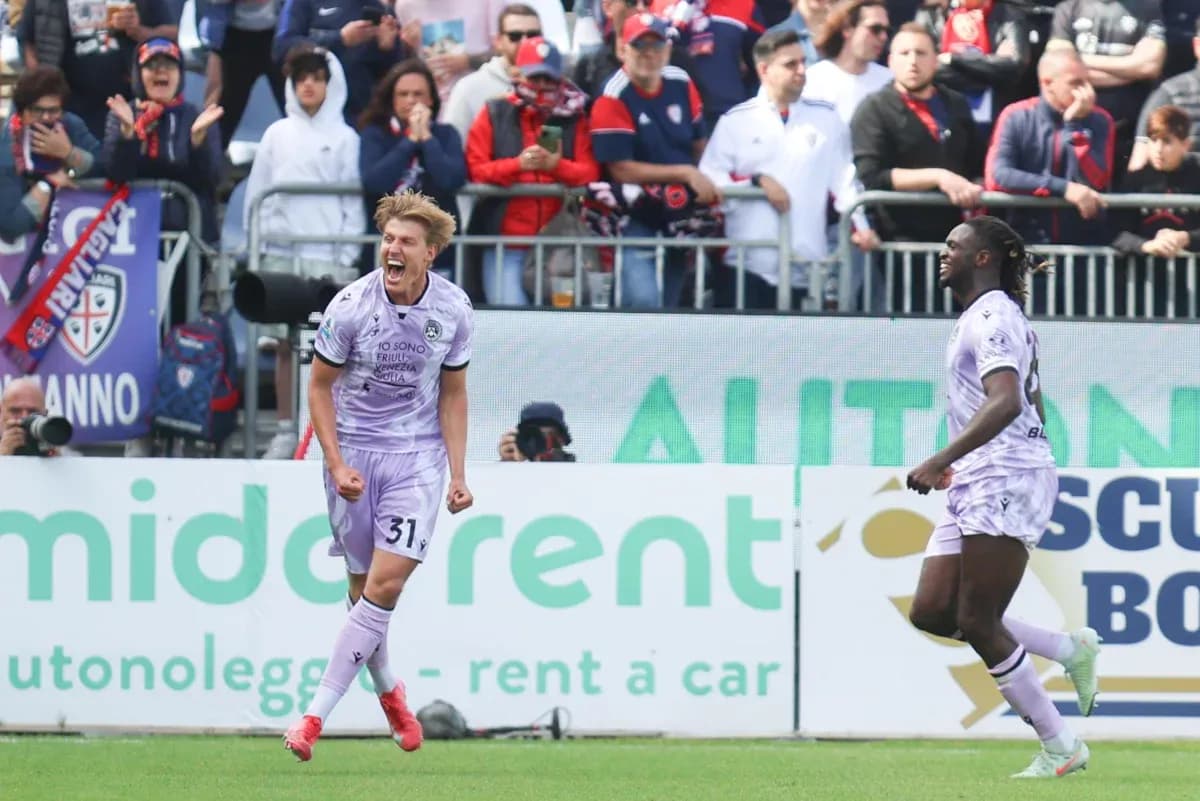
Zaniolo, on the other hand, embodied Udinese’s creative risk‑taker. With 5 goals, 6 assists and 53 key passes in total this campaign, he operates on the edge of control – 94 dribble attempts, 61 fouls drawn, 62 committed, and 8 yellow cards. At the Unipol Domus, his drifting between the lines pulled Cagliari’s midfield three out of shape, opening corridors for Atta and Buksa to attack. Every time he received between the lines, the home block had to compress, and that repeated stress eventually told as Udinese found their breakthrough and then the second goal to kill the contest.
IV. Statistical Prognosis – Why Udinese’s Plan Prevailed
Following this result, the numbers surrounding both teams feel even more logical. Cagliari’s total of 8 clean sheets overall shows they can dig in, but their 14 games failing to score underline a chronic attacking shortfall, exacerbated by the long injury list. Their season‑long reliance on set‑pieces and moments from Esposito was never likely to be enough against an away side as balanced as Udinese.
Udinese, by contrast, continue to mirror their season profile: not watertight, but structurally sound and increasingly ruthless away from home. With 5 away clean sheets and only 3 games on their travels where they have failed to score, their 3‑4‑3 here was an extension of a clear identity – aggressive wing‑backs, a rotating front three, and a midfield that manages risk rather than simply destroys.
Even without explicit xG data, the underlying patterns point to a logical outcome: a side that in total averages 1.3 goals for and 1.3 against, with multiple creative hubs in Zaniolo and Davis, against a team averaging 1.0 for and 1.4 against, stripped of attacking depth and leaning on a low block. The 2-0 scoreline feels like the statistical centre of that clash of profiles – Udinese’s away efficiency meeting Cagliari’s structural limitations, and the visitors’ superior squad depth and attacking variety ultimately deciding the narrative in Sardinia.