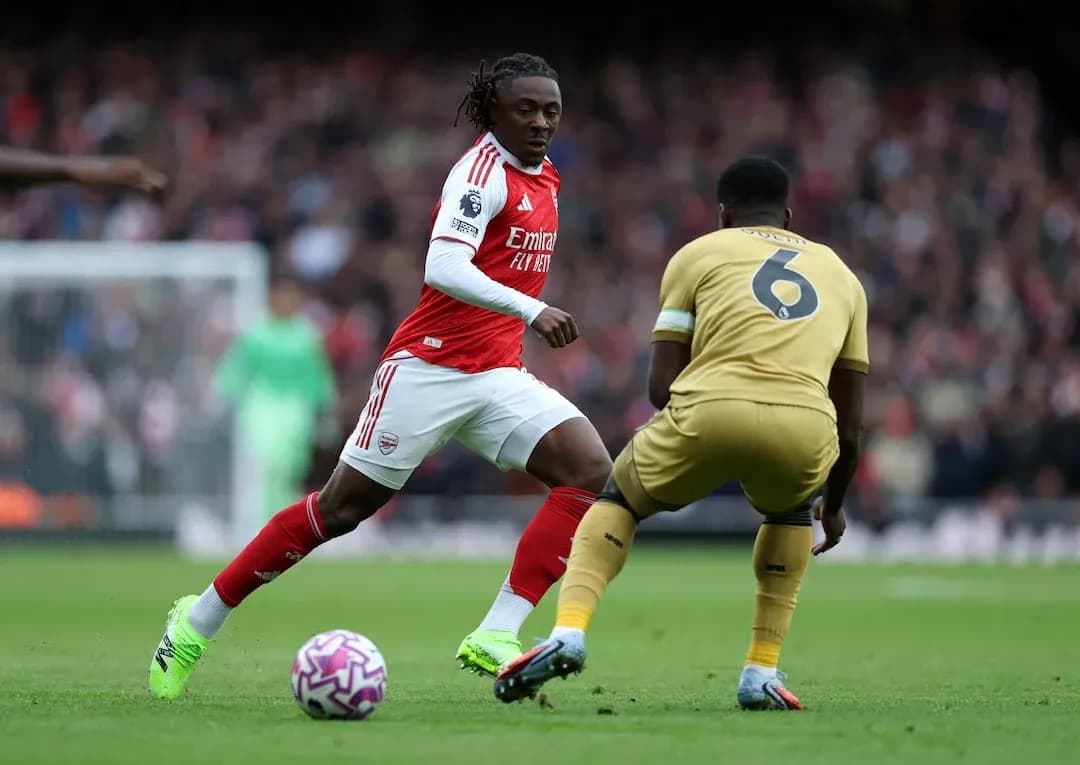
Arsenal's Tactical Edge in 1-0 Victory Over West Ham
West Ham’s 0-1 home defeat to Arsenal at London Stadium unfolded as a classic territorial siege against a compact low block. In a Premier League Round 36 fixture, Mikel Arteta’s side controlled the ball and tempo, while Nuno Espirito Santo’s West Ham tried to compress the central corridor and counter through pace in the front line. Ultimately, Arsenal’s structural superiority in possession and a late moment of quality from Leandro Trossard separated the sides, though a stoppage-time VAR intervention denying Callum Wilson underlined how fine the margins were in a match where West Ham’s defensive plan was almost rewarded.
I. Executive Summary
Arsenal’s 4-2-3-1 dominated possession (64%) and volume of attacks (15 total shots to West Ham’s 9), but needed an 83' strike from Leandro Trossard, assisted by Martin Ødegaard, to break a disciplined 3-4-2-1 block. West Ham’s compactness limited Arsenal’s shot quality (xG 1.36), while the hosts themselves generated 1.3 xG, reflecting a credible offensive threat despite long spells without the ball. Goalkeeper duels were even in terms of xG prevention (both at 0.85), but Arsenal’s David Raya had the heavier distribution load, anchoring their build-up. The final phase saw West Ham throw on extra forwards and nearly snatch an equaliser, only for VAR to disallow a potential Wilson goal at 90+8'.
II. Scoring Sequence & Disciplinary Log
There was no scoring in the first half; the interval score was West Ham 0-0 Arsenal, with the visitors controlling territory but failing to puncture the three-centre-back screen.
Disciplinary log (chronological):
- 34' Valentín Castellanos (West Ham) — Foul
- 38' Crysencio Summerville (West Ham) — Foul
- 68' Jean-Clair Todibo (West Ham) — Foul
- 77' Bukayo Saka (Arsenal) — Foul
- 79' Cristhian Mosquera (Arsenal) — Foul
- 89' William Saliba (Arsenal) — Time wasting
- 90+1' Leandro Trossard (Arsenal) — Time wasting
Total cards: West Ham 3, Arsenal 4, Total 7.
Scoring and key incident timeline:
- 83' West Ham 0-1 Arsenal — Leandro Trossard finishes, assisted by Martin Ødegaard, breaking the deadlock after sustained Arsenal pressure.
- 90+8' A potential goal by Callum Wilson (West Ham) was disallowed by VAR, denying the hosts a stoppage-time equaliser and preserving Arsenal’s narrow lead.
III. Tactical Breakdown & Personnel
Nuno Espirito Santo set West Ham in a 3-4-2-1 with Mads Hermansen behind a back three of Axel Disasi, Konstantinos Mavropanos and Jean-Clair Todibo. The wing-backs, Aaron Wan-Bissaka and El Hadji Malick Diouf, stayed relatively deep, effectively forming a back five out of possession. Tomáš Souček and Mateus Fernandes screened the central zone, with Jarrod Bowen and Crysencio Summerville operating as narrow attacking midfielders behind Valentín Castellanos.
This structure aimed to congest the half-spaces where Arsenal’s 4-2-3-1 usually thrives. The front three of Bowen, Summerville and Castellanos were tasked with triggering presses on Arsenal’s pivots and full-backs rather than the centre-backs, conceding first phase but contesting progression into midfield. West Ham’s 36% possession and 281 passes (189 accurate, 67%) reflect a strategy built around quick transitions rather than sustained build-up.
Arsenal, under Mikel Arteta, lined up with David Raya in goal behind a back four of Ben White, William Saliba, Gabriel Magalhães and Riccardo Calafiori. Declan Rice and Myles Lewis-Skelly formed the double pivot, with Bukayo Saka, Eberechi Eze and Leandro Trossard supporting Viktor Gyökeres. Their 4-2-3-1 morphed into a 3-2-5 in possession, with one full-back tucking in and the opposite side pushing high, while Rice orchestrated circulation.
Arsenal’s 503 passes, 413 accurate (82%), and 64% possession show a clear dominance of the ball. They produced 15 total shots (4 on goal, 5 blocked) with a balanced distribution between shots inside (9) and outside the box (6). The blocked-shot count from both sides (West Ham 4, Arsenal 5) underlines how compact the central channels were, forcing Arsenal to work through patient combinations and late runs rather than early clear chances.
The first key tactical shift came at 28', when Ben White (OUT) was replaced by Martín Zubimendi (IN). This moved Arsenal towards a more midfield-heavy shape, likely sliding Rice or Zubimendi into deeper build-up roles and freeing Lewis-Skelly or a full-back to step higher. At 46', Riccardo Calafiori (OUT) made way for Cristhian Mosquera (IN), maintaining defensive stability while adjusting the profile on the left side.
West Ham’s first attacking tweak arrived at 66', when Valentín Castellanos (OUT) was replaced by Pablo Felipe (IN). This fresh forward option suggested a desire to threaten in behind as Arsenal pushed for a winner. Arsenal’s response at 67' was decisive: Eberechi Eze (OUT) for Martin Ødegaard (IN), adding a more classical playmaker between the lines. This substitution proved crucial, with Ødegaard later assisting the winning goal.
At 68', Arsenal added another attacking focal point when an unnamed player (OUT) was replaced by Kai Havertz (IN), further loading the final third. The pattern was clear: Arteta progressively increased the number of technically gifted players between West Ham’s lines, trusting his centre-backs and double pivot to manage transitions.
The breakthrough on 83' encapsulated Arsenal’s structural pressure: sustained possession, circulation around the block, and eventually a combination that freed Trossard in a dangerous pocket, finished clinically for 0-1 with Ødegaard providing the final pass.
West Ham’s late push saw Axel Disasi (OUT) replaced by Callum Wilson (IN) at 85', effectively shifting to a more aggressive shape with extra forwards. This risk-reward recalibration almost paid off, culminating in Wilson’s potential equaliser at 90+8' that was disallowed by VAR. The sequence underlined how West Ham’s late structural looseness generated chaos and opportunity, but also exposed them to control loss if the equaliser did not stand.
IV. The Statistical Verdict
The xG numbers — West Ham 1.3, Arsenal 1.36 — confirm a contest of narrow margins rather than outright dominance despite Arsenal’s territorial control. Arsenal’s 15 shots to West Ham’s 9 and their 64% possession underline a clear initiative, but West Ham’s ability to generate comparable xG from fewer attacks speaks to the quality of their counter-attacking moments.
Defensively, West Ham committed 14 fouls to Arsenal’s 12, and their 3 yellow cards versus Arsenal’s 4 reflect a game where both sides stretched the limits of game management, especially late on, as shown by time-wasting bookings for Saliba and Trossard. In goal, Hermansen made 1 save to Raya’s 3, yet both keepers posted 0.85 goals prevented, suggesting similar shot difficulty and effectiveness despite different workloads.
Arsenal’s superior passing volume (503 vs 281) and accuracy (82% vs 67%) aligned with their season identity as a possession-dominant side. West Ham’s more modest passing profile matched a pragmatic, low-block and transition approach. In the end, the numbers support the narrative: Arsenal’s structural and territorial control finally translated into a single decisive action, while West Ham’s plan came within a VAR decision of earning a point.