AC Milan vs Atalanta: Tactical Analysis of a 3-2 Defeat
AC Milan’s 3-2 home defeat to Atalanta at San Siro unfolded as a tactical paradox: Allegri’s side controlled territory, possession and chance volume, yet Palladino’s Atalanta won the structural battle in both boxes. In a Serie A Round 36 fixture with European stakes, Milan’s 3-5-2 was repeatedly exposed in defensive transition early on, conceding three times before mounting a late, statistically supported but ultimately insufficient comeback.
Executive Summary
Milan finished with 57% possession, 20 total shots and an xG of 1.94, but Atalanta were far more ruthless, scoring three times from nine shots and 1.08 xG. The visitors’ 3-4-2-1, built on compact central density and vertical breaks through Ederson and the front three, punished Milan’s high line and slow rest-defense. Allegri’s second-half reshuffle with Christopher Nkunku and Niclas Füllkrug gave Milan a more direct, penalty-box oriented threat, but Atalanta’s defensive block and game management held, supported by Marco Carnesecchi’s eight saves and a disciplined, if card-heavy, closing phase.
Scoring Sequence & Disciplinary Log
Goals (chronological, all included):
- 7' Ederson (Atalanta) — no assist. A direct early strike exploiting Milan’s unbalanced midfield cover.
- 29' Davide Zappacosta (Atalanta) — assisted by Nikola Krstović. Wide overload and under-protected far side of Milan’s back three.
- 51' Giacomo Raspadori (Atalanta) — assisted by Ederson. Transition through the left half-space after Milan’s structural gamble.
- 88' Strahinja Pavlović (AC Milan) — assisted by Samuele Ricci. Set-piece or sustained pressure payoff from Milan’s late siege.
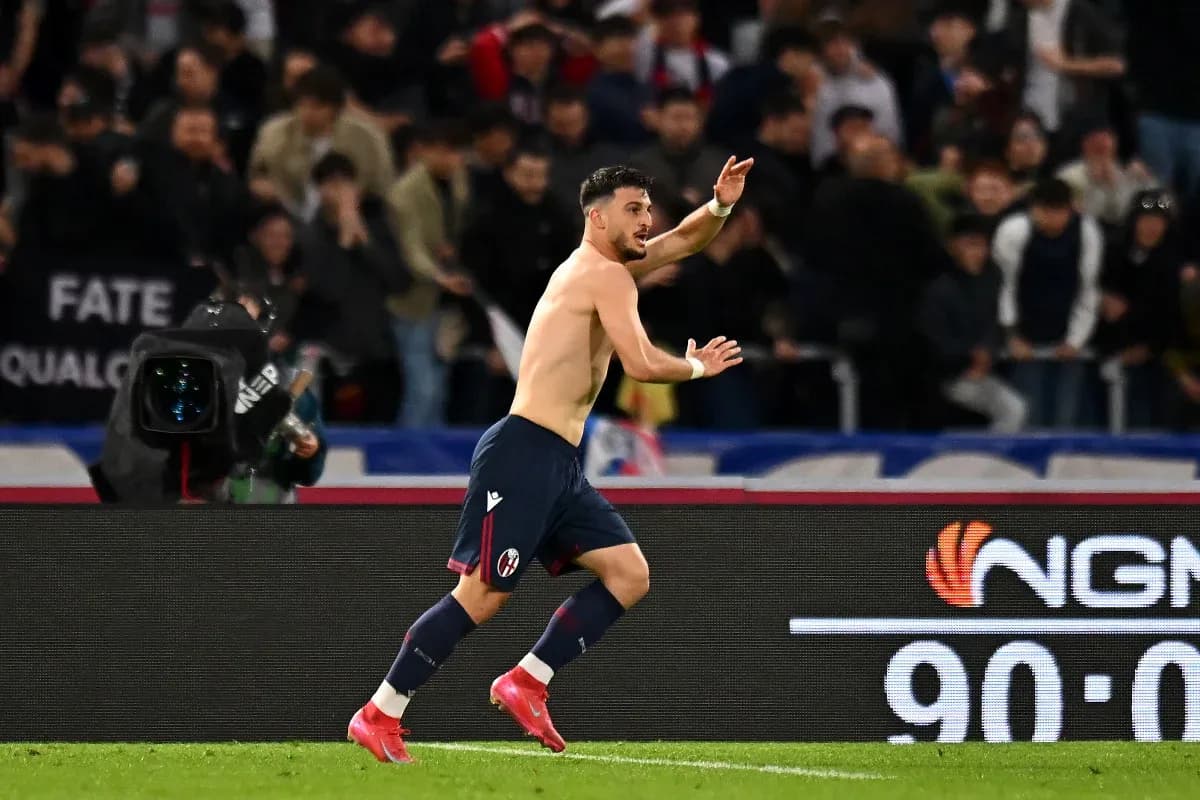
- 90' Christopher Nkunku (AC Milan) — penalty, no assist. Direct reward for Milan’s territorial dominance and box pressure.
Cards (exact, chronological, with reasons verbatim):
- 34' Rafael Leão (AC Milan) — Foul
- 70' Isak Hien (Atalanta) — Argument
- 89' Adrien Rabiot (AC Milan) — Argument
- 89' Pervis Estupiñán (AC Milan) — Foul
- 90' Alexis Saelemaekers (AC Milan) — Argument
- 90+5' Nikola Krstović (Atalanta) — Time wasting
- 90+6' Raoul Bellanova (Atalanta) — Foul
Totals: AC Milan 4 yellow cards, Atalanta 3 yellow cards, Total 7.
Tactical Breakdown & Personnel
Structures and initial phase
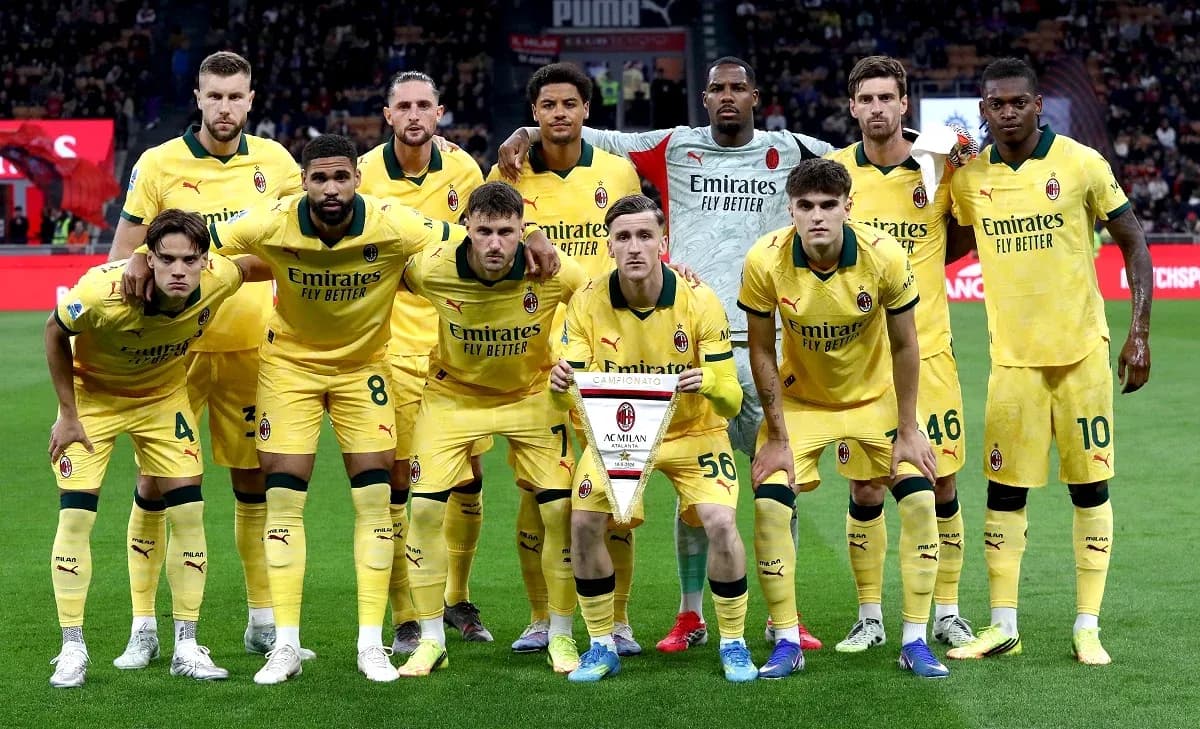
Milan lined up in a 3-5-2: Mike Maignan in goal behind a back three of Koni De Winter (right), Matteo Gabbia (central) and Strahinja Pavlović (left). The wing-backs were Alexis Saelemaekers on the right and Davide Bartesaghi on the left, with a central trio of Samuele Ricci as the pivot, flanked by Ruben Loftus-Cheek and Adrien Rabiot. Up front, Santiago Giménez and Rafael Leão formed a split-striker partnership.
Atalanta’s 3-4-2-1 placed Marco Carnesecchi behind Giorgio Scalvini, Isak Hien and Sead Kolašinac. The wing-backs were Davide Zappacosta (right) and Nicola Zalewski (left), with Marten de Roon and Ederson as the double pivot. Charles De Ketelaere and Giacomo Raspadori operated as dual 10s behind Nikola Krstović.
Atalanta’s early control
The visitors targeted Milan’s rest-defense from the opening whistle. With Milan’s wing-backs pushing high, Atalanta repeatedly found Ederson free between Ricci and the outside centre-backs. The 7' opener came from precisely this pattern: Milan’s midfield three were stretched horizontally, Ricci isolated, and the back line unable to step out without exposing depth. Ederson’s goal underlined Atalanta’s superior occupation of the half-spaces.
For the second goal at 29', Atalanta exploited the weak-side wing-back zone. As Milan shifted towards the ball, the far-side wing-back was slow to recover, leaving Zappacosta free to attack the space behind Pavlović’s outside shoulder. Krstović’s assist highlighted the central forward’s role as a wall player, pinning Gabbia and linking to the advancing wing-back.
Milan’s possession without penetration
Milan’s 57% possession and 541 passes (478 accurate, 88%) show a side comfortable circulating, but their positional play lacked vertical staggering. Loftus-Cheek and Rabiot often occupied similar heights, leaving Ricci exposed in rest-defense and reducing central overloads between Atalanta’s lines. The front pair were frequently disconnected, with Leão drifting wide to receive, which stretched Atalanta but left the box under-occupied.
Atalanta, by contrast, used their 411 passes (330 accurate, 80%) more purposefully. With only nine total shots, they prioritised high-quality entries: seven shots inside the box versus Milan’s eight, aligning with their lower but efficient 1.08 xG. Their compact 5-4-1 out of possession (wing-backs dropping alongside the back three, De Ketelaere and Raspadori sliding wide) channelled Milan into harmless circulation.
Second-half adjustments
At half-time, Allegri reacted with a structural shift: at 46', Christopher Nkunku (IN) came on for Ruben Loftus-Cheek (OUT), adding a more vertical, dribble-and-run threat between the lines. However, Atalanta immediately reasserted their transition dominance; at 51', Raspadori’s goal from an Ederson assist punished Milan’s aggressive positioning. With the score at 0-3, Milan’s 3-5-2 became a de facto 3-3-4 in possession.
Palladino responded with controlled rotation:
- 48' O. Kossounou (IN) came on for Giorgio Scalvini (OUT), adding pace and recovery capacity to the back line.
- 55' Raoul Bellanova (IN) came on for Davide Zappacosta (OUT), maintaining wing-back energy and defensive legs.
- 63' H. Ahanor (IN) entered the pitch, and Mario Pašalić (IN) came on for Charles De Ketelaere (OUT), shifting the attacking structure towards greater defensive work rate and control in midfield.
Allegri’s triple change at 58' was a clear tactical gamble:
- Z. Athekame (IN) came on for Koni De Winter (OUT),
- Niclas Füllkrug (IN) came on for Santiago Giménez (OUT),
- Youssouf Fofana (IN) came on for Rafael Leão (OUT).
This reoriented Milan towards a more classic target-man and second-wave model: Füllkrug as a central reference, Nkunku attacking from underneath, and Fofana adding ball-carrying and pressing intensity. The back line became more asymmetric, with Athekame offering extra athleticism on the right.
At 80', Pervis Estupiñán (IN) replaced Davide Bartesaghi (OUT), giving Milan a more aggressive, overlapping left-sided outlet. This directly contributed to Milan’s late territorial siege, reflected in their 9 shots on goal and 20 total shots.
Late goals and game management
Pavlović’s 88' goal, assisted by Ricci, came from sustained pressure and improved set-piece or second-phase organisation. Milan’s centre-backs were now fully integrated into the attacking structure, with Pavlović stepping high into the box. Ricci’s assist underlined his dual role as deep distributor and late-arriving playmaker.
Nkunku’s 90' penalty reduced the deficit to 2-3 and was the logical statistical outcome of Milan’s increased box occupation and shot volume. Atalanta, though, leaned on their defensive structure and game management: Krstović’s 90+5' yellow card for Time wasting and Bellanova’s 90+6' yellow for Foul illustrate a deliberate slowing of tempo and willingness to absorb pressure.
Discipline and emotional temperature
The card profile — AC Milan 4 yellows (Rafael Leão, Adrien Rabiot, Pervis Estupiñán, Alexis Saelemaekers) and Atalanta 3 yellows (Isak Hien, Nikola Krstović, Raoul Bellanova) — maps onto the match narrative. Milan’s late bookings for Argument (Rabiot, Saelemaekers) and Foul (Estupiñán) reflect frustration and aggressive chasing of the game. Atalanta’s Argument (Hien) and late-game Time wasting and Foul show a side protecting a lead under heavy pressure.
The Statistical Verdict
The underlying numbers frame this as a structurally even contest tilted by early tactical execution and finishing. Milan’s 1.94 xG versus Atalanta’s 1.08 suggests the hosts created enough to merit at least a draw, especially with 9 shots on goal to Atalanta’s 5. Yet Carnesecchi’s 8 saves, compared to Maignan’s 2, underline the visitors’ superior shot quality management and the home side’s reliance on volume over clarity.
Milan’s passing profile — 541 passes, 478 accurate (88%) — indicates strong overall form in possession but insufficient penetration and poor defensive index in transition, particularly before the interval. Atalanta’s 411 passes, 330 accurate (80%) and 17 fouls show a more pragmatic, interruption-heavy approach, calibrated to disrupt Milan’s rhythm and protect central spaces.
Both goalkeepers’ goals prevented metric (1.1 each) is revealing. Maignan conceded three from low xG shots, but his goals prevented figure suggests he also averted further damage, likely on high-quality transitions. Carnesecchi, facing higher xG, matched him, preserving Atalanta’s lead at key moments.
In tactical terms, Atalanta won the opening and control phases, Milan the late siege. Over 90 minutes, the visitors’ compact 3-4-2-1, aggressive pressing triggers and efficient use of the half-spaces outperformed Milan’s more sterile 3-5-2 circulation, leaving Allegri’s adjustments as reactive rather than decisive.