World Cup 2026: Farewell to Football Legends
The World Cup has always loved a grand farewell. In North America, it might be staging the biggest one yet.
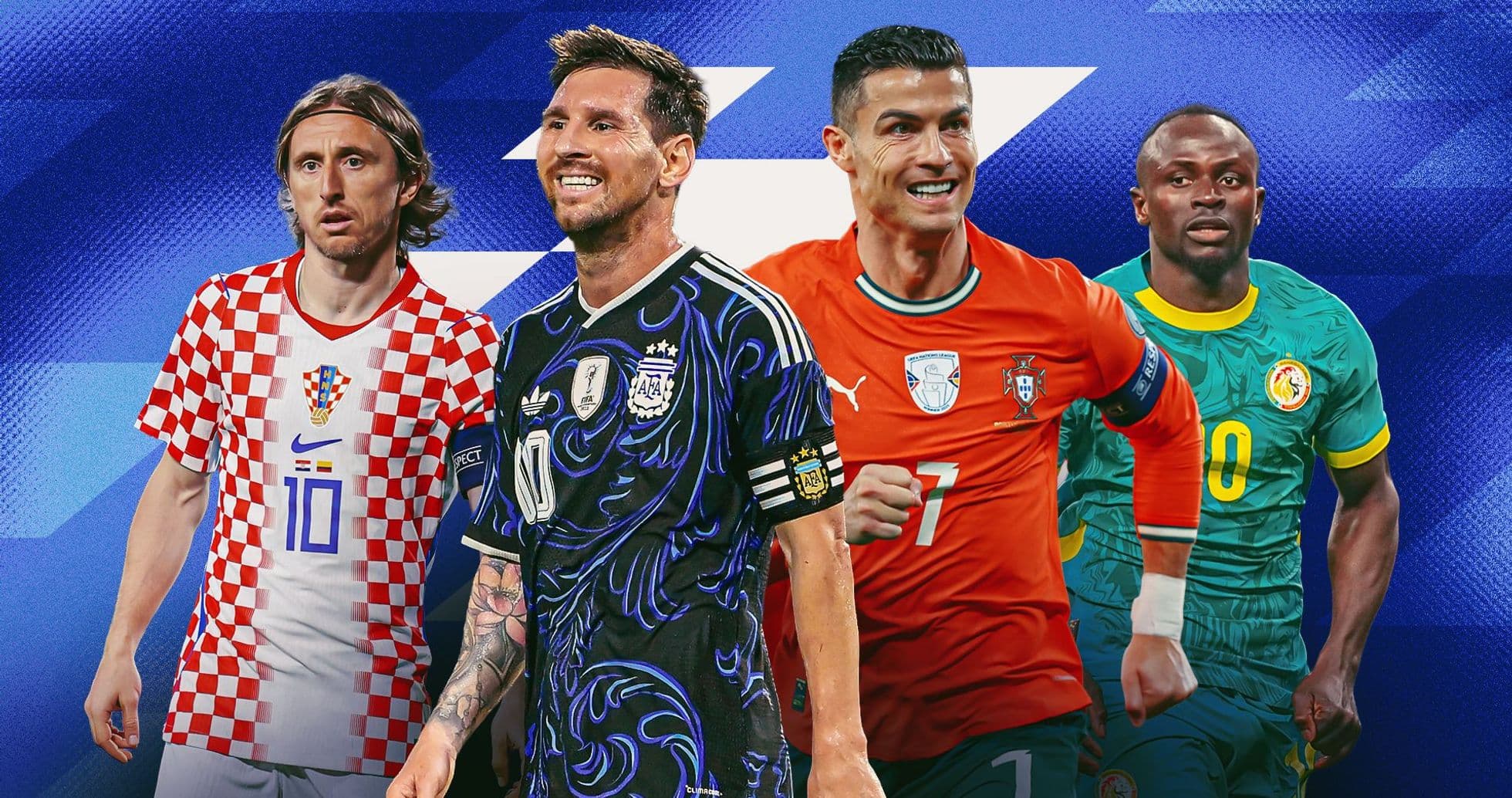
Messi, Ronaldo and the last great duel with time
Lionel Messi turns 39 with a sixth World Cup in his sights, a number that would have sounded absurd when he first appeared as a shy teenager in 2006. The one trophy that tormented him for so long now sits safely on his mantle after Argentina’s epic win over France in 2022, yet he is not done with the tournament that defined so much of his story.
Since that night in Lusail, Messi has traded Europe’s relentless grind for the pastel sunsets and packed stadiums of MLS with Inter Miami. The pace is kinder, the spotlight just as bright. His minutes are managed, his body protected, but for Argentina he still turns up, still unlocks defences with the kind of vision players half his age can’t even imagine.
Doubts swirl around him again: the expanded format, the travel, the heat that will suffocate parts of North America. Logic says this is a bridge too far. History says you underestimate Messi at your peril.
Cristiano Ronaldo, meanwhile, chases the one prize that continues to elude him. At 41, he would become the oldest player ever to lift the World Cup if Portugal go all the way. His résumé is almost complete: five Ballons d’Or, a European Championship, a Nations League title, a mountain of goals. But no World Cup, and not a single goal in the knockout rounds of the tournament.
It should be over by now. It isn’t. Ronaldo still scores relentlessly for Al-Nassr in Saudi Arabia, still trains like a man trying to impress a coach for the first time, still insists retirement can wait. Portugal’s squad is overflowing with talent – Rafael Leao, Pedro Neto, Goncalo Ramos and a new generation impatient for their turn – yet Roberto Martinez continues to build his side with Ronaldo as the central pillar.
Like Messi, he is heading for a sixth World Cup. Unlike Messi, this is his last chance to rewrite that uncomfortable World Cup chapter.
Ochoa, Neuer and the goalkeepers who refuse to fade
Guillermo Ochoa has been part of the World Cup furniture for two decades, a man who seems to come alive every four years, throw on a Mexico shirt and turn into a superhero. This time, his inclusion was anything but guaranteed.
Past 150 caps, and with just one appearance for El Tri since the CONCACAF Nations League finals in March 2024, Ochoa looked destined to watch this tournament from home. Then came Angel Malagon’s Achilles injury in March, and the door creaked open again. Javier Aguirre walked through it, bringing back the 40-year-old to represent one of the co-hosts one more time.
His club career has zig-zagged across Europe – Spain, Italy, France, Portugal, Belgium – and most recently Cyprus with AEL Limassol. He has hinted this World Cup will be his last act. For a generation, the sight of Ochoa flinging himself across goalmouths has been as much a part of the tournament as opening ceremonies and penalty shootouts. One more summer, then goodbye.
Germany have their own throwback in goal. With Marc-Andre ter Stegen battling injuries and doubts lingering over Oliver Baumann, Julian Nagelsmann reached for a familiar name and dragged Manuel Neuer out of international retirement.
Neuer, 40, had stepped away after Euro 2024 on home soil, one of several veterans who decided the curtain had fallen on their Germany careers. A strong season with Bayern Munich changed the conversation. Nagelsmann has not only brought him back, he has handed him the gloves as No.1 for a fifth World Cup, trusting him to steady a team desperate to avoid a third straight group-stage humiliation.
Modric and Dzeko: final chapters for quiet giants
Luka Modric, now 40, remains the heartbeat of Croatia’s footballing identity. He led them to their first World Cup final in 2018, then dragged them to third place in 2022. Each time, Croatia punched above their weight, and each time Modric was the metronome, the mind and the soul.
After leaving Real Madrid, he joined AC Milan last summer, a move designed to keep his legs ticking over rather than chase another superclub peak. He heads to his fifth World Cup on the brink of an exclusive club: he is set to become only the fourth player to reach 200 international caps, likely just behind Messi, who sits on 198 to Modric’s 197.
Edin Dzeko walks a different path to the same stage. For years, Bosnia and Herzegovina’s absence from major tournaments suggested his World Cup story had ended in 2014, their only appearance. Their qualifying struggles hardened that belief.
Then came one last surge. Bosnia beat Italy in the UEFA play-offs, and Dzeko, now 40, will step out in North America having dragged his country back to the top table. With more than 70 goals and close to 150 caps, he remains their defining figure. A January move to Schalke revived his club career, his goals firing them back into the Bundesliga. For a striker who deserved more World Cup nights than he got, this feels like overdue recognition – a final bow on the stage he earned long ago.
Asia and Africa’s icons eye the exit
South Korea may soon confront life after Son Heung-min. He turns 34 in July, still the nation’s captain, still its obsession. The pressure on him is relentless: score, create, lead, smile, repeat. He has already stepped away from European football to join LAFC in MLS, a decision that suggests he is managing his load carefully.
By the end of this World Cup, Son may decide he has given enough to the national cause. For a country that measures itself through the fortunes of its football team, that would be a seismic moment.
Mohamed Salah, just days older than Son, has carried Egypt even more heavily. For years, he has been the face, the finisher and the fallback plan. This time he does at least have some help, with Manchester City’s Omar Marmoush fronting a more capable supporting cast, but the Pharoahs will still turn to Salah when it matters.
His Liverpool form has dipped sharply over the last 12 months, and his only previous World Cup, in 2018, was scarred by the shoulder injury he suffered in the Champions League final. For a player of his stature, that World Cup record feels incomplete.
A move to Saudi Arabia looks likely after his departure from Anfield, a sign that the wind-down has begun. Expecting him to carry Egypt beyond this summer might be optimistic. Expecting him to approach this tournament with anything less than a desperate hunger would be naïve.
Sadio Mane completes the trio of African legends on the clock. Now 34, he has been the face of Senegal’s golden era. His penalty sealed the country’s first Africa Cup of Nations title in 2021, and he drove them to back-to-back World Cup qualifications, even if injury cruelly kept him out in 2022.
His move to Al-Nassr has taken him out of the European spotlight, but not out of Senegal’s plans. He still wears the armband, still sets the standard. Around him, Ismaila Sarr and Illiman Ndiaye are blossoming, ready to take on more responsibility. Mane’s leadership and experience could be the difference between a respectable showing and a deep run in 2026.
Riyad Mahrez, 35, remains one of the most elegant players Africa has produced. The first touch, the feints, the drifts inside that defenders still can’t read – they all endure. Yet his World Cup history is remarkably thin: just one appearance, in 2014, as Algeria’s long absence from the tournament stretched on.
Algeria’s return gives Mahrez a rare chance to leave a mark on the competition that has largely passed him by. Now at Al-Ahli in Saudi Arabia, he is clearly in the twilight of his career. This summer offers him the platform his talent has always deserved.
Europe’s fading masterminds and defensive rocks
Kevin De Bruyne has been the brain of Belgium’s so-called Golden Generation, but that era is fading fast. His first season at Napoli after leaving Manchester City has been disjointed, injuries eating into his rhythm and sparking fears that his body is starting to betray him as he nears 35.
When he is fit, nobody doubts him. De Bruyne still sees passes others don’t, still hits shots that bend away from despairing goalkeepers, still dictates games from deep or advanced positions. Belgium are in transition under Rudi Garcia, the old guard thinning out, the shine of that “Golden Generation” label dulled. Yet De Bruyne remains the man everything runs through. If he stays healthy, the Red Devils could be far more dangerous than their recent record suggests.
Virgil van Dijk, who will turn 35 during the tournament, anchors a Netherlands side that leans heavily on his presence. For years, he has been the defensive benchmark at Liverpool, the centre-back attackers openly admitted they tried to avoid facing one-on-one.
The last season has raised questions. On Merseyside, some fear he has lost a fraction of pace, that his anticipation is not as razor-sharp as it once was. For the Dutch, he is still the captain, the organiser, the man they look to when the temperature rises. This is likely his second and final World Cup. He will want it to look more like his prime than his decline.
James Rodriguez, a star of the 2014 World Cup, turns 35 in July and remains a totemic figure for Colombia. That tournament, with its wonder goals and joyous swagger, changed his life and earned him a move to Real Madrid. The years since have been more complicated.
Injuries have chopped his club career into short stints: a spell here, a cameo there, most recently with Minnesota United in MLS. Through it all, he has consistently found a way to rise to the occasion in Colombia colours. He owes his career to the World Cup. A final appearance on the stage that made him feels like the right kind of symmetry.
Neymar’s last roll of the dice
For Neymar, the road to 2026 has been jagged, painful and often lonely. Brazil’s all-time leading scorer has not played for his country since tearing his ACL in October 2023. When Carlo Ancelotti took over as Brazil coach in September and repeatedly left him out, the idea of one last World Cup felt like a fantasy.
Then injuries hit Brazil’s forward line. Ancelotti turned, almost at the last minute, and handed Neymar a place in his 26-man squad. The reaction back home was instant and wild. For many Brazilians, a World Cup without Neymar still feels unthinkable.
What role he will play remains unclear. He is 34, officially a Santos player again, and he suffered yet another injury just days after receiving his call-up. His body keeps sending the same message: enough.
The idea of him lasting until 2030 is unrealistic. This is it. One last chance to chase that sixth star, one last chance to reshape a World Cup record that never quite matched the talent.
Kane and England’s looming crossroads
Harry Kane arrives in North America at 32, in the sweet spot of a striker’s career, and fresh from a season in which he scored more than 60 goals for Bayern Munich. He is England’s all-time leading scorer, the undisputed focal point of their attack.
He could, in theory, keep going until 2030. England fans would welcome that, especially given the drop-off to those behind him in the pecking order. Yet the calendar offers a natural exit ramp: Euro 2028, on home soil, where England will be co-hosts.
A major tournament at home is a seductive place to say goodbye. For Kane, it could be the perfect stage to close his international career, particularly if it brings the trophy that has eluded England since 1966.
That same logic may appeal to others. Jordan Pickford, John Stones, perhaps even Marcus Rashford could view this World Cup as their final one, with Euro 2028 the moment to bow out in front of their own fans.
Across continents and generations, the pattern is the same. Legends clinging to one more summer. Bodies creaking, minds still sharp, legacies largely secure yet not quite complete. North America will not just host a World Cup. It will host the last stand of an era.