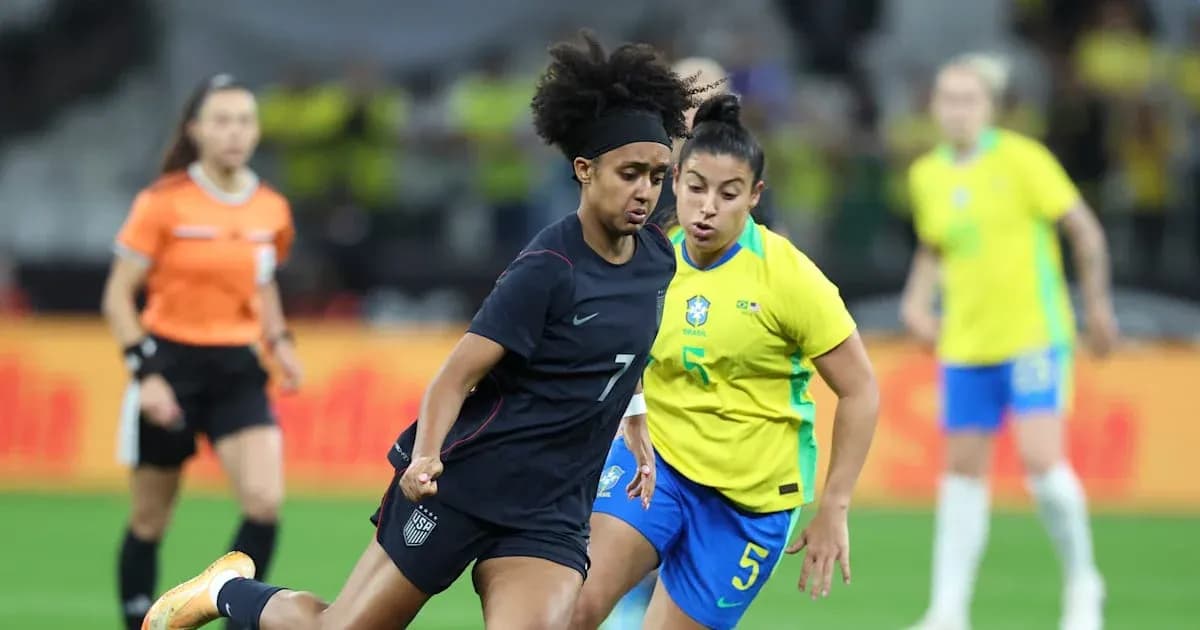
U.S. Women's National Team Faces Brazil in Hostile Environment
The United States women’s national team are used to being the destination. Opponents fly in, jet-lagged and wide-eyed, to face them in familiar American stadiums with familiar American comforts.
This June, the roles flipped.
Emma Hayes took her new-look squad into the heart of Brazil for back-to-back friendlies, a dry run for what could await them at the 2027 Women’s World Cup. No neutral ground. No soft landing. Just noise, heat and a South American side that already knows how to beat them.
Baptism in Brazil
From the first whistle on Saturday, the U.S. stepped into something different. The sound never dipped. Whistles, jeers, roars. Ninety minutes of hostility wrapped around a young team still learning how to suffer together.
“It was an amazing atmosphere and it’s one that, as much as I can prepare my team for this, you don’t really know until you experience it,” Hayes said afterwards. “I am sure for many of my players, this is the first time they’ve ever experienced an intensity [like that] from the crowd.”
Brazil brought exactly what you’d expect: physical duels, collisions on every second ball, stretches of what Hayes has called “chaos ball”. The U.S. are used to dictating tempo; here, they were dragged into a game that refused to sit still.
Hayes wanted that. She has been clear since taking over that the rebuild will not be built on comfort. With World Cup qualifiers looming in November and a likely return to South America next year, she is pushing this group into the deep end.
“I am so happy for the experience, because if we want things to be easy, we stay at home and play in LA or somewhere else,” she said. “We don’t want easy.”
Fast start, faster punch back
For a moment, it looked like the U.S. might quiet the noise. Sophia Wilson struck early, her first goal since returning to the national team, and the visitors had the perfect platform.
It didn’t last.
Brazil hit back with a rapid double, turning 0-1 into 2-1 inside 15 minutes and sending the crowd into another gear. The U.S. never truly recovered their attacking edge. They probed, they had half-chances, but clear looks at goal were rare against a home side that defended with discipline and relish.
Inside the camp, there was no attempt to dress it up. The message was simple: this is about us, not them. The defeat becomes a tool, not a trauma, as they move into Tuesday’s second meeting.
Learning to live in the chaos
Captain Lindsey Heaps cut straight to the heart of the challenge.
“It’s difficult when it’s a game like that, when you’re being thrown to the ground multiple times and calls aren’t going your way,” she said. “But it’s up to us – it’s that mental capacity to stay in a game like that.
“I’m really proud of our team because we stayed level-headed and we still created opportunities, but it’s about having that experience to get that goal back and walk away with a result from this kind of game.
“It’s hard but I think that emotional control has gotten so much better throughout this past year.”
That emotional control might be the most important currency in the Hayes era. The U.S. have long had talent, depth, medals. What they need now, in hostile venues and knockout qualifiers, is the ability to ride out injustice, ignore the whistle, and still find a way.
Wilson echoed that sentiment. Her return to the scoresheet was a personal milestone, but her focus stayed on the collective response.
“We needed to do a better job of controlling the game and keeping that lead, but it was a really good test for us, and we felt what it is like to play here in their home country,” she said. “I think we can take what we need to from this game and the nice part is we get to go again in a few days.”
The second half in particular offered Hayes a different kind of data. The U.S. did not implode. They held their shape, kept their composure, and tried to manage the tempo in a stadium that wanted the match to spin out of control.
A 45th chapter, and a warning
Tuesday’s game in Fortaleza will be the 45th meeting between these two sides, but the stakes are more psychological than historical. The U.S. are staring at the possibility of a third straight defeat to Brazil. For a program built on dominance, that matters.
They will walk into another charged arena, another night of whistles and waving flags, another test of whether this group can adapt on the fly. Hayes has made it clear: they chose this path. They chose the noise, the discomfort, the risk of losing in order to learn how to win when it counts.
The question now is not whether Brazil can unsettle them. That has already been answered. The question is whether this U.S. team can turn that discomfort into an edge before the real exams arrive.