Torino's Tactical Shift Secures 2–1 Victory Over Sassuolo
Torino’s 2–1 comeback over Sassuolo at Stadio Olimpico Grande Torino in Serie A round 36 was a match defined by structural tweaks and superior chance creation rather than sheer dominance of the ball. Leonardo Colucci’s side, in a 3-4-2-1, absorbed a slightly lower share of possession (48%) but translated their territory into a higher volume and quality of shots, while Fabio Grosso’s 4-3-3 Sassuolo threatened in phases yet lost control once Torino’s wing-backs and forwards were reconfigured around the hour.
Disciplinary Profile
The disciplinary profile underpinned the game’s intensity. Card log, in chronological order:
- 38' Luca Lipani (Sassuolo) — Foul
- 51' Luca Marianucci (Torino) — Foul
- 63' Matteo Prati (Torino) — Foul
- 86' Kristian Thorstvedt (Sassuolo) — Foul
- 89' Niels Nkounkou (Torino) — Foul
- 90+3' Gvidas Gineitis (Torino) — Foul
Totals: Torino 4 yellow cards, Sassuolo 2 yellow cards, Total 6.
Scoring Sequence
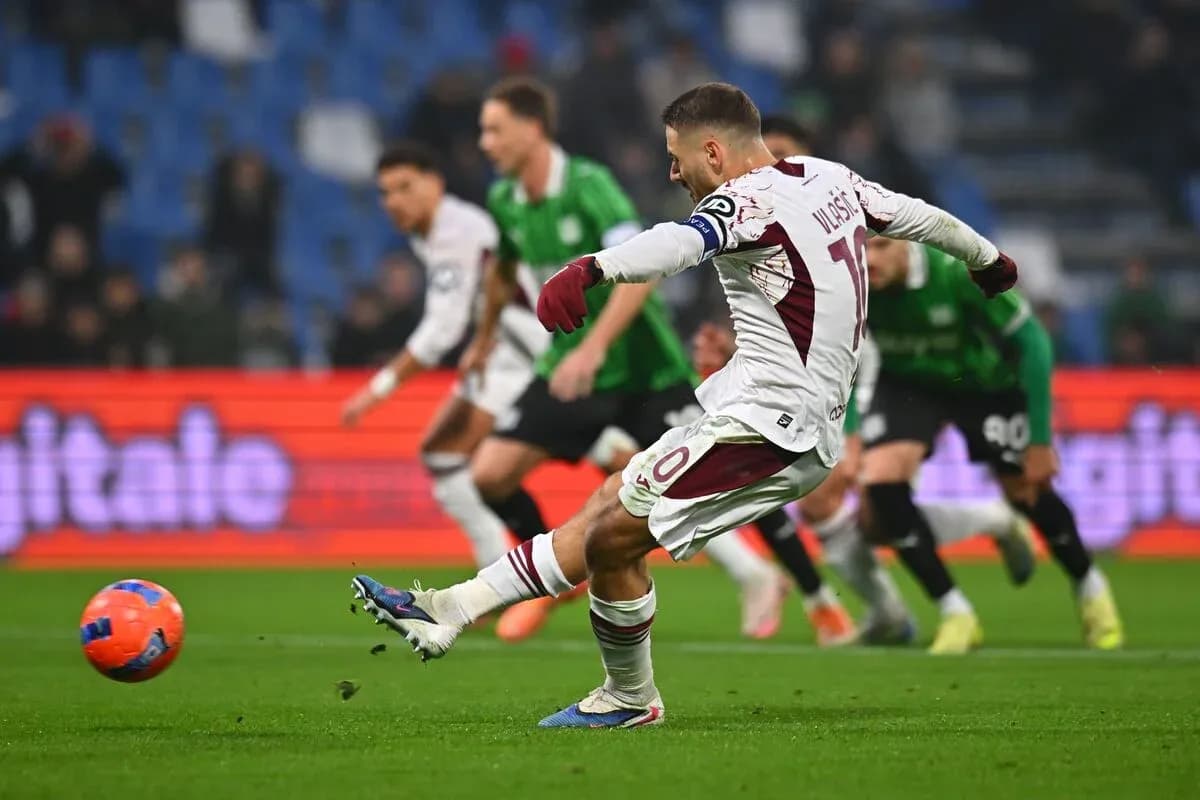
The scoring sequence unfolded after a tight, goalless first half in which Sassuolo’s 52% possession and 7 shots on target overall point to a side comfortable circulating from the back, but initially lacking incision. The breakthrough came at 51': Kristian Thorstvedt finished for Sassuolo, assisted by Luca Lipani, exploiting a central lane that had been stretched by the front three’s movement. Almost immediately around that moment, Luca Marianucci’s yellow card signalled Torino’s growing defensive strain as they tried to halt transitions.
Colucci’s response was decisive. At 59', Duvan Zapata (IN) came on for A. Njie (OUT), and M. Pedersen (IN) came on for V. Lazaro (OUT), rebalancing Torino’s front and flank dynamics. Although Matteo Prati was booked at 63' for a Foul, Torino’s structure was already shifting. On the other side, Grosso altered his midfield and front line: at 63', D. Berardi (IN) came on for C. Volpato (OUT), and I. Kone (IN) came on for L. Lipani (OUT), removing the booked regista and adding creativity but also losing some of Lipani’s positional discipline.
Torino’s equaliser at 66' came through G. Simeone, assisted by E. Ebosse. It reflected the 3-4-2-1’s capacity to create overloads down the side of Sassuolo’s back four: Ebosse stepped up from the left of the back three, exploiting the space behind the full-back line and delivering for Simeone, who benefited from improved central occupation after Zapata’s introduction. One minute later, Colucci fine-tuned the midfield: E. Ilkhan (IN) came on for M. Prati (OUT) at 67', adding fresher legs and slightly more verticality in the double pivot.
The turnaround was complete at 70', when M. Pedersen scored, assisted by D. Zapata. This goal was the clearest expression of Torino’s new attacking pattern: Zapata operating as a reference and wall player, pinning centre-backs and then releasing a late-arriving wide runner. Pedersen, nominally a defender, functioned as an aggressive wing-back, attacking the far side as Sassuolo’s 4-3-3 narrowed to protect central spaces.
Late Changes
Grosso’s reaction came late and was more like-for-like than structural. At 75', U. Garcia (IN) replaced J. Doig (OUT), followed by M. Nzola (IN) for A. Pinamonti (OUT) at 76', and D. Bakola (IN) for N. Matic (OUT) at 84'. These swaps freshened the full-back, centre-forward, and midfield roles but did not fundamentally change the 4-3-3’s dynamics. By then, Torino’s back three plus a compact midfield box were well set to manage crosses and half-space runs.
In the closing stages, discipline again shaped the rhythm. Thorstvedt’s yellow at 86' for a Foul came as Sassuolo chased the game and pressed higher, exposing them to late challenges. Colucci then protected his lead and key assets: at 86', S. Kulenovic (IN) came on for G. Simeone (OUT), and N. Nkounkou (IN) came on for R. Obrador (OUT), reinforcing the flank and adding defensive energy. Nkounkou’s own yellow at 89' and Gvidas Gineitis’ at 90+3', both for Foul, were consistent with a Torino side willing to break up play and accept bookings to manage the final minutes.
Statistical Standpoint
From a statistical standpoint, Torino’s plan is clearly validated. They produced 18 total shots to Sassuolo’s 14, with a heavy concentration inside the box (13 vs 11). Their expected goals of 2.82 against Sassuolo’s 2.1 underline that, despite having slightly less of the ball, Torino generated the better quality chances. The fact that Torino only needed 4 shots on target to score twice, while Sassuolo required 7 shots on target for a single goal, hints at shot quality and shot location: Sassuolo were more volume-efficient on target, but many attempts likely came from less favourable angles or under pressure.
Passing data supports the stylistic contrast. Sassuolo completed 418 of 480 passes (87%), Torino 373 of 439 (85%). Sassuolo’s marginally higher pass completion and possession align with a more controlled, build-up oriented 4-3-3. Torino’s slightly lower volume and accuracy but higher shot count fit a more vertical, territory-focused 3-4-2-1 that sought to break through lines quickly once possession was won.
Defensively, goalkeeper metrics are telling. A. Muric made 2 saves for Sassuolo, while A. Paleari made 5 for Torino. This confirms that Sassuolo did manage to test Paleari more often, but the xG balance and final score indicate that Torino’s defensive structure, despite conceding shots, limited truly high-value chances and then capitalised ruthlessly at the other end. Both keepers show identical goals prevented values of -0.25, suggesting neither significantly over- nor under-performed versus shot quality; the difference lay in how well their respective defensive blocks protected key zones.
Overall, Torino’s higher expected goals, superior shot profile, and effective in-game adjustments from Colucci outweighed Sassuolo’s cleaner possession and passing metrics. The 2–1 scoreline reflects not only resilience after going behind but also a coherent tactical shift around the hour that reoriented the match decisively in Torino’s favour.