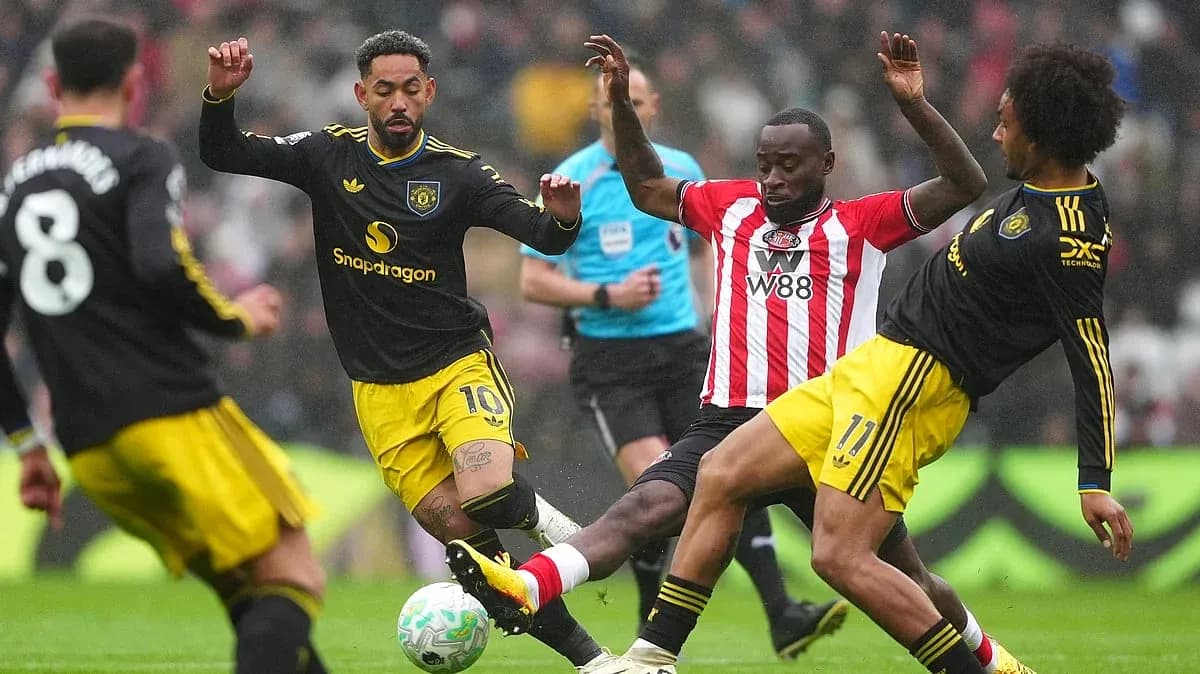
Sunderland vs Manchester United: Tactical Battle Ends in Goalless Draw
The Stadium of Light had the feel of a crossroads fixture rather than a dead rubber. Sunderland, 12th in the Premier League heading into this game with 48 points and a goal difference of -9 (37 scored, 46 conceded overall), welcomed a Manchester United side sitting 3rd on 65 points with a goal difference of 15 (63 for, 48 against overall). Round 36, a tight table, and two clubs whose seasons have been defined by very different attacking identities – all of it funnelled into a 0-0 that said as much about structure and discipline as it did about missed opportunity.
For Sunderland, this campaign’s DNA has been about balance and survival at this level. At home they average 1.3 goals scored and 1.1 conceded, built on a compact base and selective risk-taking. Manchester United, by contrast, have been one of the division’s more expansive sides: on their travels they average 1.5 goals for and 1.4 against, a high-event profile that usually guarantees drama. The surprise, then, was not that Sunderland held their own; it was that they managed to drag United into their kind of game.
Lineups
Regis Le Bris’ lineup underlined that intention. Robin Roefs in goal sat behind a robust back four of Lutsharel Geertruida, Nordi Mukiele, Omar Alderete and Reinildo Mandava – a unit built more for duels and blocks than for sweeping overlaps. In front, Granit Xhaka anchored a midfield cluster with Noah Sadiki, Trai Hume, Enzo Le Fée and Chemsdine Talbi, all tasked with compressing the central lane and shielding lone forward Brian Brobbey.
Michael Carrick’s United, even without a listed formation, carried the hallmarks of his season-long approach. Senne Lammens started in goal, with Noussair Mazraoui, Harry Maguire, Lisandro Martínez and Luke Shaw across the back. The midfield square of Mason Mount and Kobbie Mainoo behind Amad Diallo, Bruno Fernandes and Matheus Cunha supported Joshua Zirkzee up front. On paper, it was a side built to overload Sunderland between the lines; in practice, they were repeatedly funneled into the traffic of Xhaka and Le Fée.
Absences
The tactical voids on both sides were significant. Sunderland were without Daniel Ballard through suspension (red card) and R. Mundle with a hamstring injury – a double hit that stripped Le Bris of a dominant aerial defender and a wide outlet. The absence of Ballard, who has already taken one red card this season and is a key blocker (24 blocked shots overall), forced Alderete and Mukiele to shoulder more responsibility in the box.
United’s own absences were just as disruptive. Benjamin Šeško, their leading league scorer with 11 goals, missed out with a leg injury, and M. de Ligt was sidelined by a back problem. Without Šeško’s penalty-box presence and vertical threat, United’s attack leaned even more heavily on the creative spine of Fernandes and the multi-faceted movement of Cunha.
Discipline
Discipline hovered over the contest like a quiet threat. Sunderland’s season-long yellow-card pattern shows a pronounced spike between 46-60 minutes (23.38%), with another surge from 61-75 (18.18%) and 76-90 (16.88%). United mirror that volatility: 21.31% of their yellows come between 46-60 minutes, with 19.67% in the final quarter-hour. Both sides are clearly most combustible in the second half, and that knowledge informed the risk management in midfield. Reinildo, who has already seen red once this season, trod a fine line in his duels with Cunha and Amad. On the other side, Maguire – also with a red card this campaign – had to be measured stepping out to challenge Brobbey.
Overall Performance
In the “Hunter vs Shield” matchup, United arrived as the hunters. Overall they average 1.8 goals per game, with 2.0 at home and 1.5 on their travels, powered by a spread of scorers: Šeško’s 11, plus 9 apiece from Bryan Mbeumo, Casemiro and Cunha. Sunderland’s shield has been sturdier at the Stadium of Light than their overall goal difference suggests: 19 conceded at home from 18 matches, with 7 clean sheets. Holding United to zero fit that profile. Xhaka’s reading of play (49 tackles, 20 blocks, 29 interceptions overall) and Le Fée’s work rate (83 tackles, 11 blocks, 27 interceptions overall) allowed Sunderland to crowd the half-spaces where Fernandes normally thrives.
Yet the “Engine Room” duel was never going to be one-way traffic. Fernandes is the league’s leading provider with 19 assists and 8 goals, underpinned by 1,881 passes and a remarkable 125 key passes overall. He is United’s metronome and chaos agent in one. Sunderland’s answer was a double pivot of control and bite: Xhaka as the deep organiser, Le Fée as the shuttle. Le Fée’s 48 key passes and 5 assists this season made him Sunderland’s main creative valve, and his duel with Mainoo and Mount was about more than territory; it was about who could dictate tempo. United’s midfield, though, kept him largely on the periphery, forcing Sunderland to rely on longer, straighter passes into Brobbey and the channels for Talbi.
Out wide and in the half-spaces, secondary battles shaped the flow. Trai Hume, who has 9 yellow cards this season and a high duel volume (321 duels, 171 won), played on the edge against Cunha and Amad, knowing that a mistimed challenge could tilt the game. On United’s left, Shaw’s overlaps had to be measured against the counter threat of Talbi and the underlapping runs of Sadiki.
Statistical Prognosis
From a statistical prognosis perspective, a goalless draw between these profiles is an outlier but not a shock. Sunderland’s attack is modest overall at 1.0 goals per game, and they have failed to score in 13 league matches. United, for all their 63 goals, have also drawn a blank 4 times and kept only 7 clean sheets. The underlying numbers point to a game where United would normally shade xG through volume, but Sunderland’s structure and home defensive record make them adept at compressing those chances into lower-quality shots.
Following this result, the narrative is clear. Sunderland confirmed their identity as a mid-table side with a solid home platform, tactical discipline and a midfield capable of stifling even elite creators when the collective block is right. Manchester United, meanwhile, were reminded that without Šeško’s penalty-box gravity and with their attack forced into crowded central zones, their impressive season-long scoring rate can still be neutralised.
In the end, this was a match where systems beat stars. The Stadium of Light did not witness the fireworks the league table promised, but it did showcase two teams leaning fully into their seasonal blueprints – Sunderland to survive and stabilise, United to control and probe – and, for one afternoon, cancelling each other out.