Mallorca and Villarreal Share Points in Tactical Stalemate
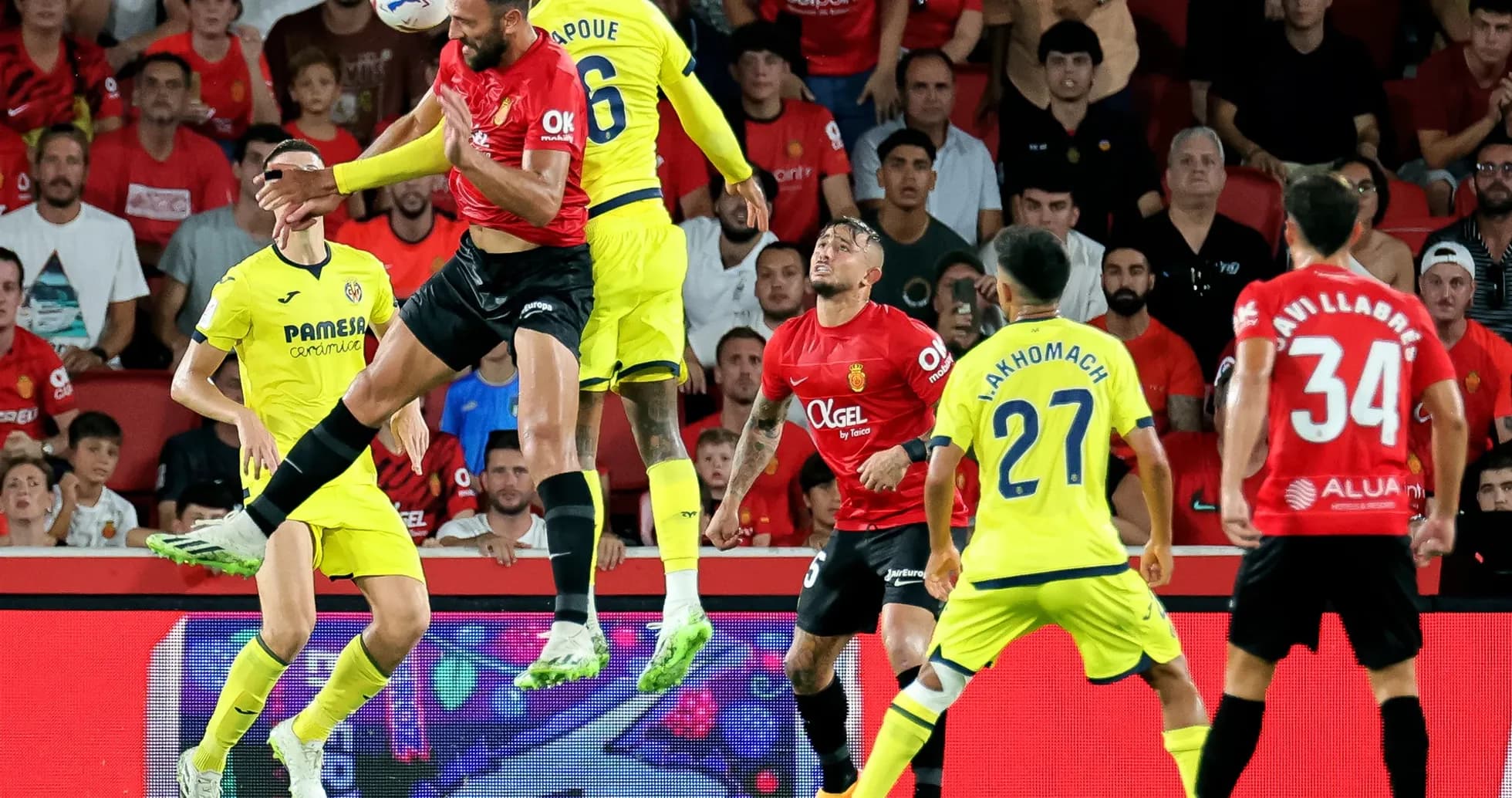
Mallorca and Villarreal shared a 1-1 draw at Estadi Mallorca Son Moix in La Liga’s Regular Season - 35, a contest defined by contrasting structures and a clear territorial edge for the hosts against the punchier, more economical visitors. Mallorca’s 4-3-1-2 under Martin Demichelis sought to dominate central spaces and volume of attacks, while Marcelino’s 4-4-2 for Villarreal prioritised compactness, vertical transitions and efficiency in both boxes. The scoreboard reflected parity, but the tactical story leaned toward Mallorca’s control against Villarreal’s resilience and goalkeeping excellence.
Mallorca 1-1 Villarreal at full time, with the half-time score also 1-1.
I. Executive Summary
Mallorca built their game on possession (56%) and high shot volume (18 total shots, 10 inside the box), using a narrow diamond structure to overload central zones and release full-backs. Villarreal, with 44% possession and only 7 shots, leaned on defensive organisation and the shot-stopping of Arnau Tenas (7 saves) to survive long stretches without the ball. The penalty converted by Ayoze Pérez and the equaliser from Vedat Muriqi framed a first half where both teams’ plans briefly clicked; the second half was more about adjustments, substitutions, and Mallorca’s sustained but ultimately frustrated pressure.
II. Scoring Sequence & Disciplinary Log
Chronologically, the decisive attacking moments started with a key VAR intervention.
At 29', a potential penalty for Villarreal involving Sergi Cardona was checked: the VAR event recorded as “Penalty confirmed” validated the decision for the visitors. That confirmation shaped the immediate tactical landscape, forcing Mallorca’s back line and pivot to recalibrate their risk profile in defensive duels.
At 31', Ayoze Pérez (Villarreal) converted the resulting penalty, giving the visitors a 0-1 lead. The goal aligned with Villarreal’s plan: absorb pressure, then exploit decisive moments rather than volume.
Mallorca responded structurally rather than chaotically, maintaining their 4-3-1-2 but pushing their midfield line higher. The reward came at 45', when Vedat Muriqi (Mallorca) scored a normal goal to level the match at 1-1, the score at half-time. His strike underlined Mallorca’s use of central occupation and crossing angles to find their target forward.
The disciplinary sequence, fully contained in the second half, reflected growing tension as Mallorca chased a winner:
- 71' Samú Costa (Mallorca) — Argument
- 73' Vedat Muriqi (Mallorca) — Foul
Card counts, locked from the data: Mallorca: 2, Villarreal: 0, Total: 2.
No Villarreal player was booked, reinforcing the picture of a disciplined, compact block that largely avoided risky challenges in dangerous areas.
III. Tactical Breakdown & Personnel
Mallorca’s 4-3-1-2 featured Leo Román in goal behind a back four of Mateu Morey, Martin Valjent, Omar Mascarell and Johan Mojica. The midfield triangle of Samú Costa, Sergi Darder and Manu Morlanes, with Pablo Torre as a narrow playmaker behind Zito Luvumbo and Vedat Muriqi, was designed to dominate central corridors. Their 454 total passes, 391 accurate (86%), show a possession structure with good technical execution and circulation.
The build-up typically saw Mascarell stepping out as a ball-playing defender, with Darder dropping to connect phases and Torre operating between Villarreal’s lines. Full-backs Morey and Mojica provided width, allowing Luvumbo to attack the half-spaces and Muriqi to fix centre-backs. The 18 total shots (8 on goal, 10 inside the box) and xG of 1.74 confirm that Mallorca’s positional play translated into sustained chance creation, even if the finishing didn’t tilt the scoreline beyond 1-1.
Villarreal’s 4-4-2 was more conservative. Arnau Tenas in goal, protected by Santiago Mouriño, Rafa Marín, Renato Veiga and Sergi Cardona, formed a compact defensive shell. The midfield of Tajon Buchanan, Santi Comesaña, Thomas Partey and Alfon González worked horizontally, shifting to close Mallorca’s central overloads and protect the half-spaces. Ayoze Pérez and Tani Oluwaseyi led the line, offering depth and pressing triggers rather than constant possession involvement.
Villarreal’s 381 passes, 304 accurate (80%), reflect a more direct, transitional approach. With only 7 shots (2 on goal) but an xG of 1.13, their attacks were fewer but not entirely speculative, anchored by the high-value penalty and selective incursions.
Goalkeeper reality was decisive. Leo Román registered 1 save, which, combined with Villarreal’s xG of 1.13 and Mallorca’s “goals prevented” figure of 2.46, suggests a match where defensive interventions and structural protection limited Villarreal’s shot quality beyond the penalty. Arnau Tenas, by contrast, made 7 saves, a critical factor in preserving Villarreal’s point given Mallorca’s 8 shots on target and xG of 1.74. Villarreal’s own “goals prevented” value of 2.46 underscores just how much work Tenas and his defensive unit did to keep the score level.
Substitutions adjusted the tactical balance rather than transforming it. At 62', Toni Lato (IN) came on for Johan Mojica (OUT), offering fresh legs on the left flank but maintaining the same role profile. At 63', Villarreal refreshed their front line and left midfield: Nicolas Pépé (IN) came on for Tani Oluwaseyi (OUT), adding more individual threat in transition, while Alberto Moleiro (IN) came on for Alfon González (OUT), providing more ball-carrying and technical security on the flank.
At 70', Mallorca doubled down on width and energy: Jan Virgili (IN) came on for Manu Morlanes (OUT), and Miguel Calatayud (IN) came on for Mateu Morey Bauza (OUT), maintaining the back-four structure while injecting pace and attacking intent from deeper areas. Villarreal at the same minute replaced their goalscorer: Georges Mikautadze (IN) came on for Ayoze Pérez (OUT), preserving the 4-4-2 shape but with a different type of forward for running in behind.
At 71', Gerard Moreno (IN) came on for Tajon Buchanan (OUT), tilting Villarreal’s right side towards more technical combination play and a threat cutting inside. At 75', Dani Parejo (IN) came on for Santi Comesaña (OUT), shifting Villarreal towards more controlled possession in the final phase. Finally, at 76', David López (IN) came on for Pablo Torre (OUT), giving Mallorca a more conservative, structurally solid profile in advanced midfield, potentially to guard against counters while still sustaining pressure.
The yellow card for Samú Costa at 71' (“Argument”) reflected rising emotional temperature as Mallorca pushed for a winner and disputed decisions. Muriqi’s 73' booking (“Foul”) was a direct by-product of his aggressive role as a pressing and duelling focal point.
IV. The Statistical Verdict
Statistically, Mallorca’s Overall Form in this match was that of a proactive, possession-heavy side: more shots (18 vs 7), more shots on goal (8 vs 2), more corners (5 vs 4), and higher passing volume and accuracy (454 passes, 391 accurate, 86%). Their xG of 1.74 indicates they created enough to justify at least the single goal they scored.
Villarreal’s Defensive Index is highlighted by their 7 goalkeeper saves, 0 yellow cards, and the same “goals prevented” value of 2.46 as Mallorca, underscoring an efficient, low-foul, high-resilience defensive display. With 13 fouls to Mallorca’s 17 and no bookings, they managed to disrupt without crossing disciplinary lines.
The 1-1 final score, with Mallorca’s 56% possession and Villarreal’s 44%, reflects a tactical equilibrium: Mallorca’s structured dominance versus Villarreal’s compactness and efficiency. From a tactical and statistical standpoint, Mallorca can argue they imposed their game, but Villarreal, through discipline and goalkeeping, extracted full value from their limited attacking moments.