Juventus Secures 1-0 Victory Over Lecce in Tactical Battle
Lecce 0–1 Juventus at Stadio Ettore Giardiniero – Via del Mare was a study in territorial control and defensive resilience. In this Serie A Regular Season - 36 fixture, Luciano Spalletti’s side struck immediately and then used the ball to suffocate the game, while Eusebio Di Francesco’s Lecce tried to stay compact and counter from a 4-2-3-1 base. Juventus’ early goal defined the tactical landscape: Lecce were forced to defend long stretches without the ball, yet stayed in the contest thanks to disciplined shape and key interventions from W. Falcone.
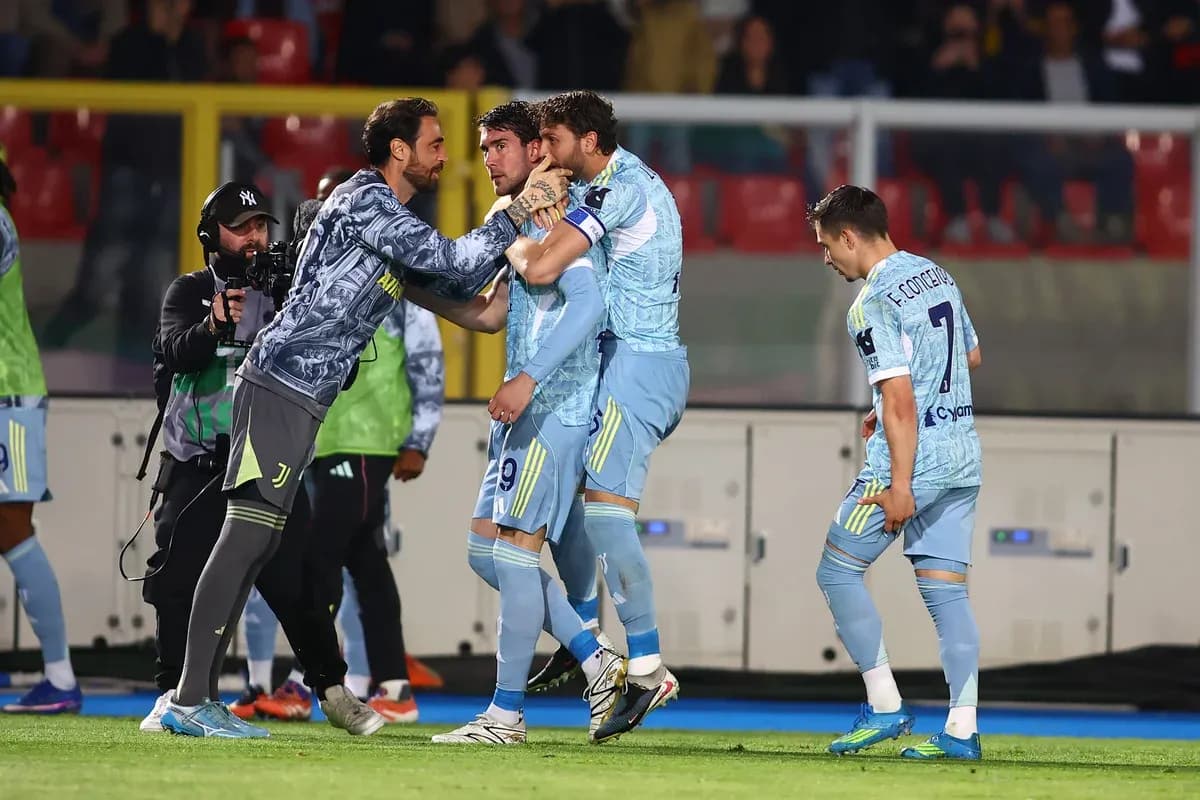
The scoring sequence began almost from kick-off. At 1', D. Vlahovic finished a move created down the Juventus left, converting a delivery from A. Cambiaso for 0–1. That early strike allowed Juventus to lean into their possession model and settle into a controlled 4-2-3-1 with M. Locatelli and T. Koopmeiners dictating tempo from the double pivot.
Two major VAR interventions shaped the second half but did not alter the scoreline. At 50', a Juventus goal involving Dušan Vlahović was cancelled after review. Again at 61', a potential goal linked to Pierre Kalulu was also ruled out by VAR. Both incidents underline how often Juventus were able to penetrate Lecce’s box (14 shots inside the area), even if the scoreboard stayed at 0–1.
Discipline was relatively clean but significant in its timing. Card verification from the events array yields: Lecce: 1, Juventus: 1, Total: 2.
Disciplinary log (all cards)
- 80' Francisco Conceição (Juventus) — Foul
- 82' Gaby Jean (Lecce) — Argument
Those late bookings reflected rising tension as Lecce pushed numbers forward and Juventus tried to manage transitions and break up play.
From a tactical standpoint, both teams lined up in 4-2-3-1 but applied the structure very differently. Juventus used their version as a dominance platform. With 65% possession and 501 total passes at 86% accuracy, Spalletti’s side built patiently from the back through Bremer and L. Kelly, using M. Locatelli as the primary outlet. T. Koopmeiners frequently dropped alongside him, creating a situational 2-3 rest defense in build-up, with full-backs A. Cambiaso and P. Kalulu positioned high to pin Lecce’s wide midfielders.
In the attacking band, F. Conceicao and K. Yildiz (from the left and right respectively in the starting grid) operated between Lecce’s lines, while W. McKennie made vertical runs from the central “10” space to support D. Vlahovic. The opening goal is a textbook example: Cambiaso advanced from left-back, exploiting the space outside Lecce’s narrow block, and Vlahovic attacked the central channel early, finishing before Lecce’s back four could compress.
Lecce’s 4-2-3-1 under Eusebio Di Francesco was far more reactive. The double pivot of Y. Ramadani and O. Ngom sat close to the back four, trying to screen passes into McKennie and deny central progress. The wingers L. Banda and S. Pierotti were often dragged deep, effectively forming a 4-4-1-1 without the ball. This compactness limited Juventus’ clear central shots but conceded territory: only 35% possession and 267 passes at 73% accuracy show how rarely Lecce could sustain attacks.
In transition, Lecce’s plan was to break quickly through L. Banda’s pace on the left and W. Cheddira’s runs in behind. However, with just 8 total shots (3 on target) and only 1 corner, they struggled to convert counters into sustained pressure. Juventus’ counter-press—especially from Koopmeiners and Locatelli—often stopped breakaways at source.
Goalkeeper reality was pivotal. W. Falcone made 5 saves, outperforming his xG-conceded profile: Juventus generated 2.16 xG but scored only once, while the data shows 0.64 goals prevented by Lecce’s keeper, matching the “goals_prevented” value. His positioning on cut-backs and one-on-ones, particularly after the interval, kept Lecce alive as Juventus repeatedly accessed the box. At the other end, M. Di Gregorio faced only 3 shots on target and made 3 saves, a controlled outing behind a defense that limited Lecce’s shot quality to 0.88 xG.
The substitution vector from Lecce was clearly aimed at injecting energy and directness. At 62', G. Jean (IN) came on for O. Ngom (OUT), adding a more aggressive profile in the back line and later becoming involved in the game’s emotional flashpoint, earning a yellow card for “Argument” at 82'. At 70', T. J. Helgason (IN) replaced D. Veiga (OUT), pushing Lecce towards a more attacking posture from midfield. At 76', F. Camarda (IN) came on for W. Cheddira (OUT) and K. Ndri (IN) for L. Banda (OUT), a double change that freshened both the central and wide attacking lanes but did not significantly alter the shot volume.
Juventus’ changes were primarily about game management and maintaining physical intensity. At 77', E. Holm (IN) came on for D. Vlahovic (OUT), sacrificing a pure striker for more defensive solidity and running on the flank. At 83', J. David (IN) replaced A. Cambiaso (OUT) and J. Boga (IN) replaced K. Yildiz (OUT), adding fresh attacking legs while slightly reshaping the front line. In the same minute, E. Zhegrova (IN) came on for F. Conceicao (OUT), ensuring that wide pressing and ball-carrying threat remained high despite the yellow card previously shown to Conceição at 80'. Finally, at 86', F. Gatti (IN) replaced W. McKennie (OUT), a clear move to lock down the result with extra defensive presence.
Statistically, the verdict reinforces the tactical story. Juventus’ 15 total shots to Lecce’s 8, and 14 of those from inside the box, underline how consistently they reached dangerous areas. Their 2.16 xG versus Lecce’s 0.88 reflects both higher volume and better quality of chances. Yet the final scoreline of 0–1, combined with identical goals prevented figures for both keepers (0.64), shows that finishing and goalkeeping compressed what could have been a wider margin.
Defensively, Lecce’s low foul count (7 to Juventus’ 18) suggests a strategy of positional defending rather than constant physical disruption, relying on shape rather than aggressive pressing. Juventus, by contrast, accepted a higher foul count as the cost of counter-pressing and late-game disruption, embodied in Francisco Conceição’s yellow for “Foul”.
Overall, Juventus’ superior Overall Form metrics—possession, passing accuracy, and xG—were matched by a strong Defensive Index: limiting Lecce to 3 shots on target and 0.88 xG away from home. Lecce’s resilience and Falcone’s performance kept the contest alive, but the early Vlahovic goal and Juventus’ control of territory and tempo made the 0–1 away win a logical tactical outcome.