Cagliari vs Udinese: A Tactical Analysis of Serie A's Round 36 Match
Cagliari’s 2–0 home defeat to Udinese at the Unipol Domus was a study in contrasting efficiency. Fabio Pisacane’s side controlled territory, tempo, and the ball, yet Kosta Runjaic’s visitors executed a ruthless, low-volume attacking plan that turned 37% possession into two second-half goals and three vital points in Serie A’s Round 36.
First Half
The first half followed a clear pattern: Cagliari’s 5-3-2 pinned Udinese’s 3-5-2 deep, with the hosts building patiently through their back five and midfield trio. With 63% possession and 537 total passes at 86% accuracy, Cagliari circulated the ball methodically, using wing-backs M. Palestra and A. Obert to stretch the pitch and create crossing angles. The front pair of S. Esposito and P. Mendy frequently dropped into pockets, trying to overload central zones against Udinese’s compact midfield line.
Udinese, however, were set up to absorb and break. The back three of O. Solet, T. Kristensen, and B. Mlacic held a narrow shape, protecting the central corridor and inviting Cagliari to funnel attacks wide. Wing-backs H. Kamara and K. Ehizibue alternated between pressing Cagliari’s wide defenders and tucking in to form a back five, ensuring the box was well populated against crosses. Despite facing 22 total shots, Udinese allowed only 5 on target, an indicator of how effectively they forced Cagliari into suboptimal shooting positions.
A key first-half flashpoint came at 34', when VAR intervened to cancel a potential Cagliari penalty involving Michel Adopo. That decision preserved parity and underlined Udinese’s commitment to last-ditch defending. The first booking followed for the visitors at 44':
44' Kingsley Ehizibue (Udinese) — Off the ball foul
It was emblematic of Udinese’s approach: intense, occasionally cynical, but structurally sound.
Second Half
The second half opened with Cagliari still on the front foot, but Udinese’s defensive discipline began to tilt the game. Cagliari’s back three, with Zé Pedro central, continued to hold a high line to keep pressure on Udinese’s half. That aggression, combined with their wing-backs’ advanced positions, created the very spaces Udinese had been waiting to exploit.
Cagliari’s only card arrived early in the second period:
53' Zé Pedro (Cagliari) — Foul
By then, Udinese were already preparing a tactical shift. At 55', Runjaic refreshed his midfield and back line:
55' L. Miller (IN) came on for J. Piotrowski (OUT)
55' N. Bertola (IN) came on for B. Mlacic (OUT)
These changes injected fresh legs in central areas and the defensive line, crucial for sustaining Udinese’s compact block and enabling more aggressive transitions.
The breakthrough came almost immediately. At 56', Udinese executed the game’s defining pattern: a quick vertical attack against an exposed Cagliari structure.
56' A. Buksa scored for Udinese, assisted by H. Kamara
Tactically, it was the logical outcome of Udinese’s plan. Kamara, operating from the left, exploited the space behind Cagliari’s advanced wing-back, driving forward and finding Buksa, whose movement between centre-backs punished Cagliari’s high, stretched line. With Cagliari’s midfield ahead of the ball, their rest defense was too thin to delay or disrupt the transition.
Pisacane reacted on 62' with a double substitution aimed at refreshing the flanks and midfield energy:
62' G. Zappa (IN) came on for M. Palestra (OUT)
62' I. Sulemana (IN) came on for J. Pedro (OUT)
Zappa provided more direct running from deep, while Sulemana added dynamism in the middle. Yet, Udinese’s response was equally proactive. At 65', with the lead to protect, Runjaic replaced his goalscorer:
65' K. Davis (IN) came on for A. Buksa (OUT)
Davis offered fresh pressing and a more vertical outlet to stretch Cagliari’s back line, ensuring Udinese could still threaten in transition rather than simply sinking into a passive low block.
Cagliari’s territorial dominance grew as they chased the game. They finished with 8 corners to Udinese’s 4 and 15 shots inside the box, but many of these were crowded efforts against a deep, numerically superior defense. Their xG of 1.41 reflects a steady accumulation of half-chances rather than clear-cut opportunities. Udinese, by contrast, generated 2.17 xG from only 9 shots, illustrating the quality of their chances on the break.
Further attacking changes from Pisacane at 73' and 88' underlined Cagliari’s shift to a more aggressive, risk-laden structure:
73' A. Albarracin (IN) came on for M. Folorunsho (OUT)
88' A. Belotti (IN) came on for M. Adopo (OUT)
88' Y. Trepy (IN) came on for A. Obert (OUT)
By the closing stages, Cagliari’s shape resembled a back four morphing into a front-heavy unit in possession, with multiple forwards and attack-minded players pushed high. This further weakened their rest defense and made them vulnerable to late counters.
Udinese’s bench management in the final quarter-hour was decisive. At 78', Runjaic rotated his attacking and wing-back options:
78' I. Gueye (IN) came on for N. Zaniolo (OUT)
78' J. Arizala (IN) came on for K. Ehizibue (OUT)
Gueye’s introduction proved pivotal. His fresh legs and direct running provided a constant outlet against a tiring Cagliari back line. Davis, already on, added physicality and hold-up play to connect transitions.
The second Udinese booking came in stoppage time, reflecting the emotional and physical intensity of the closing moments:
90+2' Keinan Davis (Udinese) — Argument
Even as Cagliari pushed numbers forward, Udinese delivered the decisive counterpunch at 90':
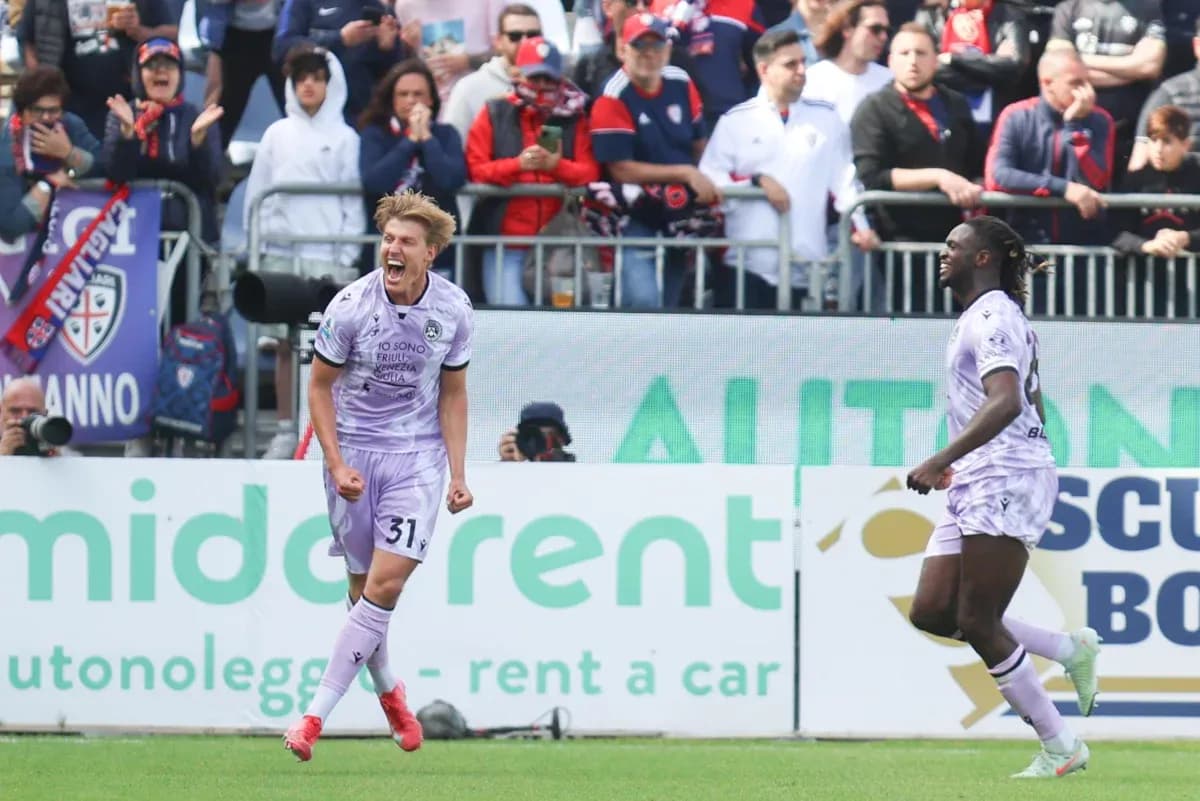
90' I. Gueye scored for Udinese, assisted by K. Davis
Tactically, the goal was the purest expression of Udinese’s game plan: a direct, incisive transition with Davis linking play and Gueye attacking the space behind a stretched defense. It sealed a performance built on compactness, timing, and efficiency.
Between the posts, both goalkeepers mirrored each other in one key metric: goals prevented, with each credited at 0.82. E. Caprile made 4 saves for Cagliari, reflecting Udinese’s high-quality but infrequent attempts, while M. Okoye’s 3 saves were supported by strong shot suppression from his defensive unit. Udinese’s back three and wing-backs limited clear sights of goal, forcing Cagliari into crowded or rushed finishes despite their volume.
Statistically, the verdict is stark. Cagliari’s Overall Form in this match—measured by possession, passing accuracy, and shot volume—suggests control and initiative, but their Defensive Index was undermined by poor transition management and an over-committed attacking structure. Udinese, with fewer passes (331 at 76% accuracy) and less of the ball, posted the superior Defensive Index through compact organization and disciplined spacing, while their attack maximized each break to outperform Cagliari both in xG (2.17 to 1.41) and on the scoreboard.
In sum, this was a classic example of territorial dominance being outmatched by tactical clarity. Cagliari dictated where the game was played; Udinese decided how it was won.